








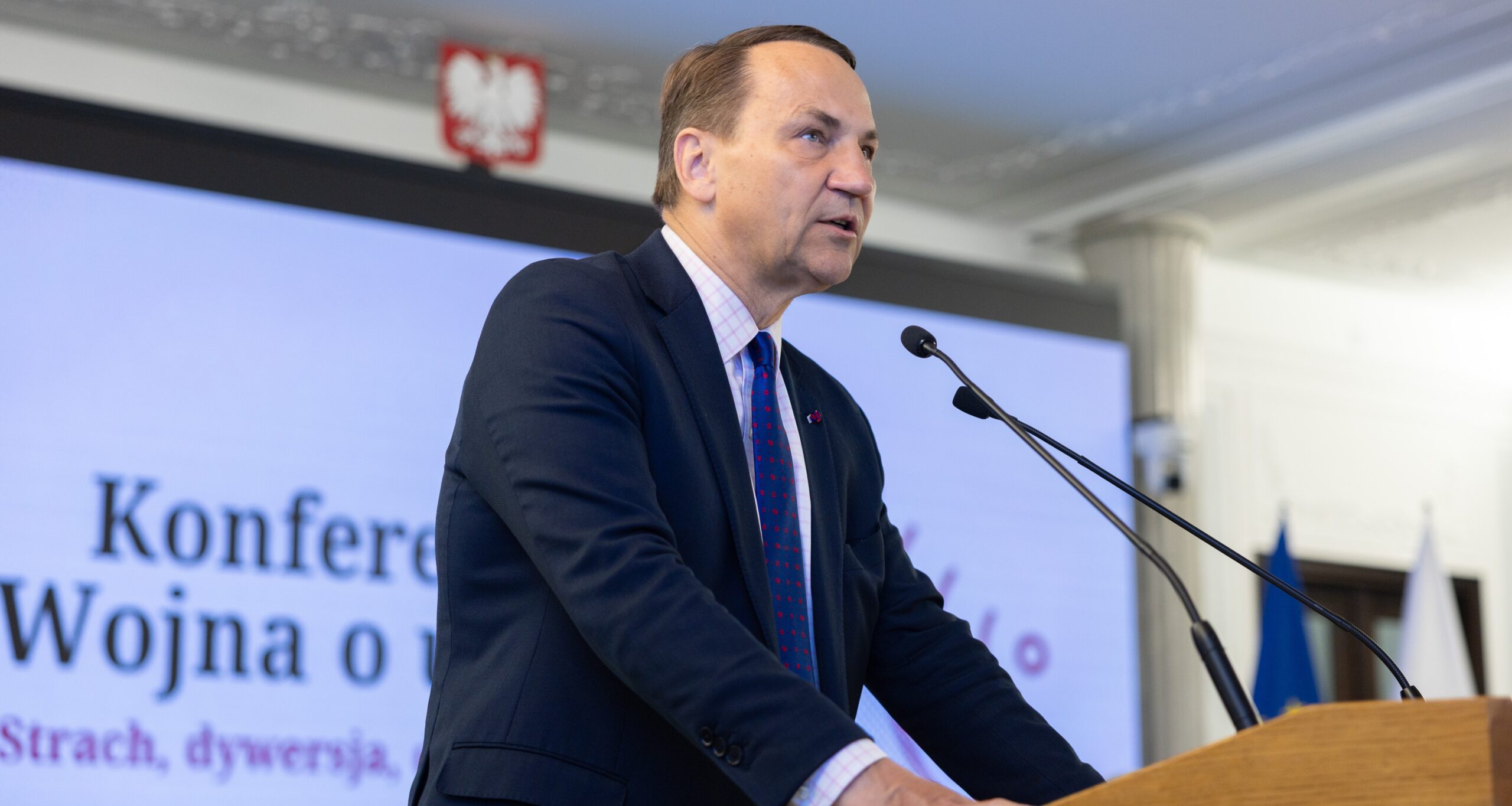
Polish Foreign Minister Radosław Sikorski has issued a stark warning that Russia is no longer merely engaging in isolated disinformation campaigns, but is instead conducting a “full-scale cognitive war” against the West. Speaking at a parliamentary conference titled “War for the Mind: Fear, Sabotage, Disinformation,” Sikorski characterized these efforts as a coordinated attempt to undermine democratic alliances and destroy the foundations of regional stability. By utilizing complex networks and layers of camouflage to operate in unconventional military spaces, the Kremlin seeks to weaken the collective will to resist, exploit democratic vulnerabilities, and incite deep-seated internal tensions.
The scale of this operation is significant, with Sikorski noting that Russia has invested over $6 billion in its propaganda apparatus since the full-scale invasion of Ukraine, including a record $1.4 billion in 2025 alone. He highlighted a troubling disparity, noting that the European Union’s dedicated funding for countering foreign information manipulation and interference (FIMI) remains only a fraction of Russia’s aggressive expenditure. According to the foreign minister, this financial commitment is designed specifically to keep Poland in a state of perpetual polarization, making the nation more susceptible to external manipulation and social fragmentation.
Central to Sikorski’s address was the unsettling assertion that a “Russian fifth column” is actively operating within Poland. While the minister did not name specific individuals or organizations, the existence of such internal proxies is a growing concern for state security services. This follows a broader trend of hybrid aggression, where Russia has been accused of inciting panic through false narratives, including the dissemination of misinformation regarding major natural disasters and the deliberate stoking of resentment between the Polish public and Ukrainian refugees to erode support for Poland’s eastern neighbor.
The reality of these threats is reflected in a sharp uptick in legal actions taken by Polish authorities against individuals accused of collaborating with Russian intelligence. The Internal Security Agency (ABW) reported that it launched twice as many espionage investigations in 2025 as it did in 2024, with the cumulative total over that two-year period exceeding the combined investigations of the previous three decades. Recent indictments include Polish citizens charged with spreading pro-Russian propaganda, conducting reconnaissance on NATO troops, and even undergoing combat training in preparation for potential sabotage operations.
The political landscape in Poland has also become a focal point for these influence operations. Radical figures, such as far-right leader Grzegorz Braun—who advocates for the normalization of ties with the Kremlin—have seen their support rise, despite controversial rhetoric that aligns closely with Russian talking points. The gravity of this infiltration is underscored by reports that one of Braun’s party candidates is currently on trial for espionage. Such political actors frequently parrot conspiracy theories, including claims that security incidents, such as Russian drone incursions into Polish airspace, are state-orchestrated fabrications designed to manipulate public opinion.
Ultimately, international security experts, including researchers from the International Centre for Counter-Terrorism, have identified Poland as the most frequently targeted country in Europe for state-sponsored acts of sabotage. As the Polish government continues to dismantle these subterranean threat networks, the challenge remains to defend democratic discourse against an adversary that has effectively integrated cognitive warfare into its core military doctrine. For Poland, the battle is now as much about protecting the integrity of its information space as it is about traditional territorial security.


