







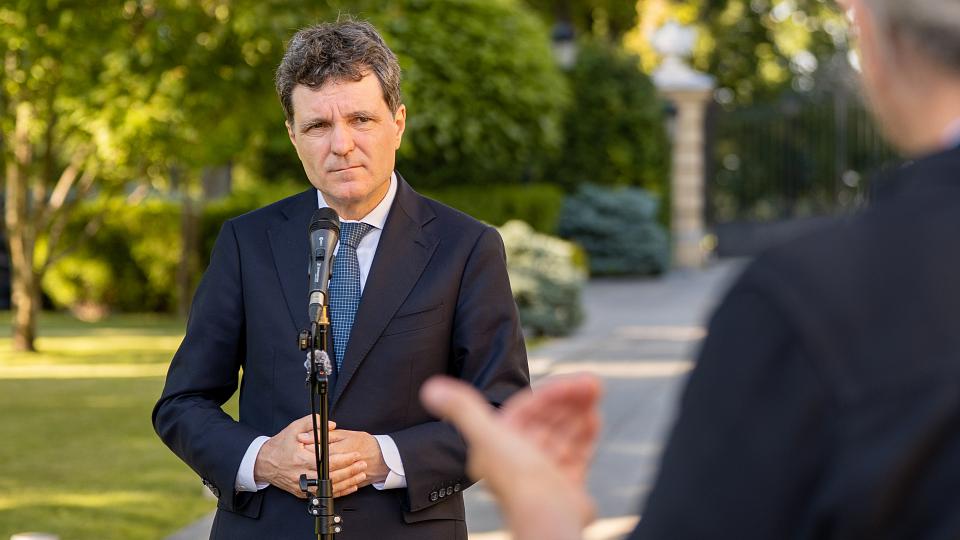
During a high-level visit to Kyiv on Wednesday, July 15, President Nicușor Dan delivered a candid assessment of Romania’s current national security posture, declaring that the country’s progress in countering foreign and domestic disinformation remains insufficient. Addressing the challenges faced during the intense 2024 electoral cycle—which encompassed European, local, parliamentary, and presidential contests—Dan signaled an urgent need for legislative reform. He emphasized that without immediate policy adjustments, the integrity of Romania’s democratic processes remains vulnerable to the distorted narratives that characterized recent political debates.
The President identified two primary arenas where reform is critical: the audiovisual media sector and the rapidly evolving landscape of social media platforms. Regarding traditional media, Dan pointed to efforts by the National Audiovisual Council (CNA) to modernize the legal framework. He proposed that the CNA’s regulatory authority must be expanded and that current sanctioning mechanisms require an overhaul. Specifically, he noted that fines currently reflect outdated monetary values from when the law was first enacted, rendering them ineffective as a deterrent against the spread of false information in the modern era.
While acknowledging the progress within traditional media oversight, President Dan admitted that Romania is lagging dangerously behind in governing social networks. He pointed to the slow implementation of two key European regulations as a primary point of concern, noting that the country has significant ground to make up to modernize its digital oversight. Directly addressing the current state of national resilience, the President was blunt, stating plainly that the progress made thus far cannot be described as “impressive,” suggesting that the current pace of reform is ill-suited to the speed of modern digital threats.
A pivotal part of the solution, according to Dan, lies in the operational discipline of state institutions. He argued that the current bureaucratic pace of the Romanian government often facilitates the spread of misinformation; when authorities fail to provide accurate information in real time, a “vacuum of uncertainty” is created. This gap, which can last anywhere from six to twelve hours, serves as a breeding ground for harmful speculation and conspiracy theories. By failing to communicate swiftly, state institutions inadvertently cede control of the narrative to those seeking to manipulate public perception.
Beyond governmental responsibility, Dan also leveled criticism at the contemporary media landscape, arguing that the distinction between objective reporting and subjective opinion has become alarmingly blurred. He contended that journalists are too often prioritizing the solicitation of commentary over the rigorous validation of facts. This professional culture of interpreting events before they are properly established allows disinformation to take root. He urged a shift in media standards, emphasizing that the health of the public discourse depends on the media’s ability to anchor their reporting in proven, clearly established facts rather than reflexive speculation.
The necessity for these reforms is further underscored by recent data from “Rapid Response – The European Summit for Strengthening Resilience to Disinformation,” an event backed by the Romanian Presidency. Research presented at the summit revealed a startling concentration of influence: 76% of engagements with disinformation narratives on TikTok were traced back to a mere ten accounts. Furthermore, the study identified that one in six influencers and one in eight official or media sources have become repeat distributors of false information. As Romania looks toward the 2028 election cycle, President Dan is positioning these findings as a clear mandate for systemic change in how the government and media handle the flow of information.


