








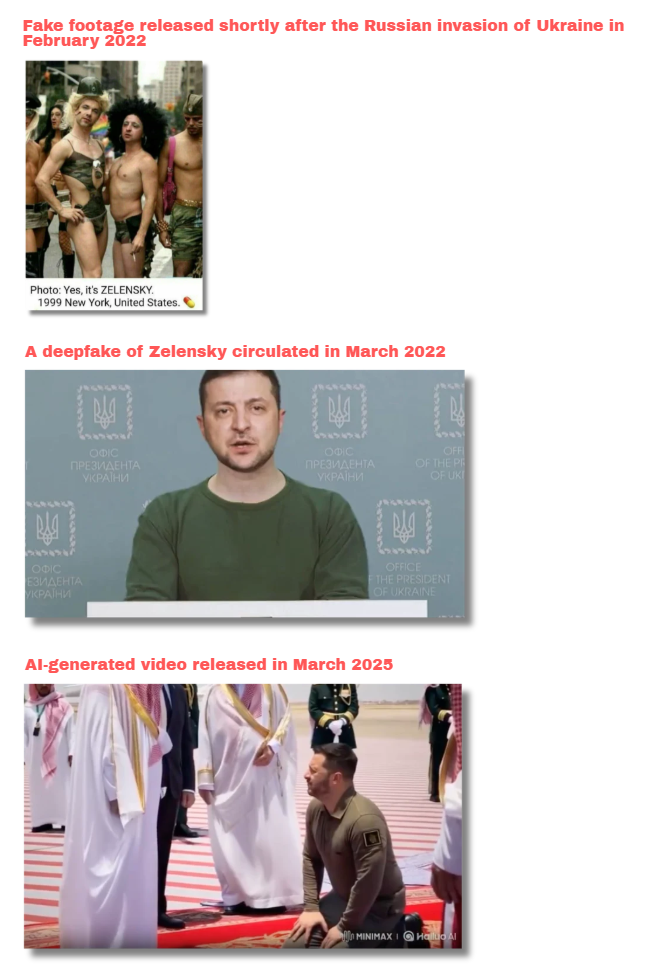
Since the onset of Russia’s 2022 invasion, a persistent campaign of disinformation has utilized ridicule, parody, and satire to undermine the credibility of Ukrainian President Volodymyr Zelenskyy and his government. Referred to as “hahaganda,” this strategic form of communication does not aim to convince the public of its factual accuracy, but rather to humiliate its targets and erode institutional trust. By employing tactics ranging from crudely manipulated photos to sophisticated deepfakes, actors have portrayed the Ukrainian leader as a clown, a corrupt official, or a submissive vassal to foreign powers, effectively weaponizing humor to demoralize both the Ukrainian citizenry and international supporters.
A central component of this study—conducted by the ATAFIMI project, which includes European fact-checkers like StopFake and Maldita.es—highlights the escalating sophistication of these campaigns. Early efforts relied on basic image editing, such as placing Zelenskyy’s face on irrelevant photos or altering his clothing to mimic clownish attire. However, the rise of generative artificial intelligence has allowed propagandists to create seamless synthetic videos, including deepfakes depicting the president announcing a fake surrender or kneeling before foreign leaders. By integrating foreign figures into these narratives, attackers aim to create the illusion that criticism of Ukraine is widespread among its Western allies.
The campaign has also spilled into physical public spaces and established media brands. Throughout Europe, reports of fake graffiti appearing in cities like Madrid, Paris, and Warsaw depict Zelenskyy as a predator or a parasite, often amplified by Russian diplomatic channels. Similarly, the French satirical magazine Charlie Hebdo has faced consistent identity theft, with propagandists forging fake covers that feature the publication’s branding to spread anti-Zelenskyy messages. These forgeries are designed to exploit the magazine’s cultural cachet, tricking international audiences into believing that even staunchly independent media outlets are mocking the Ukrainian cause.
Operational structures behind these efforts, such as “Operation Overload” and “Operation Matryoshka,” reveal a deliberate attempt to weaponize the information ecosystem. By flooding journalists and fact-checkers with requests to verify fabricated content, these networks aim to exhaust media resources and disrupt the flow of credible information. This strategy forces independent investigators into a defensive posture, distracting them from systemic analysis while simultaneously inserting the Kremlin’s political agenda into the public discourse via Telegram, TikTok, and other viral platforms.
Military propaganda has similarly adopted AI to target the morale of the Ukrainian Armed Forces and their image abroad. By generating fabricated videos of obese soldiers or displays of cowardice and desperation, these actors seek to cultivate a narrative of institutional decay and imminent collapse. A notable example is the “telethon” network, which uses AI to mimic legitimate news formats, distributing emotionally charged, manufactured content across post-Soviet and European countries to discourage foreign recruitment and dismantle the image of a disciplined, effective military force.
Ultimately, the success of these operations relies on the participatory nature of modern social media, where the goal is to drive engagement through shares and comments. By framing disinformation as humor and “memetic” content, these campaigns bypass traditional critical defenses, embedding negative sentiments deep within online subcultures. As researchers from the ATAFIMI project continue to map these cross-border threats, the resilience of the information space depends on identifying these coordinated, technologically-driven psychological operations that prioritize the systematic erosion of reality over the presentation of a coherent, truthful narrative.


