









The following is a news summary based on the provided report:
Following a massive overnight barrage on Kyiv on June 15, the Kremlin has initiated a sweeping disinformation campaign aimed at absolving itself of responsibility for strikes on civilian and cultural landmarks. According to the Center for Countering Disinformation (CCD), Russian state-affiliated media and proxy social media channels are deploying classic psychological warfare tactics—shifting blame onto Ukrainian forces or fabricating elaborate conspiracy theories to reframe the attacks as “provocations” or “false flag” operations.
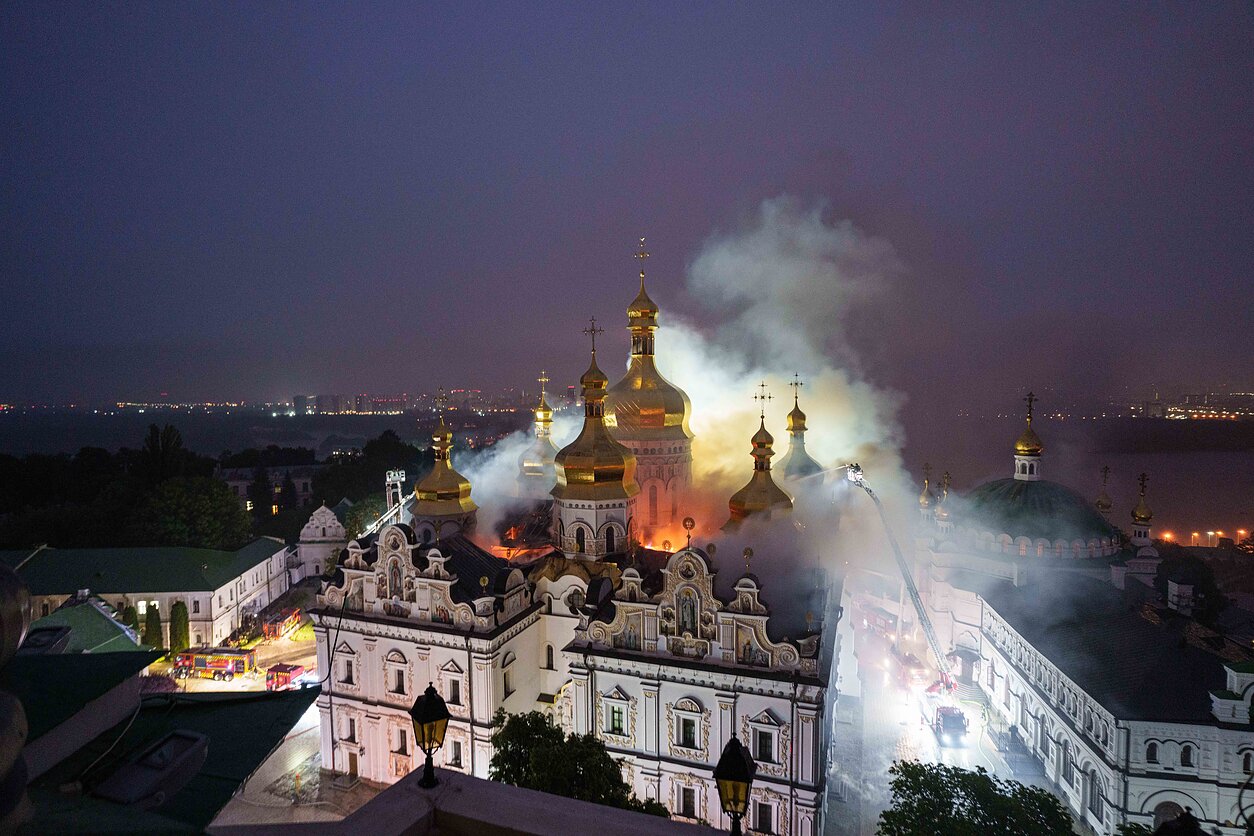
A primary focus of this propaganda effort centers on the damage sustained by the Kyiv-Pechersk Lavra, a UNESCO World Heritage site and a spiritual heart of Ukraine. Despite visual evidence documenting the impact of a Russian-launched Shahed-type drone on the Assumption Cathedral, Russian sources have brazenly labeled the incident a “Ukrainian provocation” or even “self-arson.” This narrative attempts to deflect international condemnation regarding the deliberate targeting of internationally protected cultural heritage sites.
Furthermore, the disinformation campaign has targeted several prominent infrastructure sites, including the building of the Supreme Anti-Corruption Court and the historic Oleksandr Dovzhenko National Film Studio. In their attempt to justify the strikes, Russian propagandists have labeled the film studio a “hotbed of propaganda,” while suggesting—without evidence—that the judicial building was hit due to alleged internal Ukrainian malfeasance. These claims are consistent with a broader Kremlin strategy to designate any non-military structure as a “military facility” to bypass international humanitarian law.
Central to this misinformation offensive is the recurring “Air Defense” lie. Russian outlets are once again telling their audiences that the destruction of residential buildings and cultural artifacts was caused by the malfunctioning of Ukrainian interceptor missiles rather than Russian weaponry. By recycling this debunked narrative, Moscow aims to erode public trust in the effectiveness and safety of Ukraine’s air defense systems, while simultaneously distancing its own strike forces from the civilian casualties recorded during the assault.
Beyond mere denial, this propaganda push serves a tactical purpose: it seeks to redefine the rules of engagement by claiming that Ukrainian weapons production is being hidden within civilian infrastructure. By normalizing the idea that every building is a potential military target, the Kremlin attempts to dilute global outrage following the June 15 attack, which left four people dead—including a child—and injured at least 23 others. The CCD warns that such narratives are designed to create a “smoke screen,” providing the Russian public with a justification for the ongoing systematic bombardment of non-military areas.
As the full extent of the destruction is still being assessed, both the Ukrainian authorities and international observers underscore that these information campaigns are integral to Russia’s broader war effort. Efforts by the Center for Countering Disinformation are focused on clarifying the truth and documenting the reality of these strikes to counter the Kremlin’s attempt to rewrite the events of the June 15 attack in real-time. The incident serves as a stark reminder of the dual nature of modern conflict: the kinetic strikes against the nation’s physical foundations, and the digital war being waged to distort human perception of those crimes.


