








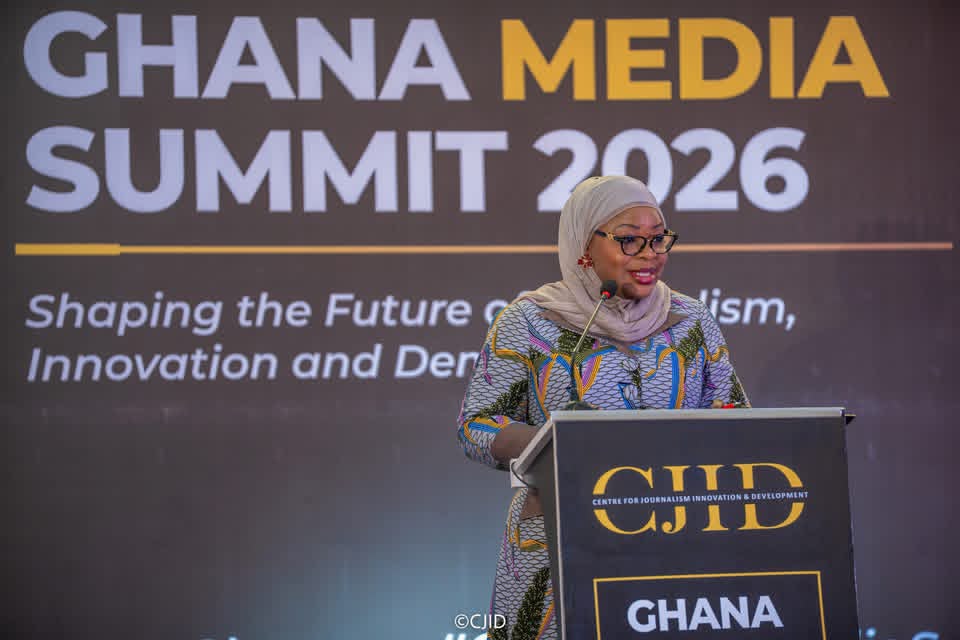
Title: Media Literacy as Democracy’s Shield: Experts Sound Alarm at Ghana Media Summit
By Eric Appah Marfo, GNA
ACCRA, July 9 – At the recently concluded Ghana Media Summit, the critical intersection of digital innovation and democratic stability took center stage. The event, organized by the Centre for Journalism Innovation and Development (CJID) through its DUBAWA Ghana initiative, brought together a diverse group of stakeholders, including veteran journalists, policymakers, and academics. Marking seven years of dedicated efforts to combat misinformation and bolster media integrity, the summit served as a platform to address the evolving threats to the press, which organizers emphasized are no longer merely technical issues but profound challenges to the democratic fabric of West Africa.
Delivering a keynote address on behalf of Mr. Felix Kwakye Ofosu, Minister of State for Government Communications, Deputy Presidential Spokesperson Madam Shamima Muslim issued a stark warning regarding the “new battlefield” of democracy. Unlike the challenges faced by previous generations—such as authoritarianism and censorship—today’s threats are fueled by high-speed digital platforms and sophisticated artificial intelligence. Madam Muslim noted that in an era where information travels faster than verification, the rapid emergence of generative AI and deepfakes has created an environment where misinformation and disinformation can polarize societies and erode public trust in governance with alarming efficiency.
Madam Muslim underscored that in the modern digital age, the role of the citizen has fundamentally shifted. With every smartphone functioning as a printing press and every social media profile acting as a broadcasting station, the burden of truth has been decentralized. Consequently, she argued that media literacy should no longer be viewed as an elective educational program, but rather as a non-negotiable democratic imperative and a vital national security priority. By equipping citizens with the tools to analyze, verify, and think critically about the content they consume and share, society can insulate itself against the destabilizing effects of falsehoods.
The discussion also highlighted journalism’s role as the “democratic infrastructure” necessary for a functional state. Madam Muslim urged media professionals to pivot their focus from the race for speed to the pursuit of reliability. She emphasized that in an information-saturated landscape, the credibility of journalism will be defined by its ability to sustain public trust through rigorous digital verification, data journalism, and cybersecurity standards. She further noted that the government’s role should not be one of censorship, but of fostering an environment of transparency, protecting press freedoms, and empowering the public to make informed decisions.
Adding his voice to the discourse, Mr. George Sarpong, Executive Secretary of the National Media Commission, warned that the democratic decline observed in parts of West Africa is being exacerbated by misinformation. He pointed to a corrosive mix of economic hardship, systemic corruption, and declining faith in electoral processes as catalysts that have made the public more susceptible to disinformation and political propaganda. Mr. Sarpong cautioned that once public debate is distorted by persistent falsehoods, it becomes increasingly difficult for citizens to make the informed choices required to sustain a healthy democracy.
Ultimately, the summit served as a clarion call for a unified approach to information integrity. Participants concluded that defending democracy in the digital age requires a tripartite commitment: government action to protect institutional transparency, media industry investment in professional development and fact-checking, and a national commitment to embedding media literacy into the public consciousness. As these stakeholders look toward the future, the message remains clear: the survival of democratic institutions depends on the ability of citizens to distinguish truth from fabrication in an increasingly complex and contested information environment.


