









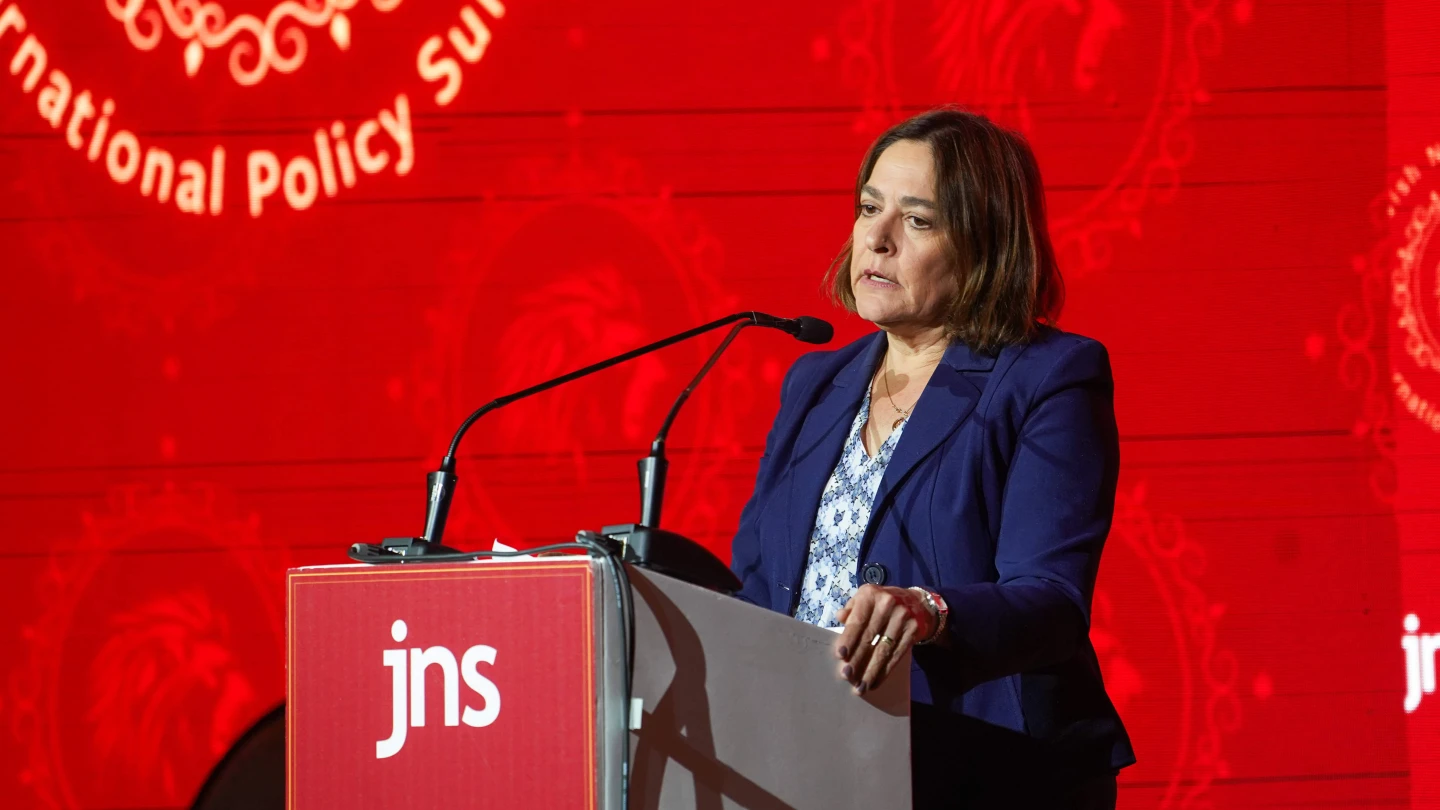
At the Second Annual JNS International Policy Summit in Jerusalem, Caroline Glick, international affairs adviser to Israeli Prime Minister Benjamin Netanyahu, identified the intensifying global battle over information as the “eighth front” of Israel’s ongoing conflict. Addressing attendees on June 22, 2026, Glick warned that the rapid dissemination of deliberate, malicious disinformation poses a profound challenge to Israel’s global standing. She argued that false narratives gain traction easily because they tap into pre-existing prejudices, offering audiences an effortless scapegoat for complex problems rather than asking them to engage in constructive, fact-based problem-solving.
Glick highlighted the sophisticated nature of this digital warfare, noting the prevalence of automated bots designed to suppress pro-Israel advocacy. She cited the anecdotal experience of Jeremy Boreing, a media figure who frequently encounters waves of antisemitic, bot-driven attacks whenever he shares pro-Israel content. Furthermore, she observed a troubling trend among online influencers, particularly within the “woke Right,” who have discovered that adopting antisemitic rhetoric serves as a lucrative strategy for increasing engagement and attracting new subscribers, effectively mainstreaming hatred as a “calling card” for internet clout.
The critique extended deep into the heart of Western establishment institutions, which Glick accused of fostering a “complex of un-truth.” She specifically challenged the integrity of major media outlets like The New York Times, alleging that they manipulate imagery to suit preconceived, anti-Israel agendas. Glick pointed to the controversial publication of a photo depicting a child with cystic fibrosis, which she claimed was edited to remove the child’s healthy sibling to perpetuate a “blood libel” narrative accusing Israel of the deliberate starvation of Gazan civilians.
Academic institutions were also a focal point of Glick’s address, where she denounced ideological frameworks such as “settler-colonial studies.” Describing her own home in Efrat—a location of immense historical significance as the birthplace of King David—as a community of ordinary families rather than a colonial outpost, she argued that such academic disciplines are fundamentally untethered from reality. She identified foreign funding, particularly from Qatar, as a key driver in these shifts, enabling donors to institutionalize distorted history and manipulate the intellectual environment of American universities.
Despite the systemic nature of this propaganda, Glick maintained an optimistic stance regarding the eventual triumph of objective truth. She emphasized that while the “Israeli narrative” is often attacked, the facts remain on Israel’s side, and she expressed confidence that a sufficient number of people globally remain committed to reality. She encouraged supporters of Israel to persevere, framing the defense of factual reporting not merely as a political necessity but as a moral imperative essential to the mission of safeguarding Jewish continuity and the nation’s future.
Concluding her remarks, Glick offered a robust defense of Prime Minister Benjamin Netanyahu’s leadership during this volatile period. She predicted that history would remember his contributions alongside legendary figures like King David and Joshua. By positioning the current era as a pivotal milestone in Jewish history, Glick called upon her audience to embrace their role in protecting the Jewish state with steadfast faith, asserting that by remaining committed to the truth and their identity, they are successfully securing a path toward Jewish eternity.


