








In a compelling cultural expansion for Jersey City, Gladwell Projects—led by founder Christiana Ine-Kimba Boyle—has transformed a former warehouse into a sprawling art venue. Among six concurrent solo exhibitions currently occupying separate floors of the industrial structure, artist Trevor Warren commands an entire 20,000-square-foot level. This ambitious presentation showcases a broad, masterful selection of his latest works, creating an immersive environment that bridges the gap between raw, post-industrial space and a deeply soulful, human-centric approach to painting.
Warren’s work is characterized by a sophisticated dialogue with art history, drawing on the traditions of Abstract Expressionism, Art Informel, and the late-Modernist resurgence. Yet, he successfully avoids the trap of derivative mimicry, instead asserting a distinct 21st-century voice that remains noticeably uninfected by AI tropes. His background—spanning academic training in the Pacific Northwest and Southern California, supplemented by intensive professional gallery experience—has clearly matured his technical sensibilities and allowed him to navigate subjective allegiances with confidence.
The exhibition features works that oscillate between rhythmic structure and fluid atmosphere. Pieces like Éliane, dedicated to the composer Éliane Radigue, utilize sewn-together canvases and “xylophone-bar” edges to evoke the structured, repetitive cadence of musique concrète. Elsewhere, Warren explores varying emotional registers: Rubik’s Cube trades in a romantic, Nordic stillness reminiscent of Caspar David Friedrich, while Brinnon shifts abruptly into a vibrantly colored topography that brings to mind the stained-glass radiance of abstract marbleization.
Warren’s technique is equally diverse, displaying a refined command of paint application. Works such as Evening’s Net offer a gritty, cross-sectional intensity, while pieces like Another Light, A Different Sun utilize a blurring, soft-focus technique that echoes Gerhard Richter’s photographic sensibility. By smoothing and smearing pigment during the drying process, Warren creates ethereal, horizon-like shifts that suggest the cooling glow of dusk, proving he can balance aggressive texture with delicate, light-filled transitions.
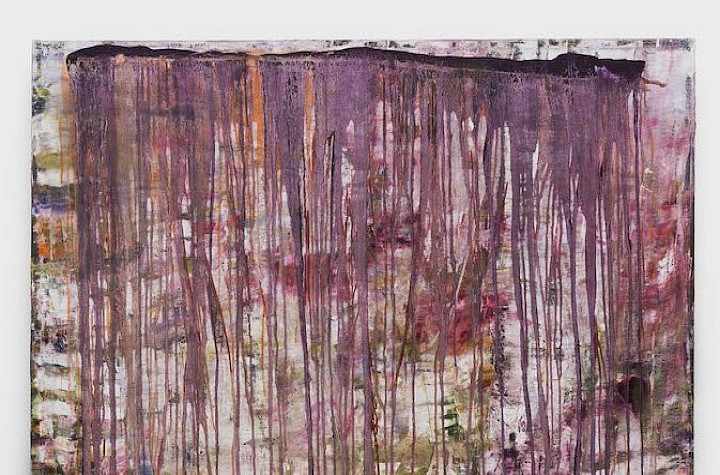
A recurring theme throughout the exhibition is the relationship between the viewer and the material surface, often leaning into alchemical and organic metaphors. The titular piece, With Two Eyes, uses a purplish-gray veil to obscure deep, anatomical, or aerial vistas, while the vertical Key pays homage to the minimalist discipline of John McCracken. These varied approaches confirm that Warren is not adhering to a single “brand” of abstraction, but is instead engaged in a rigorous, multi-faceted investigation of paint as a medium for psychological depth.
Ultimately, this exhibition serves as a necessary antidote to the frantic, shallow pace of our modern digital existence. By championing a formal discipline that honors its lineage while pushing toward new emotional territories, Warren’s work offers a sense of stability and nourishment. At a time when cultural, social, and political stakes are at an all-time high, the residency at Gladwell Projects underscores a vital commitment: investing in the slow, tactile, and profound progress of a new generation of artists.


