








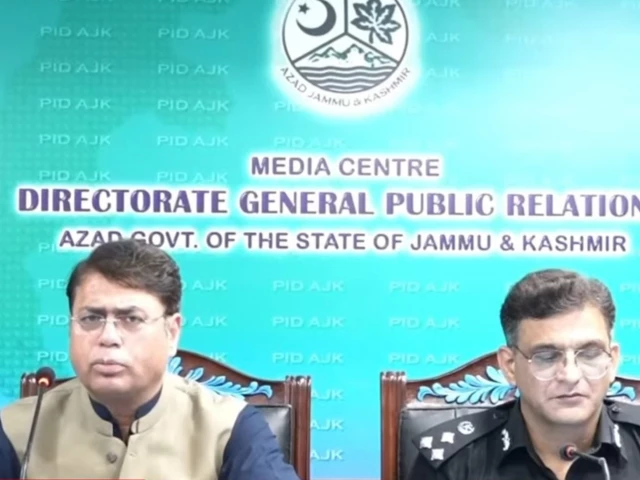
The Azad Jammu and Kashmir (AJK) government has launched a stern response to ongoing civil unrest, accusing the banned Awami Action Committee (JAAC) of orchestrating a violent campaign to sabotage the democratic process amid regional elections. During a press conference in Muzaffarabad, AJK Information Secretary Mohammad Rashid Hanif and DIG Irfan Masood Kashfi emphasized that the state remains committed to upholding its writ against what they described as “disruptive elements.” Officials highlighted that despite attempts to incite chaos in areas like Rawalakot—following the successful first phase of polls in Mirpur—the public’s participation in elections serves as a clear rejection of these agitators.
The security situation has escalated into a direct confrontation, with authorities alleging that the protesters are not advocating for public grievances but are instead armed combatants using civilians as human shields. DIG Kashfi reported the tragic death of a Rangers official and injuries to several security personnel, noting that law enforcement has exercised extreme restraint despite being targeted by sophisticated weaponry. The government has urged citizens to distance themselves from the movement, warning that the unrest is a calculated, long-term strategy designed to provoke state violence and destabilize the region for ulterior political agendas.
AJK Prime Minister Faisal Mumtaz Rathore echoed these sentiments, condemning the march toward the capital as a deliberate effort to engineer mass instability. In public statements, the Prime Minister argued that the rioters are utilizing strategic vantage points to attack security forces, aiming to capture territory through force. By exploiting innocent civilians and women as human shields, the agitators are accused of creating a volatile environment where the state is forced into defensive action, which the protesters then weaponize through social media propaganda to frame the government as the primary aggressor.
On the national front, leaders from mainstream political parties, including the Pakistan Muslim League-Nawaz (PML-N) and the Pakistan Peoples Party (PPP), have characterized the unrest as a security threat rather than a legitimate protest movement. Rana Sanaullah asserted that the region has been infiltrated by members of banned militant groups who possess no genuine interest in public welfare and are instead exploiting democratic channels to further extremist objectives. While advocates like Nasir Hussain Shah called for a nuanced approach to protect innocent, misguided citizens, the general consensus among these leaders is that stringent action is necessary to combat those openly inciting violence against the state.
Conversely, the situation has drawn sharp criticism from opposition figures and religious leaders who view the state’s crackdown as an affront to democratic rights. JUI-F Chief Maulana Fazlur Rehman has condemned the firing on civilians, labeling it “open terrorism” and arguing that the state is effectively “burying the Kashmir cause” by suppressing the public’s constitutional right to protest. Fazlur Rehman questioned the state’s narrative, suggesting that labeling legitimate protesters as foreign agents is a tactic to evade accountability for governmental failures. He expressed solidarity with the affected families and argued that the current unrest is a direct product of the state’s refusal to address the people’s grievances through dialogue.
As tensions remain high, the government has vowed to identify and penalize those facilitating the armed elements behind the clashes. While the state insists it possesses the capacity and the duty to maintain law and order, the growing divide between the official narrative of militancy and the opposition’s narrative of civil rights reflects a deep-seated crisis in AJK. For now, the administration continues to warn the public against sharing verified online material, urging a retreat from the conflict zones as they attempt to reclaim control and prevent further casualties.


