









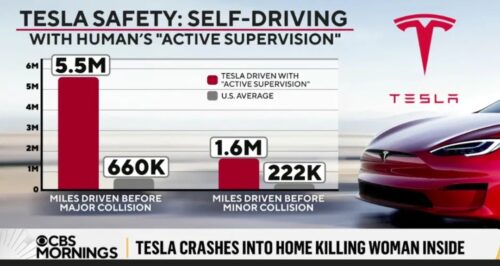
The integrity of automotive safety reporting has come under intense scrutiny following a CBS Morning segment that featured a Tesla “Vehicle Safety Report” while simultaneously covering a fatal Tesla crash in Texas. Critics argue that the visual data presented by CBS is not only misleading but constitutes an act of targeted disinformation. By displaying a chart that claims Tesla vehicles are roughly eight times safer than the U.S. average, the network effectively provided a corporate narrative that contradicts the very tragedy being reported, highlighting a systemic failure in media fact-checking and the problematic nature of self-reported corporate statistics.
At the heart of the controversy is the methodology Tesla uses to calculate its safety metrics. Internal data, critics note, is “cooked”—a characterization likened to corporate accounting scandals like Enron or WorldCom. On the numerator side, Tesla’s crash reporting is severely constrained; the company counts crashes primarily when airbags deploy or restraints engage, and it typically excludes any incident occurring more than five seconds after a system disengagement. According to NHTSA findings, Tesla captures data on only about 18% of police-reported crashes. By artificially lowering the number of logged accidents, the company mathematically inflates the distance traveled, resulting in a false “miles per crash” metric.
Beyond the numerator, the denominator of the Tesla graphic is equally artificial, relying on a “highway-weighted” dataset that favors the autopilot system. While Tesla’s 5.5 million-mile figure reflects driving done under supervised, ideal conditions, the “U.S. Average” used for comparison includes every road type, weather condition, and vehicle age—including decades-old cars lacking modern electronic stability control. Comparing a sophisticated modern vehicle on a highway to every clunker on a rural road provides no meaningful data on the specific safety of Tesla’s system, serving instead as a propaganda tool that masks the reality of actual road performance.
Further invalidating the report is the concept of “active supervision,” a marketing term that effectively credits the machine for the attentiveness of the human driver. By measuring the combined output of a human monitor and the autonomous software, Tesla attributes safety outcomes entirely to the machine despite the human’s role in preventing collisions. Experts, including those who have testified that there is “no math or science” behind these corporate reports, note that unlike companies such as Waymo—which adjusts for road types and submits data to third-party review—Tesla keeps its raw data closed and resists independent scrutiny.
When the numbers are corrected for an “apples-to-apples” comparison, the safety advantage Tesla claims collapses entirely. When analysts match airbag-deployment statistics to similar vehicle classes, data suggests Tesla’s autopilot system may actually be three times more dangerous than human-only driving. This stands in stark contrast to the CBS graphic, which claims an 8x safety lead. If one applies the NHTSA’s police-reported baseline for accidents, the supervised Tesla fleet appears to underperform compared to the average driver by a factor of eight to sixteen times, depending on the specific metrics used, turning Tesla’s own “safety” narrative into a potential liability.
Ultimately, the disconnect between marketing charts and reality is further underscored by independent data from sources like LendingTree, which ranked Tesla owners as having the highest accident rates among thirty major brands. With higher rates of crashes per 1,000 drivers and a fatal accident rate significantly higher than the all-brand average, Tesla’s public safety claims are being characterized as a “bald-faced lie.” As media outlets continue to broadcast these graphics without context or challenge, the public is left with a distorted view of road safety, suggesting that the industry’s rush toward autonomy is being built on a foundation of statistical manipulation rather than verified technological success.


