





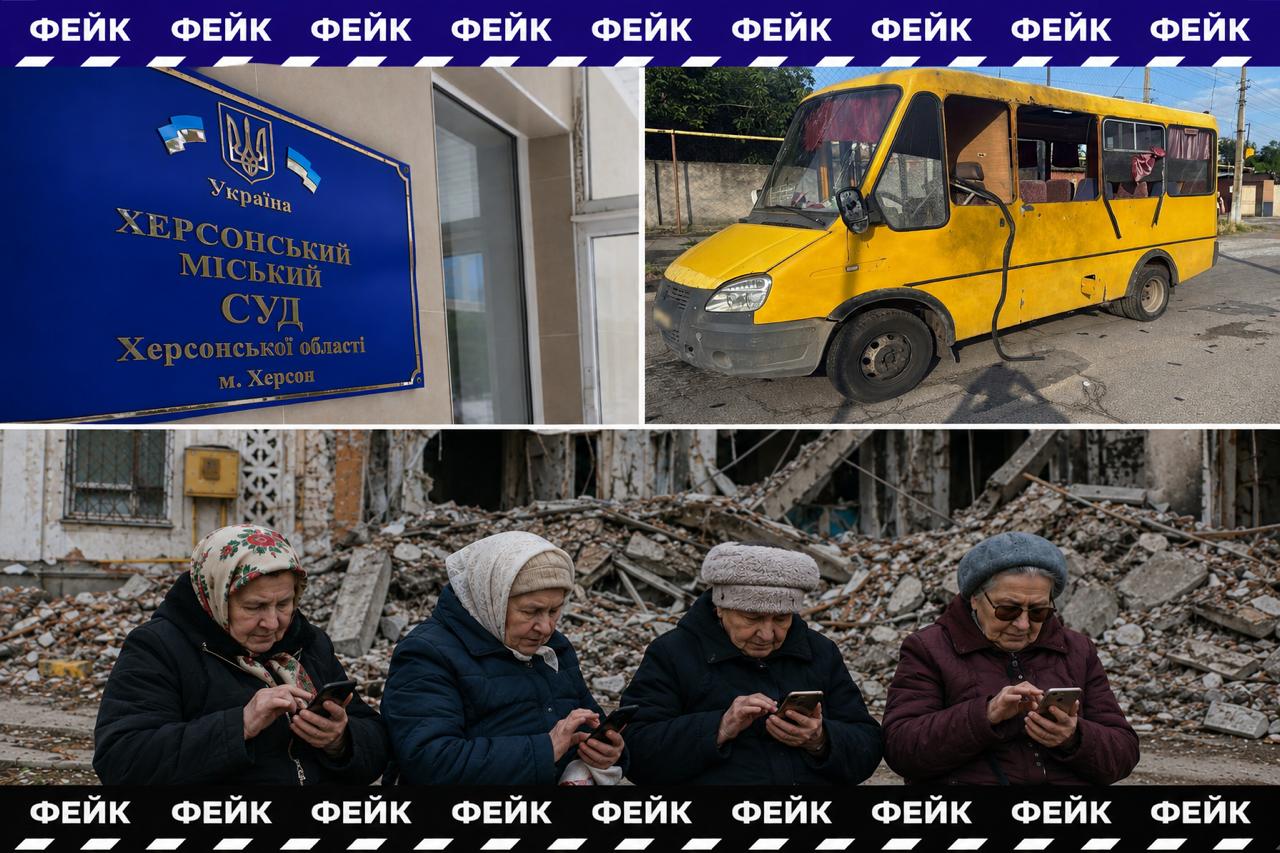
Russian propaganda concerning Kherson has intensified, deploying a series of transparent fabrications designed to demoralize Ukrainian citizens and shift blame for ongoing violence. Last week, occupation media outlets launched a coordinated misinformation campaign, claiming that city judges have fled in anticipation of a Russian offensive, that local residents are forbidden from using social media, and that the Armed Forces of Ukraine (AFU) are actively attacking their own people to “punish” them for refusing to evacuate. These narratives, however, unravel upon scrutiny, revealing a desperate attempt to cover up the realities of Russian aggression in the region.
The claim regarding an exodus of judges is a blatant distortion of safety measures necessitated by Russian state violence. While the Kherson City Court did shift to remote and urgent-only proceedings, it was a direct result of a July 1 drone strike on the courthouse that killed a 64-year-old woman and wounded ten others. Despite the occupation media citing a “rapid advance” of Russian troops as the catalyst for the judiciary’s retreat, the court’s operational change was explicitly documented as a response to the destruction caused by Russian shelling. The propaganda machinery even went so far as to steal images from local investigative outlets to support their false narrative of a judicial collapse.
Furthermore, occupation officials have absurdly claimed that the Ukrainian government has imposed a “ban” on the use of social media in Kherson to suppress reports of the city’s conditions. This assertion is demonstrably false; residents continue to post content regularly, and the amount of media circulating from the city remains significant. The actual decline in some footage from vulnerable coastal districts is not due to government policy, but rather an awareness of security risks. Pro-Russian influencers and military channels have been observed openly leveraging such user-generated content to assist in targeting city infrastructure, forcing residents to be more cautious about the footage they upload.
The propaganda campaign reached a new level of malice following a Russian drone attack on a civilian minibus in the Korabelny district, which resulted in multiple casualties. Occupation spokesperson Volodymyr Vasylenko attempted to deflect blame, alleging that the AFU deliberately targeted the bus to terrorize residents who refused to evacuate. This narrative of “punishment” by the Ukrainian government is a recurring trope used to sanitize the brutal impacts of Russian kinetic operations against civilian transport and infrastructure.
The internal contradiction of these claims became apparent when Russian Telegram channels inadvertently exposed their own lies. While Vasylenko publicly accused Ukrainian forces of committing a “provocation” against civilians, various pro-Russian military blog channels simultaneously boasted about the strikes, justifying the carnage by baselessly claiming that Ukrainian soldiers might have been passengers on the bus. This disconnect between the “official” narrative of protective occupation and the enthusiastic celebration of war crimes by on-the-ground Russian sources serves as a clear indictment of the propaganda campaign’s incoherence.
Ultimately, these fabrications confirm a pattern of psychological warfare where Russian officials ignore ground realities in favor of manufactured narratives. Whether inventing phantom offensives, suggesting impossible social media bans, or gaslighting victims of their own missile strikes, the Russian information operation in Kherson remains reliant on verifiable falsehoods. By contrasting these claims with the documented reality of the city’s endurance, it is evident that the “occupation media” is more concerned with creating a distorted reality to suit their geopolitical agenda than reporting the facts of the ongoing conflict.