





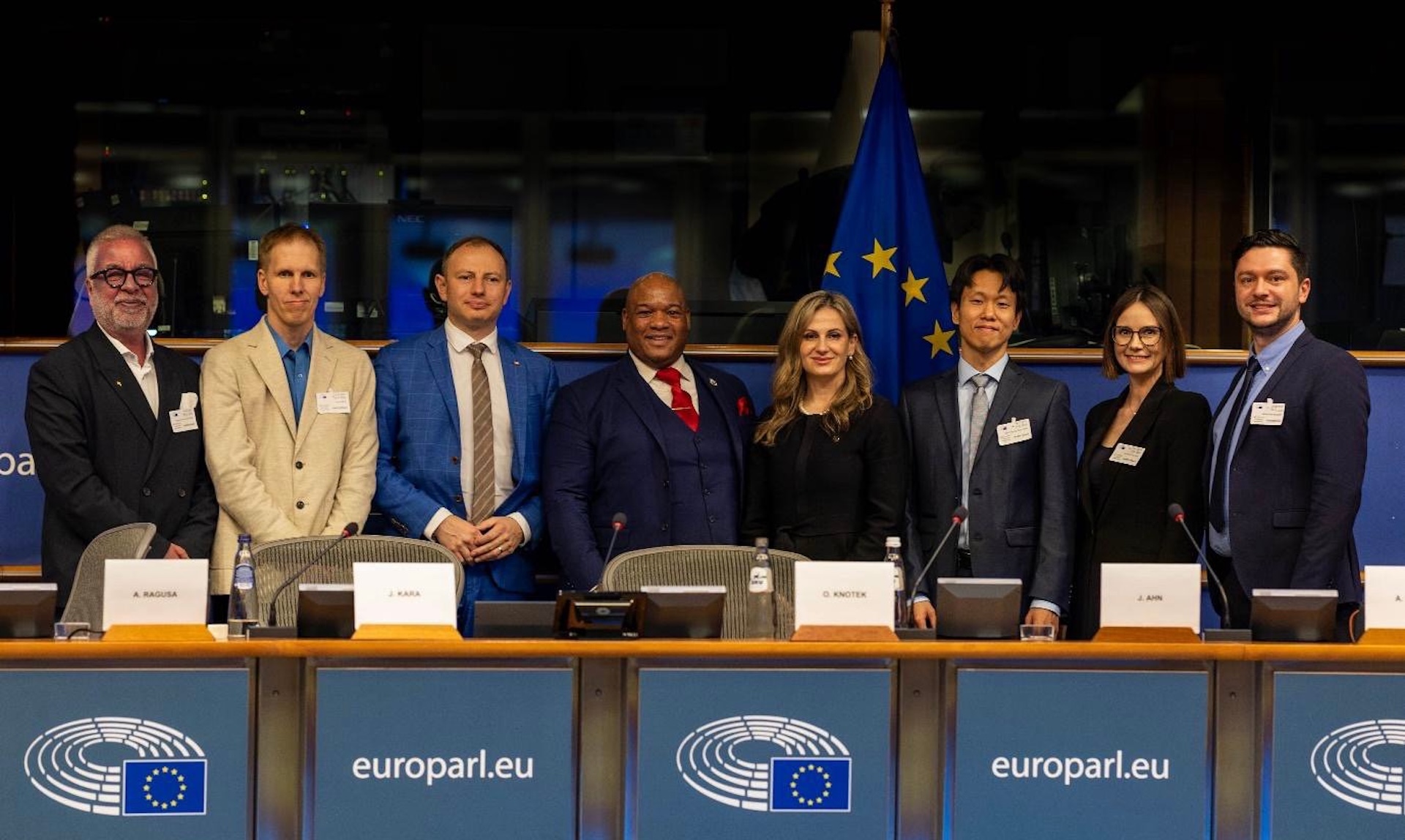
A recent conference held at the European Parliament concerning the dangers of nanoplastics has sparked significant controversy and alarm following revelations about the event’s organizers. An investigation conducted by openDemocracy and featured in the Nepali Times identified that the event, titled “Nanoplastics: Hidden connections and emerging risks,” was co-hosted by AllatRa, an organization widely characterized as a religious cult. AllatRa maintains a belief system centered on the prediction that human civilization will face total extinction by the year 2036, a narrative they bolster with a mix of fringe theories and pseudoscience.
The core of the scandal lies in how AllatRa has utilized its platform to disseminate unfounded claims regarding the origins of global climate change. Rather than aligning with established environmental science, the group asserts that climate instability is being driven by a combination of plastic pollution and a cyclical cosmic phenomenon that occurs every 12,000 years. By securing a venue at the European Parliament alongside Czech lawmaker Ondřej Knotek, the organization successfully placed these fringe theories under the veneer of legitimate legislative and scientific discourse, creating a platform that blurred the lines between factual research and dangerous misinformation.
The investigation highlighted a concerning tactic employed by AllatRa: the strategic manipulation of reputable scientists. Panels at the conference reportedly featured a mixture of genuine academic experts and members of the AllatRa think tank. Several researchers whose work was featured in AllatRa’s documentaries and promotional materials have since come forward to claim that their interviews were heavily edited or spliced to imply endorsement of conclusions they never actually reached. Marine biology professor Richard Thompson of the University of Plymouth explicitly denounced this, noting that the group connects disparate facts to create false narratives that remain unsupported by peer-reviewed evidence.
The broader scientific community has reacted with sharp criticism, emphasizing that the group’s rhetoric serves to undermine essential climate action. Turkish marine biologist Sedat Gündoğdu, who formally requested the removal of his interview from an AllatRa documentary, labeled the group’s connection between nanoplastics and human “intellectual extinction” as pure nonsense. This type of disinformation is seen by experts as a dangerous distraction; by misrepresenting the drivers of climate change, these groups divert public and political attention away from the urgent, proven necessity of reducing fossil fuel dependency.
Experts in policy and security have warned of the long-term consequences of allowing such organizations into the halls of government. Patrycja Sasnal of the UN Human Rights Council Advisory Committee noted that disinformation exploits the established scientific consensus on climate change, creating a sense of confusion that makes it increasingly difficult for policymakers to enact effective, science-based legislation. By providing a stage for an organization that deals in esoteric and apocalyptic themes, the European Parliament has inadvertently granted a level of mainstream validation that helps such groups shield themselves from public scrutiny.
Ultimately, the goal of this infiltration appears to be the pursuit of legitimacy rather than the advancement of environmental science. Researcher Petra Mlejnková observed that for organizations like AllatRa, gaining access to high-level summits is a critical objective aimed at shedding their labels as sectarian or radical. As the fallout from the conference continues to unfold, officials are facing mounting pressure to explain how such a group was granted access to a prestigious international platform. The incident serves as a stark reminder of how high-profile venues can be exploited by fringe groups to sanitize their agendas and sow doubt in the face of existing climate challenges.