


PU Professor Conducts Workshop in Germany on Tackling Fake News and Migration Misinformation
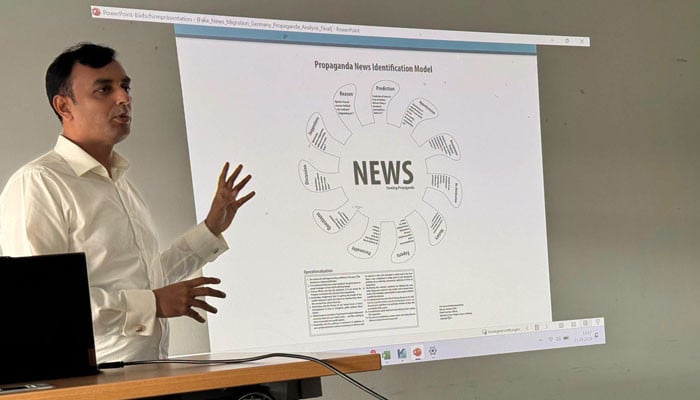
LAHORE: In a significant acknowledgment of Pakistani academia’s growing contribution to global digital discourse, Punjab University’s Assistant Professor Dr Khuram Shahzad has conducted a specialized workshop in Germany on the critical intersection of fake news and migration. The workshop, titled ‘Fake News on Social Media and Migration’, was held at Bielefeld University—one of Germany’s leading research institutions—on September 23, 2026, following a formal invitation extended to Dr Shahzad by the university’s faculty. The event brought together students, researchers, and academics who engaged with the visiting Pakistani scholar on one of the most pressing challenges of the digital age: the proliferation of misinformation surrounding human mobility. The invitation itself underscores the international recognition of Dr Shahzad’s pioneering research in this field, as well as the esteem in which Punjab University’s academic output is held on the global stage. Given Germany’s central role in European migration debates over the past decade, the selection of Bielefeld as the venue for this workshop carries particular resonance, providing an ideal setting for a nuanced exploration of how false narratives shape public perceptions of migrants and refugees. The workshop’s timing also reflects growing concern among European institutions about the weaponization of social media platforms in shaping migration policy discourse, making Dr Shahzad’s expertise highly relevant to contemporary challenges facing both Europe and South Asia.
The intellectual foundation of the workshop rested upon Dr Shahzad’s doctoral research, which was completed at Punjab University and represents a substantial contribution to the field of media and communication studies. During his PhD, Dr Shahzad developed a comprehensive model comprising eleven scientific indicators specifically designed for the identification and analysis of propaganda content circulating through digital channels. These indicators, which were elaborated extensively during the Bielefeld sessions, provide a systematic framework for distinguishing between legitimate information and deliberately misleading content. This model is particularly valuable in an era where sophisticated disinformation campaigns increasingly blur the lines between fact and falsehood, often rendering traditional verification methods inadequate. By presenting his research-based methodologies to an international audience, Dr Shahzad effectively positioned Pakistani scholarship at the forefront of the global fight against misinformation. The response from workshop participants reportedly demonstrated deep engagement with the material, with many students expressing appreciation for the practical applicability of the indicators. The eleven-indicator framework offers not merely a theoretical abstraction but a usable toolkit for media consumers, educators, and policymakers alike, enabling them to systematically evaluate the credibility of content they encounter on social media platforms. Furthermore, the research’s emphasis on scientific rigor establishes a benchmark for future studies in the field, potentially influencing how universities across the world approach the teaching of media literacy and misinformation detection.
During the course of the comprehensive workshop sessions, Dr Khuram provided students with detailed briefings on the practical techniques required for identifying fake news as it circulates across social media networks. He devoted considerable attention to information verification methodologies, instructing participants on how to cross-reference sources, trace the origin of claims, and utilize both traditional journalism ethics and contemporary digital tools to establish factual accuracy. The sessions also examined the multifaceted nature of misleading content, breaking down the various forms that disinformation can take—from entirely fabricated stories to subtly manipulated images, out-of-context quotations, and selectively edited video footage. Students were guided through real-world examples, many drawn from migration-related coverage, illustrating how even seemingly innocuous posts can carry hidden agenda or serve to amplify divisive narratives. Dr Shahzad placed particular emphasis on understanding the different dimensions of misleading content, helping participants recognize that not all misinformation stems from malicious intent, with some arising from genuine errors, cultural misunderstanding, or the viral nature of online sharing. This comprehensive approach ensured that students gained not just technical competence but also the critical thinking skills necessary to navigate the increasingly complex information ecosystem. The workshop’s interactive format allowed participants to apply these techniques in practice, with exercises designed to test their ability to spot deception in both textual and visual content. By equipping these students with such analytical capabilities, Dr Shahzad directly contributed to building a more discerning generation of social media users capable of resisting manipulation.
A central theme of the workshop concerned the substantial social impacts of fake news specifically as it relates to migration, a topic that Dr Shahzad explored with considerable depth and sensitivity. He explained, drawing upon his research findings, how false and unverified information can exercise a profound influence on public opinion, shaping the way entire communities perceive migrants and refugee populations. The workshop addressed how viral misinformation has the power to systematically distort social perceptions, transforming nuanced human experiences into simplistic negative stereotypes that fuel prejudice and hostility. Particularly concerning, Dr Shahzad noted, is the speed at which such narratives can spread through algorithmic amplification, often reaching millions of users before fact-checkers and journalists can mount an effective response. The potential implications of these distorted perceptions extend beyond mere public sentiment, carrying significant consequences for policy debates surrounding migration, which is among the most sensitive and contentious issues in contemporary politics across Europe, North America, and increasingly Asia. The presentation illustrated how carefully crafted disinformation campaigns can pressure policymakers into adopting reactive or punitive measures based upon false premises rather than evidence-based assessments of migration realities. Germany, with its substantial migrant population and ongoing integration challenges, provided a particularly relevant context for these discussions, as the country has observed firsthand how online rumors and conspiracy theories have occasionally escalated into real-world tensions and even violence in certain communities. By illuminating these dynamics, Dr Shahzad underscored the urgent necessity of addressing fake news not merely as an informational nuisance but as a genuine threat to social cohesion.
Perhaps the most critical message delivered during the Bielefeld workshop was the importance of equipping students and the broader public with scientific research methods for identifying fake news, an endeavor that Dr Shahzad framed as essential to both individual protection and collective civic health. He argued persuasively that awareness of these methods can help students shield themselves from misinformation, reducing their vulnerability to manipulation by political extremists, commercial interests, or foreign interference operations seeking to exploit social tensions. Moreover, he suggested that informed individuals have a responsibility to contribute to a more responsible and information-based understanding of significant social issues such as migration, thereby actively participating in the strengthening of democratic discourse. The workshop stressed that media literacy, when grounded in robust scientific methodology, transforms passive consumers of information into active critical thinkers who, when faced with contested claims about migration, have recourse to structured processes of verification rather than emotional reactions. Dr Shahzad’s presentation argued that the development of such analytical skills is essential for maintaining the integrity of public debate, especially as social media platforms become increasingly dominant sources of news for younger generations across the globe. He also highlighted the role that universities and educational institutions must play in institutionalizing media literacy training as a core component of modern curricula, ensuring that future practitioners in fields ranging from journalism to public policy possess the tools required to distinguish truth from falsehood. The workshop participants were encouraged to develop their own strategies for promoting awareness within their communities, creating a multiplier effect that extends academic knowledge beyond the lecture hall.
The successful completion of this international workshop represents a significant milestone for both Dr Khuram Shahzad personally and for Punjab University as an institution committed to global academic engagement. The event demonstrated that scholarly research conducted in Pakistan can achieve international recognition and contribute meaningfully to addressing global challenges, challenging outdated narratives that often position developing countries as merely passive recipients of knowledge produced elsewhere. Bielefeld University’s decision to invite a Pakistani academic to lead this important conversation about fake news and migration reflects the growing appreciation for diverse perspectives in tackling issues that transcend national boundaries. As misinformation increasingly operates across borders, international academic cooperation of this nature becomes ever more vital, allowing for the exchange of methodologies, insights, and strategies between societies confronting similar challenges in different contexts. For Dr Shahzad, the workshop opening doors for further research collaborations and academic exchanges, while also having raised the international standing of Punjab University’s media studies department. The techniques and principles shared in Germany now have the potential to influence how European students and researchers approach the detection of misinformation, incorporating the eleven-indicator model into their own analytical frameworks. Ultimately, the success of this workshop serves as a testament to the power of academic diplomacy in fostering mutual understanding and equipping the global citizens of tomorrow with the critical skills they will need to navigate an increasingly complex information landscape. It is hoped that this engagement marks the beginning of sustained collaboration between Pakistani and German institutions in the vital, ongoing struggle to protect truth in the digital public square.