







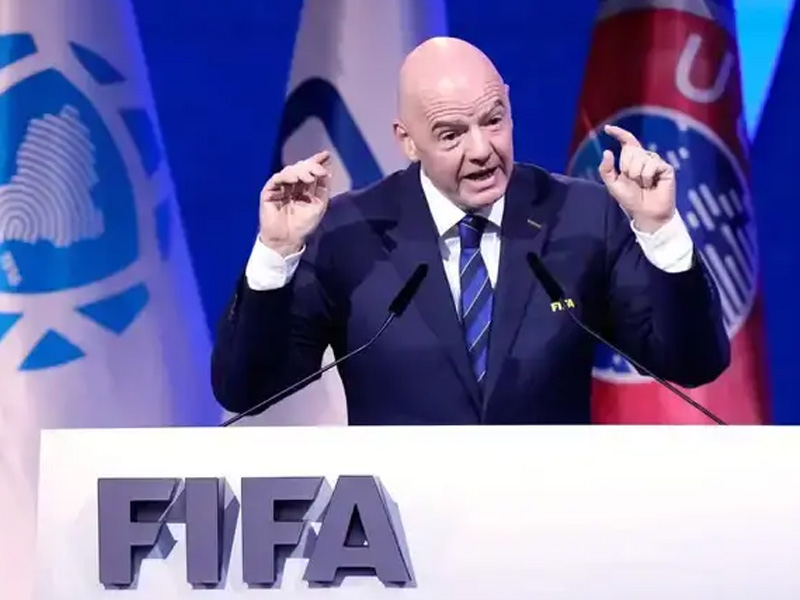
FIFA has accused UEFA of waging a “misinformation campaign” and attempting to influence the upcoming presidential election, as the world football governing body urged a US court to reject a discovery request linked to its controversial investment proposal. In a response filed with the Southern District of Florida, FIFA said UEFA’s application to obtain testimony and documents for use in a planned criminal complaint in Switzerland against FIFA President Gianni Infantino contained “numerous false or misleading statements” about FIFA and Infantino. The legal fight revolves around the abortive FIFA Forward Enterprise (FFE) plan, an ambitious and highly contentious proposal to transfer World Cup commercial rights into a subsidiary designed to attract outside investors. UEFA alleged that Infantino developed the plan secretly with a small group of advisers and investors, bypassing FIFA’s established governance processes, failing to consult the FIFA Council, regional confederations or member associations, and that he stood to benefit personally. FIFA dismissed that allegation in unusually blunt language, asserting that “with no basis whatsoever” did UEFA suggest that Infantino sought to profit personally from the FFE proposal, and insisting that suggestions that he violated any law or ethical principle were “categorically without merit.” The filing is the latest and most serious clash in a deepening institutional conflict between football’s global governing body and the European confederation, raising questions about who controls the sport’s most valuable commercial assets and how FIFA’s leadership conducts its affairs at a moment when Infantino is preparing to stand for another term. UEFA’s application was filed last month, and FIFA’s response came just weeks before the scheduled vote. The dispute has already overshadowed preparations for the FIFA Congress and has forced other confederations to take sides in what was once an internal matter.
The roots of the dispute lie in FFE, a special-purpose vehicle that FIFA began exploring as a way to monetise the broadcast, sponsorship and licensing rights associated with future men’s World Cups. UEFA’s application, filed under Section 1782 of the US Code — a statute that allows parties to obtain discovery in the United States for use in proceedings before foreign tribunals — asked a US federal court to authorise discovery from FIFA (AMERICAS), Inc. and FWC2026 US, Inc., two FIFA entities based in Florida. According to UEFA, the planned transaction would have seen outside investors pay $4.2 billion for a stake in FFE, implying an overall valuation of approximately $20 billion for the commercial rights bundle. UEFA argued that this valuation significantly undervalued FIFA’s crown-jewel assets, particularly the World Cup, and said the proposed deal was neither subjected to an open auction nor assessed by an independent valuer. The confederation also contended that Infantino had failed to consult the FIFA Council and other stakeholders, raising serious governance concerns. UEFA said it intended to use the intelligence gathered through US discovery to support a criminal complaint it plans to file in Switzerland against Infantino, relating to his role in the FFE proposal. The request, if granted, would allow UEFA’s lawyers to take depositions and compel the production of internal FIFA documents, potentially exposing the inner workings of the FFE project and the degree of Infantino’s personal involvement. The use of Section 1782 is noteworthy because the statute is typically used in cross-border commercial disputes and criminal investigations; invoking it in a conflict between two football confederations is highly unusual and reflects the increasingly litigious relationship between FIFA and UEFA. The corporate name FWC2026 US, Inc. suggests a connection to the 2026 World Cup, which will be hosted in North America, and underscores the financial stakes involved in the dispute.
FIFA’s response was not limited to procedural objections; it mounted a full-frontal assault on UEFA’s narrative. The governing body said the FFE proposal was at all times subject to approval by FIFA’s member associations and the FIFA Council, and that the subsidiary would have been overseen by both bodies had it been established. That position is central to FIFA’s defence, because it contradicts UEFA’s claim that Infantino was acting unilaterally. FIFA further accused UEFA of deliberately distorting the financial structure of the deal. “UEFA, whether deliberately or through ignorance, conflates equity value with enterprise value,” FIFA said in its filing. It explained that the “initial equity valuation” of FFE was $20 billion — that is, the value remaining for shareholders after debts and other obligations had been satisfied. By contrast, FIFA said, the total enterprise value of FFE, which takes into account debt and reflects the full economic value of the venture, was “well over $30 billion” according to materials distributed to FIFA’s member associations. In other words, FIFA argued, the $4.2 billion investment that UEFA focused on was not a measure of FFE’s total worth, and the deal was nowhere near as undervalued as UEFA claimed. The distinction is not merely technical; it goes to the heart of the allegations. If the enterprise value was indeed more than $30 billion, then a $4.2 billion equity investment could be commercially reasonable. But FIFA did not directly address UEFA’s separate point that the process lacked an open auction and an independent valuation, which remains the basis for concerns about transparency. FIFA also rejected any suggestion that Infantino acted for personal gain, stressing that the proposal was never approved and that the organisational checks and balances would have applied at every stage. The tone of the filing suggests that FIFA views UEFA’s legal action not as a good-faith attempt to expose wrongdoing but as a politically motivated campaign to tarnish Infantino’s reputation ahead of the March election.
The FFE project was ultimately abandoned in July after a wave of opposition from several confederations, including UEFA, CONCACAF and the Asian Football Confederation, over concerns about the consultation process. Though the plan was officially dropped, its legacy has been a deep credibility crisis for FIFA’s leadership. The dispute has fuelled calls for changes to FIFA’s governance, with critics asking how a proposal of such financial magnitude could have been developed without broader input and why investors were involved in what should have been a transparent process. In an apparent effort to regain the initiative, Infantino last week wrote to FIFA’s 211 member associations proposing an independent review of the governing body’s decision-making processes. The letter was widely interpreted as an attempt to address legitimate criticism while also heading off more radical reform demands from UEFA and other regional bodies. It came after months of pressure from national associations, confederations and governance experts who argued that FIFA’s structures give the president too much power and fail to ensure accountability. FIFA’s announcement did not mention FFE or the Swiss complaint, but it acknowledged that governance improvements were necessary. The timing of the review, however, heightens suspicion that it is a defensive measure designed to influence FIFA’s presidential election rather than a genuine commitment to structural change. The independent review is expected to examine how decisions of strategic importance are made, the role of the FIFA Council, and the consultation of confederations and member associations; unless it is conducted by genuinely independent figures and produces concrete recommendations, it may do little to restore trust. Member associations now face a choice between supporting the incumbent, who promises a more inclusive and transparent FIFA, and backing reformist proposals from those who believe Infantino’s concentration of power is the core problem. The FFE affair has become a lens through which all of these tensions are being observed, and it has turned an internal commercial matter into a public referendum on Infantino’s leadership.
The election context is impossible to separate from the legal proceedings. Infantino is seeking re-election as FIFA president in March, and FIFA has explicitly alleged that UEFA’s legal action is intended to influence the outcome. “Just before FIFA’s election, UEFA filed this 1782 Application (and three others) spreading misinformation regarding Mr Infantino,” FIFA said in its court filing. “This court should reject any attempt to influence FIFA’s presidential election based on these grounds.” The mention of “three others” indicates that UEFA has filed multiple related discovery applications, suggesting a coordinated strategy across several jurisdictions or targeting different individuals and entities. FIFA’s framing casts UEFA not as a concerned stakeholder seeking accountability, but as an opponent determined to interfere in the internal democratic process of the global governing body. This argument is likely to resonate with FIFA’s member associations, particularly those in Africa, Asia and the Americas that rely heavily on FIFA’s development funding and often resent what they perceive as European paternalism. It also gives the court a potential basis to refuse discovery, since US judges have discretion to deny Section 1782 applications that are brought for an improper purpose, such as harassment, intimidation or undue influence over an organisation’s internal affairs. UEFA, for its part, is likely to argue that it has a legitimate basis for seeking evidence of potential criminal conduct and that the timing of the election is incidental, not evidence of bad faith. The election will be held by FIFA’s 211 member associations, each with one vote. Many of those associations have benefited from FIFA’s Forward programme of financial support, which may influence their willingness to challenge Infantino. UEFA’s legal campaign therefore needs to overcome not only legal hurdles but also a political structure in which FIFA has substantial leverage. The court will have to weigh these competing narratives without deciding the underlying allegations, and regardless of the legal outcome, FIFA has succeeded in making the election a central part of the narrative, presenting the FFE dispute as an attempted coup by its European rival rather than a straightforward corporate governance complaint.
The immediate decision now rests with the US District Court for the Southern District of Florida, which must determine whether UEFA’s discovery request is a valid request for assistance to a foreign criminal proceeding or an abuse of process. Courts generally grant Section 1782 applications liberally, but they retain discretion to consider factors such as the good faith of the applicant, the burden on the target, and whether the request is intended to circumvent foreign procedures. FIFA has urged the court to view the application in the context of the presidential election and what it calls UEFA’s deliberate misinformation campaign. The judge may also consider whether UEFA could obtain the same information through Swiss authorities or other channels, and whether the planned criminal complaint is sufficiently concrete to warrant US assistance. Whatever the outcome, the FFE affair has already reshaped the institutional landscape of international football. It has deepened the rift between FIFA and UEFA, exposed the fragility of FIFA’s governance safeguards, and given critics of Infantino a concrete issue around which to mobilise. Should UEFA proceed with its planned criminal complaint in Switzerland, the legal conflict will likely intensify, with the US discovery motion serving as a prelude to a broader battle over the conduct of FIFA’s leadership. If discovery is granted, UEFA could obtain sensitive documents that might embarrass FIFA and strengthen calls for reform. If it is denied, FIFA can claim vindication and use the ruling to discredit UEFA’s allegations as baseless. A further appeal by the losing side could prolong the process well beyond the March election, meaning that the court’s immediate decision may be at most a preliminary skirmish. Even a refusal by the court to grant discovery would be a significant setback for UEFA’s efforts to gather evidence and would strengthen FIFA’s claim that the application was always about politics rather than wrongdoing. The ultimate stakes are not merely commercial; they concern the future direction of world football, the balance of power between global and continental authorities, and the fate of Infantino’s presidency. In the coming months, both sides are likely to continue fighting across multiple forums, leaving the sport’s administration mired in controversy and uncertainty.


