








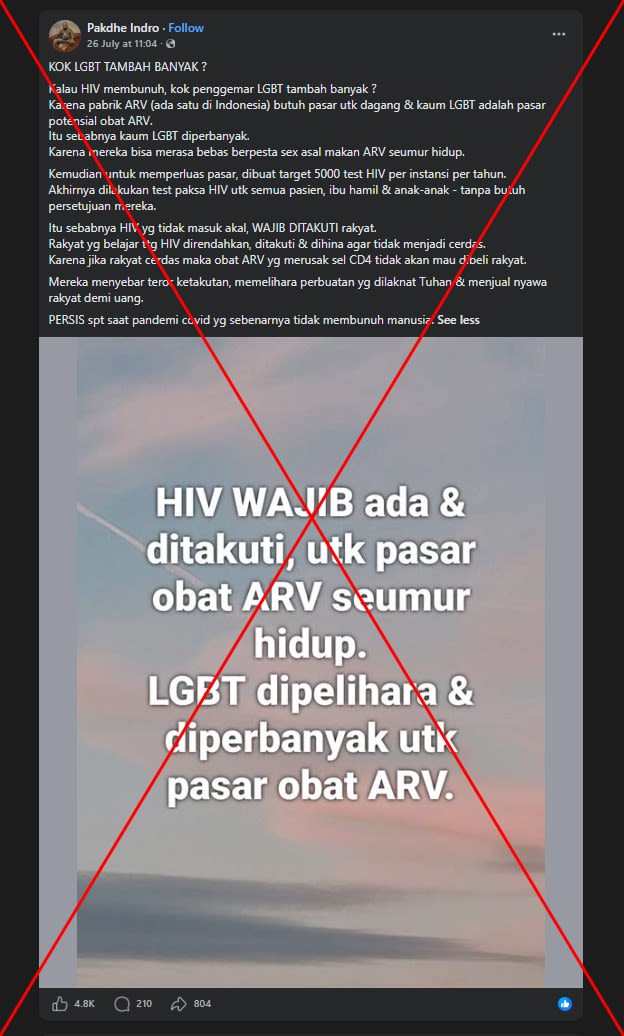
International health organisations and HIV specialists have pushed back against viral social media posts in Indonesia falsely claiming that antiretroviral (ARV) drugs damage the immune system and that HIV is exaggerated to create a lifelong market for pharmaceutical companies. The posts, which have circulated on Facebook and Instagram since July 2026, further allege that LGBT people are “maintained and multiplied” to expand demand for ARV drugs. Experts told AFP that these claims are not only scientifically baseless but dangerous, because they discourage people living with HIV from seeking treatment that has been proven to save lives. The false graphic, shared by an account previously known for spreading baseless claims about the measles vaccine, says: “HIV must exist and be feared in order to sustain a lifelong market for ARV drugs. LGBT people are maintained and multiplied to create a market for ARV drugs.” It also says people who study HIV are “belittled, frightened, and insulted” so they won’t realise ARV drugs “damage CD4 cells.” CD4 cells are white blood cells that act as the immune system’s first line of defence. Commenters amplified the claim: “It makes perfect sense, because that drug doesn’t cure you; it just creates a lifelong dependency,” one wrote. Another said: “Thank you for the knowledge. Now I understand who’s funding the LGBT, it could be a pharmaceutical company.” The posts emerged amid a rising tide of anti-LGBTQ sentiment in Indonesia, the world’s most populous Muslim-majority nation, where the Indonesian Ulema Council (MUI) has previously announced plans to criminalise the community and warned men not to wear women’s clothing for Independence Day celebrations. Experts stress that ARV therapy does the opposite of damaging CD4 cells: it prevents HIV from replicating, thereby stopping the virus from destroying the very cells that coordinate the immune response.
To understand why the claim is false, it is necessary to look at how HIV attacks the body and how ARV drugs work. HIV is a retrovirus that infects and kills CD4-positive T lymphocytes, which are essential for signalling other immune cells to fight infections. Without treatment, the virus replicates relentlessly, progressively depleting CD4 cells until the immune system collapses. At that advanced stage, a person develops AIDS and becomes vulnerable to opportunistic infections such as tuberculosis, pneumonia and certain cancers, many of which are life-threatening. Antiretroviral therapy, or ART, interrupts this process. The drugs target different stages of the HIV lifecycle, including the enzymes reverse transcriptase, integrase and protease, which the virus needs to copy itself and infect new cells. By blocking these steps, ART reduces the amount of virus in the blood—known as the viral load—often to undetectable levels. This allows CD4 counts to recover or remain stable, preserving immune function. The United Nations programme on HIV/AIDS (UNAIDS) states that ART has been proven to “dramatically reduce AIDS-related illness and death.” Although it is not a cure, combination antiretroviral therapy “has enabled people living with HIV to live longer, healthier, more productive lives by reducing viraemia (the amount of HIV in the blood) and increasing the number of CD4-positive cells (white blood cells that are central to the effective functioning of the immune system).” The World Health Organization (WHO) recommends ART for all adults living with HIV, regardless of their CD4 count or disease stage. According to UNAIDS data, around 41 million people worldwide are living with HIV, and as of 2025 about 32.1 million are accessing antiretroviral therapy. In Indonesia, the Ministry of Health has provided ARV drugs free of charge for years as part of its target to eliminate HIV and sexually transmitted infections by 2030, with goals of zero new infections, zero AIDS-related deaths and zero discrimination.
Experts interviewed by AFP were unequivocal that ARV drugs do not damage CD4 cells. Monica Gandhi, professor of medicine and associate division chief of the Division of HIV, Infectious Diseases, and Global Medicine at the University of California, San Francisco, explained in an email that ART works by preventing the virus from replicating. “Since HIV is a virus that targets and kills CD4 cells, ART drugs will prevent HIV from damaging CD4 cells. Therefore, ART actually prevents HIV from hurting the immune system,” Gandhi said on August 8. Otto O. Yang, professor of medicine and microbiology, immunology, and molecular genetics at the University of California, Los Angeles, and interim director of the UCLA AIDS Institute, added that ARV drugs are designed to attach only to proteins the virus uses to reproduce itself. “That attachment is very specific, and the drugs are designed not to attach to proteins in normal cells,” Yang said in an August 5 email. He acknowledged that any medicine can have side effects, but stressed: “There is no reason for ARVs to damage CD4 cells. Also note that like most drugs, ARVs are not targeted to a particular type of cell, like a CD4 cell.” Dariusz P. Olszyna, adjunct associate professor at the Department of Medicine at the National University of Singapore, said that in some patients white blood cell counts do not rise after starting ART because they were diagnosed late and their immune systems have already been severely damaged. “This stresses the importance of frequent HIV testing and starting HIV treatment early,” Olszyna told AFP on August 11. “It is worth pointing out that even if CD4 counts do not recover, but patients continue taking ARVs and maintain undetectable viral loads, they remain healthy and do not get serious opportunistic infections.” These expert views align with the global scientific consensus: ART is not an immune suppressant; it is an immune protector.
The consequences of spreading such misinformation can be severe. Otto Yang warned that false claims about ARV drugs “can cost lives” because any delay in treatment for people living with HIV can have a serious impact on health. “Unfortunately, the younger generation does not remember the era before effective treatment was available, when people with HIV were dying in droves,” he said. “Treatment has saved millions of lives, and if people avoid treatment because of misinformation, deaths will rise. It’s clear that earlier treatment is more effective than waiting until late disease.” Monica Gandhi echoed that warning, describing the posts as “damaging to public health as it indicates that people with HIV should not be on ART.” Without treatment, she said, “people with HIV will experience progressive immune damage, get severe infections, and die.” She added: “ART is life-saving and very important to improve CD4 cell counts and allow people with HIV to live normal lifespans. HIV is not a conspiracy and is a real infection that can kill so do not believe this misinformation.” The risk is particularly acute in Indonesia, where UNAIDS estimates about 570,000 people live with HIV. The agency has identified closing the “treatment gap” as one of the foremost challenges: only 31 percent of people living with HIV in Indonesia are accessing treatment, and just 14 percent are virally suppressed. That means a large majority of people with HIV in the country are not receiving the benefits of ART, leaving them at risk of illness and death while also increasing the likelihood of onward transmission. Misinformation that discourages people from testing or taking ARV drugs threatens to widen this gap even further.
The Facebook and Instagram posts also promote a conspiratorial view of the pharmaceutical industry and LGBT communities. The false graphic claims that “LGBT people are maintained and multiplied to create a market for ARV drugs,” a baseless assertion with no supporting evidence. It taps into a political and social climate in Indonesia in which conservative voices have increasingly targeted sexual and gender minorities. The MUI, the country’s influential clerical body, has previously said it was drafting measures to criminalise the community, and in August 2026 warned men not to wear women’s clothing for Independence Day festivities, despite a long tradition of men in dresses playing football as part of the annual fun. This followed a spate of physical attacks on gay people and a presidential regulation classifying “LGBTQ culture” as a security threat. Public health experts say such narratives are not only harmful to LGBT people but also to public health. Associating HIV with a conspiracy and framing ARV drugs as a tool of profit-making can stigmatise both the disease and the populations most affected, pushing people away from clinics and testing services. It also distracts from the real, evidence-based reasons why HIV remains a global health challenge: late diagnosis, unequal access to healthcare, stigma, and insufficient funding for prevention and treatment programmes. Antiretroviral medication is one of the most effective tools public health officials have to stop the HIV epidemic; undermining confidence in it weakens the entire response.
AFP has previously debunked misinformation surrounding HIV and LGBT communities in Indonesia, and fact-checkers have repeatedly shown that claims about ARV drugs causing harm are false. Medical institutions, including the WHO and UNAIDS, continue to recommend ART for all people diagnosed with HIV, regardless of their CD4 count, and Indonesia’s health ministry provides the drugs free to anyone who needs them. The scientific evidence is clear: antiretroviral therapy saves lives by suppressing the virus, protecting CD4 cells, and preventing progression to AIDS. It also makes it possible for people living with HIV, when virally suppressed, to live healthy lives and avoid transmitting the virus to others. The social media posts claiming otherwise are not a revelation but a recycle of long-debunked conspiracy theories that have circulated in various countries for years. Experts urge the public to seek information from medical professionals and trusted public health authorities rather than unverified social media accounts. As Monica Gandhi put it, “HIV is not a conspiracy and is a real infection that can kill.” The only proven way to protect people living with HIV is to diagnose them early, start them on antiretroviral therapy, and support them to stay on treatment. For people who see posts like the one shared in July 2026, the message from doctors and scientists is straightforward: do not believe the misinformation; trust the evidence, get tested, and if you are living with HIV, start treatment immediately. Lives depend on it.


