







Estonia Has Built Immunity to Russian Disinformation, Foreign Minister Says
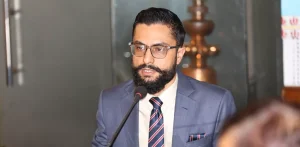
ZHYTOMYR — Estonia’s foreign minister has declared that his country has developed a durable defense against years of Russian disinformation, saying Baltic citizens now possess a kind of societal immunity because they understand the true nature of the Kremlin. Margus Tsahkna made the remarks at the opening of the “EDUHUB” educational center in the Ukrainian city of Zhytomyr, according to the online media outlet Ukrinform. “Russia has been pursuing a policy of disinformation against Estonia for years, but we are immune to it because we know that Russia is an aggressor state,” Tsahkna said. The venue was not incidental. Zhytomyr, a regional capital in northern Ukraine, has faced repeated missile strikes and severe damage during Russia’s full-scale invasion. The opening of an educational hub there is a reminder that Ukraine is determined to preserve learning and normal life even under fire, and it gave Tsahkna a powerful backdrop to explain what he sees as a fundamental lesson from Russia’s war: information warfare and conventional warfare are inseparable. Estonia has long been a target of Russian influence operations, from cyberattacks and propaganda outlets to attempts to weaponize social media. But Tsahkna’s message to Moscow and to Western allies was that these efforts no longer have the desired effect. He did not claim that disinformation had disappeared from Estonia’s information space, but instead argued that it is being met with widespread public skepticism and institutional resilience. In his view, the strongest defense in the digital age is a society that already knows the score.
Tsahkna described Estonia’s approach as a combination of education, active engagement on social media, legal enforcement, and the consistent promotion of reliable information. “We educate the public, work with social media and information resources, and shut down harmful websites. It is also extremely important to disseminate truthful information,” he said. These are not vague principles. In Estonia, media literacy and critical thinking have become part of the school curriculum from an early age. Children learn how propaganda works, how to examine sources, and why false information can be as dangerous as physical threats. Public broadcasters offer news in both Estonian and Russian, ensuring that information produced by state institutions and independent journalists reaches every segment of society. Civil society organizations, fact-checking platforms, and academic researchers share the responsibility of scanning the online environment for coordinated manipulation. Social media companies are pressed to remove accounts and posts that originate from foreign influence operations. The state, meanwhile, uses its legal powers to block websites that are clearly tools of hostile propaganda. Tsahkna’s insistence on truthful information is crucial. Estonia has learned that fighting disinformation is not only about debunking lies; it is also about providing citizens with fast, transparent, and credible communication from their own government. In moments of crisis—whether a war nearby, a cyberattack, or a pandemic—people turn to authoritative sources they already trust. If that trust does not exist, false narratives fill the vacuum. For Estonian officials, public awareness is therefore not an abstract ideal but a concrete security measure. The country’s experience suggests that a well-informed population is the most difficult target for foreign manipulation.
The threat itself, however, is constantly evolving. Tsahkna noted that Russian disinformation is not limited to familiar themes such as Russia’s supposedly peaceful intentions or the alleged hostility of the West and NATO. The Kremlin has also learned to exploit the issues that matter directly to ordinary people. Migration policy has been a frequent target, with false or exaggerated claims used to stoke fears of social change and national decline. During the COVID-19 pandemic, Russian-language media and anonymous accounts spread doubt about vaccines, promoted conspiracy theories about the origins of the virus, and portrayed Western governments as incompetent and authoritarian. Now energy prices, inflation, and the cost of living are being used in similar ways to deepen public frustration and reduce trust in democratic institutions. The pattern is clear: disinformation attaches itself to real anxieties. A parent worried about school safety, a pensioner worried about prices, a worker worried about unemployment—each can become an entry point for a narrative that says the government is corrupt, the West is failing, and Russia is the only honest voice. This is much harder to counter than a direct attack on national sovereignty because it lives in gray areas and uses the language of everyday concern. Tsahkna’s warning is that resilience cannot be taken for granted. A society that ignores social inequality, institutional corruption, or the marginalization of minorities leaves itself open to manipulation. Estonia’s strategy therefore combines information defense with a broader effort to maintain social cohesion and inclusive governance. The fight against disinformation is ultimately a fight for public trust.
Estonia’s experience has been shaped by geography and history. Sharing a long border with Russia and hosting a significant number of Russian-speaking residents, Estonia has dealt with hybrid threats since it regained independence in 1991. The country’s first serious encounter with Russia’s willingness to wage non-military attacks came in 2007, when massive cyberattacks targeted Estonian government portals, banks, and newspapers after the relocation of a Soviet war memorial. That event was an early warning. Since then, the annexation of Crimea in 2014 and the full-scale invasion of Ukraine in 2022 have made the stakes even clearer. Estonia has watched how Russian narratives about fascists, oppressed minorities, and hostile Western alliances were used to justify armed aggression. That is why Tsahkna placed so much emphasis on the fact that Estonians know Russia is an aggressor state. Once a society accepts that basic fact, it is much less vulnerable to false analogies, historical rewriting, and calls for neutrality in the face of atrocity. Tsahkna also stressed that Estonia is drawing on Ukraine’s experience in combating information threats. Ukraine has developed one of the world’s most sophisticated networks for exposing Russian lies, involving open-source analysts, government communication teams, digital forensic experts, and independent journalists. Estonia has studied these methods carefully and integrated them into its own institutional practice. The cooperation between Tallinn and Kyiv is practical, not just political. By working with Ukrainian specialists, Estonian agencies have learned to detect information attacks earlier, trace them to their sources, and respond with language that can cut through the noise. For a small nation, such lessons are invaluable. They cannot replicate Russia’s scale, but they do not need to; the goal is to reach the public quickly and credibly.
At the institutional level, the Estonian response is built on continuous monitoring and rapid action. Tsahkna said that government agencies identify information attacks and take measures to neutralize them. This involves watching social media networks, messaging platforms, and online news sources around the clock. When an attack is detected, the response is immediate: official spokespersons and state media channels provide factual information, civil society organizations are mobilized, fact-checkers analyze the claims, and European allies are informed through shared communication channels. Legal authorities can act against websites that are openly operated by Russian intelligence services or their proxies. Estonia is a democracy with a strong tradition of freedom of expression, and officials are careful not to cross the line into censorship. Every restriction on a website must be based on evidence and subject to review. But in the case of foreign-origin influence operations, the law provides clear powers to defend national security. International cooperation is indispensable. Estonia works closely with the European Union’s East StratCom Task Force, which was created specifically to identify and counter Russian disinformation campaigns. As a NATO member, Estonia also contributes to the alliance’s discussions on hybrid and cyber threats. The NATO Cooperative Cyber Defence Centre of Excellence is headquartered in Tallinn, and it has become a center of expertise for the entire alliance. Yet no amount of institutional machinery can protect a country if its citizens do not trust their own government. That is why Tsahkna’s visit to Zhytomyr, and his presence at the opening of an educational hub, carried a deeper meaning. Education, in war-torn Ukraine, is not only about teaching mathematics or history; it is about giving people the tools to think clearly, to resist despair, and to rebuild their society. By helping Ukraine build these capacities, Estonia is supporting the front line of a broader European battle against falsehood.
In his final remarks, Tsahkna expressed strong support for Ukraine and urged people everywhere to treat messages disseminated by Russia with a critical attitude. His words were not a claim that Estonia can now relax. On the contrary, he implied that immunity must be maintained constantly. New technologies are making the information battlefield more difficult: artificial intelligence can generate realistic fake videos, voices, and news stories in seconds. Social media algorithms amplify outrage, while messaging apps allow influence operations to move into private spaces beyond the reach of public scrutiny. The challenge for Estonia and for all democracies is to remain open and free while defending against manipulation. Tsahkna’s appearance in Zhytomyr offered an answer to that challenge. The strategy that has made Estonia resilient is not complicated. It is built on public education, transparent government, credible media, legal enforcement, and international partnership. But the essential element is a society that has made a shared decision to face the truth. Because Estonians know that Russia is an aggressor state, they do not waste time debating whether Russian intentions are benign or whether the West is actually responsible for the conflict. They focus on protecting their institutions, informing their citizens, and helping their partners do the same. In the rubble and classrooms of Zhytomyr, the message was clear: information security is part of national security, and the war for truth is inseparable from the war for freedom. Estonia’s immunity is not an accident. It is the result of years of patient work, and it stands as an example to the whole democratic world.


