



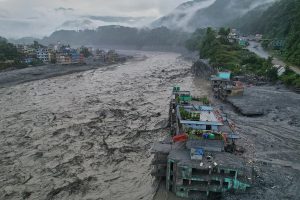




TOKYO — In the immediate aftermath of the Kumamoto earthquake on July 28, social media was flooded with unverified information, including old disaster footage repurposed to depict current damage, videos exaggerating the situation and baseless posts predicting further quakes. The phenomenon is not new, but it is becoming more dangerous. When a strong earthquake strikes, many residents and onlookers instinctively go online in search of answers: Is my family safe? Where is the fire? Which roads are passable? Where are the evacuation centers? Social media can provide an immediate, street-level view of a disaster, often before official agencies have issued their first bulletins. In the best cases, this allows people to confirm each other’s safety, request urgent rescue, and share practical details about shelter and supplies. But the same qualities that make social media useful — speed, reach, and lack of editorial control — also make it vulnerable to contamination. Old clips from a typhoon in a distant country can be presented as footage from the latest quake; a single dramatic image, however misleading, can be viewed by millions within hours. Baseless predictions of imminent aftershocks can send residents into the streets unnecessarily, increasing the risk of accidents, panic and injury. The July 28 quake was no exception. Within minutes of the tremors, social media accounts began circulating unverified claims, some of them recycled from previous disasters, others invented to exploit public anxiety. Official rescue agencies had to spend time debunking rumors instead of focusing on relief operations, and genuine requests for help had to compete with the noise. The result was a chaotic information environment in which the public was left uncertain about what was real and what was fabricated.
Social media’s role in disasters is double-edged. It has proven indispensable in many respects: the ability to post a precise location can alert rescue teams to people trapped under collapsed buildings; local authorities can broadcast shelter locations and water distribution points; family members scattered across the country can know within minutes whether their loved ones have survived. During the 2016 Kumamoto earthquake, social media was already central to the disaster response ecosystem. Yet that same event produced one of the most famous examples of disaster misinformation in Japan: a false post claiming that a lion had escaped from a zoo following the earthquake. The rumor spread rapidly, causing widespread alarm and prompting urgent inquiries to local authorities and zoos. It was eventually debunked, but not before many people in the affected area had to decide whether to stay indoors or flee an imaginary threat. The “escaped lion” incident became emblematic of the dangers of sharing without checking. A decade later, misinformation has entered a new phase — one in which the line between real and fabricated is increasingly blurred by artificial intelligence. In 2016, text-based rumors and repurposed photos could sometimes be traced with reverse-image search. Today, generative AI can produce entirely new scenes that have no basis in reality but look completely plausible. This changes the calculus for both the creators of misinformation and the institutions trying to counter it. It also raises the stakes for ordinary citizens, who must question not only the intent of a post, but whether the image or video attached to it is even a photograph of a real event. The evolution from the 2016 lion rumor to AI-generated disasters is not just technological; it is a profound shift in the nature of public knowledge during crises. In 2016, seeing was still believing, even if the words could be lies. Today, seeing is merely a reason to begin verifying.
Of particular concern is the increasing sophistication of fake images and videos created with generative artificial intelligence. With tools now widely available online, a person with no technical skill can produce a convincing scene of collapsed buildings, raging fires, towering tsunamis, or victims crying for help in a matter of minutes. The technology has advanced so rapidly that the old tells — warped hands, strangely rendered faces, garbled text — are often no longer visible to the naked eye. AI-generated video has become especially troubling because moving images carry a strong psychological sense of authenticity. Even when news outlets and fact-checkers quickly label a piece of content as false, the emotional impact of having seen a “video” of a building falling can linger in the public mind and shape perceptions of the disaster. Audio, too, has been affected. Synthetic voices can be used to create fake emergency broadcasts or fabricated statements attributed to officials, adding yet another layer of deception. Some creators go further by constructing news-style packages, complete with logos, lower-third text and urgent narration, to make their fabrications look like legitimate journalism. The result is an environment where even experienced media professionals must double-check material before using it, and where ordinary viewers can no longer rely on visual intuition. Perhaps the most insidious effect is that genuine footage of disaster damage is now increasingly questioned as potentially AI-generated. When a real video of a landslide or an actual image of a collapsed house circulates, it may be dismissed by some viewers as fake, simply because fake images have become so common. This dynamic is sometimes called the “liar’s dividend”: the more fakes circulate, the easier it is for people to deny real events, and the harder it is for victims to prove what has happened to them. For rescue agencies, the flood of AI-generated material creates a severe resource drain. Every false report must be investigated; every questionable image must be analyzed. Meanwhile, genuine images of people in urgent need may be buried under a mountain of highly engaging fabrication. This is not a hypothetical future. After the July 28 Kumamoto earthquake, fact-checkers and journalists reportedly encountered AI-generated visuals of destruction that were shared by thousands of users, and at least some of that content was designed to look like breaking news from established media brands. The technology has moved faster than society’s ability to build defenses against it, and the gap is widening.
The motives behind spreading misinformation on social media are also changing. In the past, a significant share of disaster rumors could be attributed to simple pranks, careless jokes, or the desire to feel important by breaking “news.” Those motives still exist, but they have been joined by more systematic and financially driven schemes. One of the most notable patterns observed after the latest Kumamoto quake is known as “impression farming.” In this practice, users seek to earn revenue by maximizing the number of views and engagements on their posts. A sensational image of a burning city or a so-called survivor under the rubble can generate enormous traffic, especially in the first hours after a disaster, when uncertainty is greatest and public attention is focused. The more outrageous the claim, the more clicks it tends to attract. Social media algorithms, which are optimized to keep users on the platform by feeding them emotionally charged content, compound the problem. A fake post that predicts another major earthquake can keep people refreshing their feeds, cycling through pages and watching videos, all of which translate into advertising income for the account holder. This is not philanthropy; it is a business model built on human anxiety. There were also noticeable numbers of posts after the Kumamoto quake that lured users to a simplified version of a video-sharing app, prompting them to register so that the referrers could earn points. These posts often used heartrending stories or rescue footage as bait. A user, eager to help or simply curious, would follow a link, create an account, and inadvertently become part of a referral marketing scheme. In other words, people’s anxiety about disasters and their goodwill toward victims are being exploited to generate advertising revenue and referral rewards. The emotional energy of a humanitarian crisis is a resource that scammers and malicious actors know how to mine. They study the behavior of worried citizens: the urge to forward important-sounding safety warnings, the desire to share calls for donations, the willingness to click on links that promise live updates. Every one of those actions can be monetized. This marks a troubling shift from the earlier era of misinformation, which was often episodic and unserious. Today, disaster misinformation is increasingly organized, repetitive and professionally executed. It is not always easy to distinguish between an individual who has been fooled and an account that has been created specifically to exploit a crisis. The motives vary — money, influence, clicks, data collection — but the effect is the same: a pollution of the information environment that makes it harder for real people to get real help.
Why does misinformation spread so easily in the wake of a disaster? The answer lies in a combination of human psychology and the nature of crises themselves. Disasters are of great concern because they threaten lives, and the full extent of the damage is often unknown immediately after they occur. In that vacuum, people naturally try to fill the gaps with whatever information they can find. They are also driven by good intentions. Many who share disaster-related posts believe they are being helpful: alerting neighbors to a planned evacuation, warning about a suspected gas leak, or amplifying a call for volunteers. This is especially true among people outside the affected area. Family members in other prefectures, friends in Tokyo, and even strangers abroad want to assist, and one of the easiest ways is to pass along information that appears useful. The result is a perfect environment for falsehoods to take root. Even if only a few people create false posts, they can spread explosively if amplified by a well-meaning majority. A rumor that begins on a single account can be screenshotted onto another platform, picked up by a local media site, reshared by an influencer, and within hours it is treated as established fact. This amplification effect is particularly dangerous because the majority of people sharing the rumor are not malicious; they are simply too busy, too concerned or too trusting to verify. Yet their goodwill is precisely what makes the misinformation so powerful. The consequences are not abstract. Sharing unverified information does not help; it can actively hinder relief efforts. Rescue teams and local authorities are forced to spend time and manpower investigating false alarms, following up on fabricated videos, and issuing corrections. Every minute spent checking a baseless rumor is a minute not spent searching for survivors. Furthermore, false information can drown out the information that is genuinely needed. In the chaotic hours after a quake, a single real request for rescue may be posted by a small account, while dozens of fake but sensational posts dominate the algorithm. The real story is lost. At a more systemic level, misinformation erodes public trust in all sources of information. When people see repeated fake images and false warnings, they may begin to discount even the official warnings that are meant to protect them. This can lead to dangerous behaviors: ignoring evacuation orders because a previous order was thought to be fake, or failing to prepare because no one’s reports seem reliable. The social cost of this erosion is enormous, and it is disproportionately borne by the most vulnerable members of society — the elderly, the disabled, those who do not have the time or ability to cross-check every claim. Misinformation is thus not an annoying side effect of social media; it is a core threat to disaster resilience.
What is required of us is not expert-level analysis, but simply asking ourselves two questions when encountering information: “Is this true?” and “Is this something I should share?” These two questions are the foundation of a more responsible information culture. To answer them, ordinary citizens can use a few practical steps. Check the source of the material. Is it an official account or a known news organization? Does the person who posted it have a history of reliability, or an anonymous account with little information? Check the date and time and location details. Old footage can often be identified by looking for seasonal clues, weather patterns, or other context that does not match the current disaster. Cross-check against information from local governments, the weather agency, police, fire departments and news organizations. If an official source is silent on the matter, that itself is a sign that the post should not be trusted. If you are still unsure, do not share it. Rather than sharing something “just in case,” we need to resolve that “it stops with me.” This personal commitment is not enough, however. Governments, news outlets and platform operators should move quickly to debunk emerging misinformation. They should also advance “prebunking” — informing people in advance about the kinds of false information that may appear during disasters — providing a kind of inoculation against misinformation. Prebunking works on the same principle as a vaccine: expose people to a weakened or hypothetical example of a misleading story, and teach them to recognize its structure, so that when a real fabricated post appears, they are less likely to be fooled. Some platforms already use this technique in the context of elections and public health, and it can be adapted to disaster preparedness. Local governments can distribute prebunking guides alongside earthquake preparedness leaflets; schools can include misinformation awareness in disaster drills; media organizations can run features on common disaster fake claims. The goal is to reduce the window of time in which falsehoods can spread, and to make the public more resilient to manipulation. Rather than being manipulated by disaster-related information, each of us should calmly scrutinize what we encounter and distinguish fact from falsehood. Doing so will help cultivate “disaster prevention literacy” — the ability to make sound judgments and act appropriately in the face of a disaster. This is not an impossible ideal. It is a practical skill, one that can be learned and strengthened with practice. The Kumamoto earthquakes, and the misinformation that followed them, are a warning. But they are also an opportunity. By changing our own behavior, and by demanding that institutions take responsibility for the platforms they operate, we can make sure that the next disaster does not come with a second disaster of confusion and falsehood. (Reo Kimura, born in 1975, is a professor at the University of Hyogo specializing in disaster psychology and disaster education. He holds a doctorate in informatics from Kyoto University and has served as an assistant professor at a graduate school at Nagoya University among other posts.)


