









Medicine in the Media Workshop Tackles Health Misinformation and Rural Healthcare Challenges
By Nicola Smith
Since its inception in the early 2000s, the annual Medicine in the Media workshop has helped journalists specializing in medicine and science sharpen their reportorial skills in an era of increased mis- and disinformation. Organized by Steven Woloshin, professor of health policy and clinical practice at the Geisel School of Medicine, the conference is supported by Houston-based Arnold Ventures, as well as the Geisel School of Medicine, Dartmouth, and Dartmouth Health. This year’s workshop, held Aug. 24-27 at Dartmouth and at locations across the Upper Valley, convened 25 journalists, researchers, doctors and scientists from across the nation to analyze the persistent challenges of reporting on the complex American health care system. Among those attending were journalists from NPR, the New York Times, the Journal of the American Medical Association, and STAT News, as well as universities and online news sources focusing on health and medicine. Subjects covered included AI’s potential effect on healthcare; shifts in federal vaccine and health policies; lack of government funding for research; federal government cuts to Medicaid; highlighting rural healthcare stories; and the use of AI Large Language Models to create texts. In introductory remarks at the Irving Institute for Energy & Society on the conference’s first day, Jennifer Hunt, dean of the Geisel School of Medicine and chief academic officer at Dartmouth Hitchcock Medical Center, told the assembled journalists that the warp speed at which scientific information is now disseminated runs counter to the methodology of rigorous peer review and testing honed over years and even decades. “Today, we live in a world of instantaneous proclamations, anecdotes that are co-opted into evidence and opinions that look and sound and masquerade like science,” Hunt said. Her warning framed the workshop’s central challenge: how to report responsibly in a media environment where speed is rewarded and nuance is often lost. The workshop, which has been held annually since the early 2000s, is designed to give journalists the critical thinking tools needed to evaluate health claims, understand statistics, and avoid being misled by hype. Participants attend free-of-charge, a policy intended to ensure that reporters from a wide range of outlets, regardless of budget, can benefit from the training.
The urgency of the workshop’s mission was underscored by recent polling. This spring, the Pew Research Center released the results of a 2025 survey that polled 5,000 Americans on their confidence in the veracity of medical information they receive through the media. While respondents indicated they tended to trust their own doctors, more than 50 percent of those polled were unsure which news sources to trust when it came to untangling conflicting information on health care issues. That finding raises a fundamental question for journalists: How can they persuade audiences that their reporting on science and healthcare is truthful, nonpartisan and accurate, given the layers of information they must evaluate? Woloshin urged those in the introductory session to “develop and employ the critical thinking and quantitative skills that you need to evaluate health messages, and not to accept things at face value. Ask hard questions and learn to identify the health claims and evidence behind them.” The workshop, originally funded by the NIH, was taken over by Woloshin and Lisa Schwartz, a professor of The Dartmouth Institute and of Community and Family Medicine at the Geisel School of Medicine who passed away in 2018, after a few years. Since then, it has become a fixture in the professional development calendar for health journalists. The curriculum is built around real-world examples and interactive sessions, allowing journalists to practice applying quantitative reasoning to medical claims. In addition to the formal agenda, the workshop created opportunities for informal peer exchange, a feature that participants said was among the most valuable aspects of the conference. Reporters from different beats and outlets shared tips on how to handle skeptical editors, how to interview researchers who overstate their findings, and how to maintain accuracy under deadline pressure.
The workshop also delved into the cognitive and statistical traps that can distort medical reporting. Journalists learned how to distinguish perceived, actual and relative risk—a distinction that often determines whether a headline alarms readers or reassures them. They considered the implications of overdiagnosis, a phenomenon in which patients are diagnosed and treated for conditions that would never cause symptoms or death. They explored the potential for psychedelic-assisted therapy, a field that has attracted intense media interest but remains scientifically contested. And they examined the media’s tendency to report medical or scientific findings with either an exaggerated sense of threat or an unrealistic promise of cures. As an illustration, Woloshin showed a social media influencer’s paid endorsement for a drug that claims to completely resolve migraines within an hour—an assertion he debunked. “I’ve been a doctor for a long time. I’ve never seen it,” he said. The example underscored the need for journalists to be skeptical of testimonials and to look for randomized controlled trials and other rigorous evidence before presenting a treatment as effective. With the rise of AI large language models, the workshop also considered how automated tools can generate convincing but false medical texts, adding another layer of complexity to the the fight against health misinformation. Participants discussed the importance of verifying sources, checking primary literature, and being transparent with audiences about the limitations of scientific knowledge. They also examined how AI could be used responsibly in newsrooms, for example to help analyze large datasets or identify emerging health trends, while remaining alert to to the risks of algorithmic bias and fabrication.
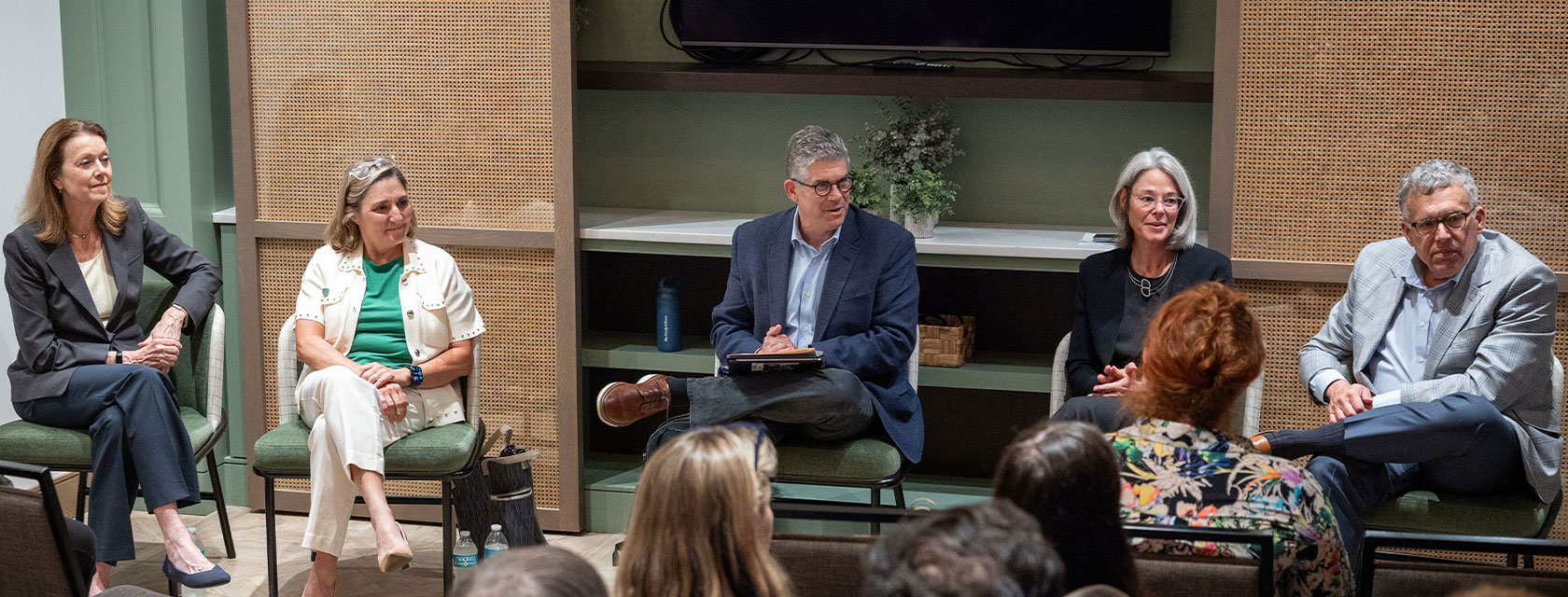
A key session was a panel discussion and Q&A focused on obstacles facing both rural healthcare providers and rural populations, and how to bring these stories to the public. Moderated by former New York Times journalist Jacques Steinberg ’88, the panel included Dartmouth Health CEO Joanne Con Conroy, Dean Jennifer Hunt, recently named director of the Dartmouth Cancer Center Roy Herbst, and director of The Dartmouth Institute for Health Health Policy and Clinical Practice Amber Barnato. Conroy said Dartmouth Health is well-positioned “to have a really sharp lens on the challenges of of rural healthcare–not only because where we’re located, but the fact that we have the research and the education and the long history studying rural healthcare and the impact of decisions on rural healthcare.” She noted that that 20 percent of people in the the U.S. live in rural areas. “And they want to know how they can stay healthy,” she said, which means improving access to transportation, among other issues. Herbst added that at the Dartmouth Cancer Center, the increased use of personalized and precision medicine in targeting cancer points to the urgency of making “sure that advances that we we have get to patients at the point of care.” The panelists acknowledged that rural populations often face higher rates of chronic disease, less access to to specialists, and greater difficulty traveling for care. They also discussed the need for journalists to cover rural health not as as a niche subject but as a core part of the American healthcare story. The conversation touched on workforce shortages, hospital closures, and the role of academic medical centers in supporting rural communities. Panelists emphasized that solutions will require collaboration among policymakers, providers, and community leaders, and that journalists have a responsibility to illuminate both the problems and the promising efforts to address them.
Hovering over the future of American healthcare is the prospect of nearly $1 trillion in cuts to federal health care spending, including to Medicaid and and SNAP food benefits. Barnato warned that “core infrastructure elements of our health care care delivery system that are disproportionately funded through Medicaid, such as substance use disorder treatment programs that all members of the community rely upon, may wither.” She predicted “a huge heterogeneity in the way states manage the new requirements and the changes in funding from from the federal government,” with wealthier areas better positioned to absorb the cuts without adversely affecting community service availability. The panelists discussed how these funding changes would affect rural hospitals, mental health services, and preventive care. They also noted that journalists have a critical role to play in explaining the the real-world consequences of budget decisions, particularly for communities that are already underserved. The workshop’s focus on policy and funding was complemented by practical guidance on how to cover these complex issues accurately, including how to read federal budget documents and interpret state-level data. Participants were encouraged to to look beyond press releases and to examine the actual language of legislation and agency rules. They also considered the importance of following the money: who benefits from federal health spending, who loses when it is cut, and how those effects vary by region and income level. With changes to Medicaid and SNAP likely to have cascading effects on hospitals, food security, and community health, the journalists at the workshop left with a deeper understanding of the stakes involved.
Participants left with a stronger sense of purpose and practical tools to apply in their reporting. Freelance journalist Rod McCullom, a Knight Journalism Fellow at MIT who has written for Scientific American and MIT Technology Review, appreciated the chance to be with his peers. “It was great to be around a table and bounce ideas off each other,” McCullom said. The conference “amplified the need for clear, easy, simple, accessible language. Scientists and researchers and journalists often use jargon or acronyms because they’re easier. But I think sometimes, as journalists, we fall into the trap of trying to sound too smart,” he said.. Karen Fisher, a freelance journalist from New Mexico, said she now has a “good, foundational knowledge of what I’’m looking at. We don’’t always have the tools to assess what’s trustworthy and what’s not. We do the best with the information we have.” After four days listening to medical and scientific experts explain how to decipher data, Fisher said she has a better sense of how to “look at a study and know what’s statistically significant, and what’s not.” The workshop ended with a reminder that the the fight against misinformation is ongoing. As Woloshin has long argued, the most important tool a journalist can bring to a story is a willingness to ask hard questions and to demand evidence. For the 25 participants who gathered in New Hampshire, the lessons of the of the Medicine in the Media workshop will inform their reporting for years to come.


