



A well-organised, large-scale disinformation campaign aimed at poisoning relations between Poland and the Czech Republic has been exposed, with investigators warning that it represents the first operation of its kind directed against the two Central European allies and may have been designed as a test of how they would respond to hybrid threats. The campaign, detailed in a podcast interview with investigative journalist Lukas Valasek for Seznam Zpravy on Monday, pushed the baseless narrative that Poland was preparing to invade and annex a small border area around the twin towns of Cieszyn/Těšín. Valasek, who has tracked Russian influence operations, described the operation as unprecedented in scale and coordination. “It is the first ever operation of this scale,” he said. The machinery of the hoax included paid Facebook advertisements, AI-generated images, a fake website designed to impersonate Czech Radio’s iRozhlas.cz portal, and a network of fabricated social media accounts belonging both to ordinary citizens and to senior officials, including Czechia’s ambassador to Poland, Bretislav Dancak. The apparent goal, analysts quickly concluded, was to spark fears of a Polish land grab and property seizures, while stirring up historical grievances linked to the controversial 1958 border treaty between Poland and then-Czechoslovakia. The operation used a fragment of real history and amplified it with modern tools of deception, creating an alternative reality in which Warsaw was secretly planning to revise the border by force. Although the campaign ultimately failed to trigger a diplomatic crisis, Valasek warned that the episode should be understood as a diagnostic test. “If we understand this whole thing as a test from a potential Russian actor on how the Czech Republic will respond to a wave of disinformation, then I think that the Czech political scene, and especially the government, did not quite pass,” he said.
The operation exploited a genuine but relatively minor dispute over the border around Cieszyn/Těšín, a region that has carried historical weight since the early twentieth century. The 1958 treaty between Warsaw and Prague settled the post-war frontier, but lingering grievances over land and local identity remained, and those resentments provided fertile soil for the hoax. Czech security expert Bohumil Kartous argued that the campaign bore all the hallmarks of a Russian-backed hybrid operation, using what he called “a fragment of truth” and placing it “in a completely different context of fear over losing property.” The target, he said, was not just the border region but the broader alliance of countries supporting Ukraine in its defence against Russia’s full-scale invasion. “The goal is precisely to trigger a dispute within this pro-Ukrainian coalition,” Kartous said. Both Poland and the Czech Republic are frontline members of NATO and the European Union, and both have been among Ukraine’s most steadfast supporters, providing military aid, humanitarian assistance, and diplomatic backing. A wedge between Prague and Warsaw would not only weaken European unity but also shift attention away from Russia’s own aggression and destabilise the eastern flank of the Western alliance. The use of paid advertisements and AI-generated imagery was intended to make the falsehoods appear authentic and to saturate social media feeds with alarming content. The fabricated accounts of ordinary citizens gave the impression of genuine public outrage, while the fake profiles of officials, including the Czech ambassador, lent an air of institutional confirmation. The operation did not need to convince a majority of the population; it only needed to generate enough confusion and suspicion to force official denials, provoke political recriminations, and test the speed and effectiveness of the Czech and Polish responses. In that respect, it has already become a valuable case study in the vulnerabilities of open societies to information warfare.
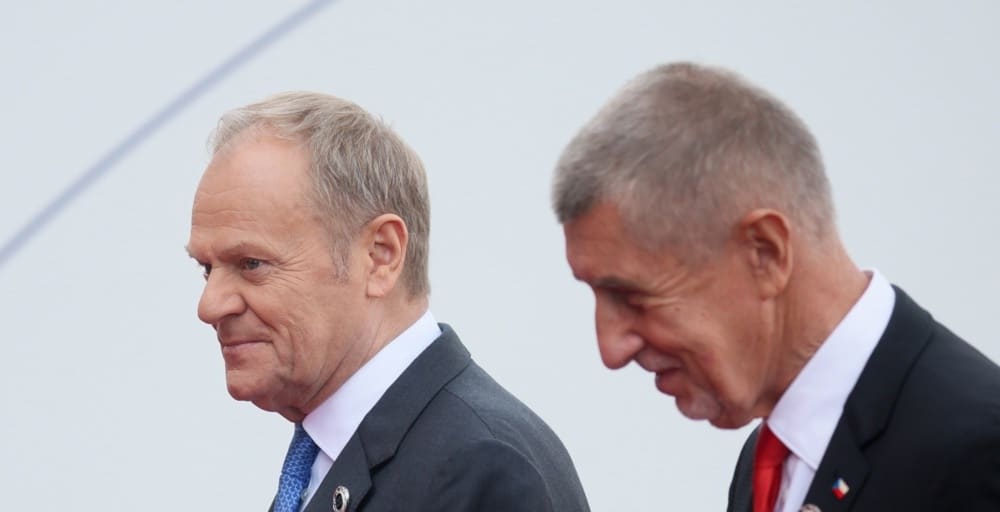
On the Polish side, the response was swift, confident, and effective. Prime Minister Donald Tusk and Foreign Minister Radoslaw Sikorski quickly dismissed the claims of an imminent Polish annexation as absurd, orchestrated, and wholly disconnected from reality. Poland’s institutional experience with Russian hybrid attacks, accumulated over years of confrontations with Moscow, appeared to pay off as Warsaw moved immediately to identify the operation and neutralise its effects. Tusk, rather than issuing a dry statement, used humour and symbolism to defuse the tension. He posted an image of friendship between the two countries’ most beloved cartoon characters—Reksio, the Polish dog, and Krtek, the Czech mole—with the caption: “Reksio and Krtek have known this for a long time, Poland and Czechia are true friends.” The gesture resonated widely and helped reset the narrative, reminding citizens on both sides of the border that their countries share far more than a boundary. Polish officials also stressed that Warsaw would not be provoked into a diplomatic incident, and Polish intelligence services launched their own investigation into the origins of the fake advertisements and accounts. The contrast with the Czech response could hardly have been starker. Warsaw’s rapid and unhesitating rejection of the hoax deprived the operation of the controversy it sought to create. Instead of angry exchanges between capitals, the world saw a display of unity, symbolised by the viral friendship of Reksio and Krtek. Social media users in both countries embraced the meme, sharing their own versions and effectively mocking the premise that Poland and the Czech Republic could be driven to conflict over a false territorial claim. The Polish response demonstrated that a coordinated and well-prepared official reaction can blunt the impact of even the most sophisticated disinformation campaign, and it left the political leadership in Prague struggling to explain why it had been so much slower to act.
Across the border, however, the official Czech reaction was hesitant, muddled, and ultimately damaging to public confidence. It took several days for the Czech Foreign Ministry to issue an unequivocal statement rejecting “the spread of false information about alleged Polish territorial claims to the Czech Republic.” That delay allowed the hoax to circulate without an authoritative rebuttal, and it gave the impression that Prague was uncertain about how to respond. Czech President Petr Pavel eventually intervened, describing the operation as “a targeted provocation” and expressing relief that ordinary people were not falling for it. “I’m very glad that people are not listening to this provocation on either side of the border,” Pavel said, adding that “Poland is one of the Czech Republic’s closest and most important partners.” But the message of unity was quickly overshadowed by domestic political chaos. Late last week, Prime Minister Andrej Babis lashed out against his own intelligence services, saying he had only heard about the ongoing hoax campaign through the media. On Monday, he again pointed the finger at the Office for Foreign Relations and Information, known as UZSI, and blamed Czechia’s envoy in Poland, Bretislav Dancak, for the failed response. The prime minister’s comments triggered a wave of finger-pointing in Prague, with intelligence officials reportedly pushing back against what they saw as an unfair attempt to shift responsibility for a failure that was political as much as institutional. Security experts noted that the prime minister’s first instinct was to attack state institutions rather than the foreign actors behind the campaign. The delay in official denial, combined with the public rebuke of intelligence services, gave the hoax far more attention than it would otherwise have received. Although the operation evidently failed to drive a wedge between Prague and Warsaw, it succeeded in exposing the fragility of the Czech government’s crisis communication and in creating a domestic political dispute that further eroded trust in the state’s ability to handle hybrid threats.
The most severe criticism, however, concerned the Czech government’s broader decision to dismantle its own defences against disinformation. Shortly after taking office, Babis’s government scrapped the Strategic Communications Department, known as Stratkom, and reduced the number of ministerial experts focused on monitoring and countering influence operations. This decision, critics argued, left the state almost blind to the very operation that had just targeted it. Oldrich Bruza, the former head of Stratkom, said the episode was a predictable consequence of those cuts. “If, by chance, there had still been any strategic communication of the state, analysts would have caught [the disinformation campaign] long before and the top representatives of the state could have communicated it,” he said. “At least we have our Polish brothers.” His remarks were echoed by opposition politicians, including former foreign minister Jan Lipavsky, who accused the government of having ignored repeated warnings. “We have repeatedly warned about this,” Lipavsky said. “For ideological reasons, the government is liquidating the state’s capacities for combating disinformation and influence operations at the very time when someone is using them against the Czech Republic.” Babis rejected the criticism, insisting that dedicated strategic communication units were unnecessary. “We don’t need a Strategic Communications Department,” he said. “We have [intelligence] services here that are supposed to work for the state, for the people and for the interests of the state.” The exchange exposed a fundamental disagreement over how to defend against hybrid threats. Intelligence services, by their nature, operate in secret and are not designed to shape public narratives in real time; strategic communication requires a different set of skills, including rapid analysis of social media trends and proactive engagement with the public. The government’s decision to eliminate those capacities, combined with its reluctance to name Moscow as the likely culprit, left many experts worried that the Czech Republic remains dangerously unprepared for the next operation. Polish and Czech intelligence services are still investigating the origin of the campaign, and no formal attribution has yet been made. Officials insisted that the absence of an official accusation reflected the need for thorough legal and technical work rather than any lack of suspicion. But the political fallout in Prague demonstrated that the operation succeeded in at least one of its goals: it disrupted domestic politics, exposed institutional weaknesses, and revealed how quickly a fabricated story could move from the margins of the internet to the centre of national debate.
Amid the political recriminations, the response of ordinary citizens offered a more hopeful picture. Social media in both countries was quickly flooded with montages, cartoons, and jokes featuring Reksio and Krtek as inseparable friends, effectively nipping in the bud any fears of cross-border animosity. The public’s instinct to reach for humour rather than fear was widely credited with helping to defuse the hoax and to restore a sense of perspective. While failings at the top were evident, the response from the local population did not disappoint. People on both sides of the border made clear that they would not be manipulated into hostility against their neighbours, and the viral friendship of two cartoon characters became a powerful counter-narrative to the dark warnings of invasion and property confiscation. The episode, though alarming, may ultimately serve as a warning and a learning opportunity. It demonstrated that even absurd lies can gain traction if they are well-funded, technically sophisticated, and inserted into an information ecosystem that has been hollowed out by cuts to strategic communication. It also showed that hostile actors are willing to invest in dividing Europe’s eastern flank, using historical grievances as raw material for modern influence operations. The failure to drive a wedge between Prague and Warsaw should not be mistaken for the failure of the operation’s broader purpose. As Valasek and others argued, the campaign was likely designed as a test—of Czech resilience, of Polish reaction, of the coordination between allied governments. In that respect, the results were mixed. Poland passed with flying colours; the Czech government stumbled; the populations of both countries, however, demonstrated a healthy scepticism that no algorithm has yet overcome. The challenge for Europe is to institutionalise that resilience before the next test arrives. The “Reksio and Krtek” moment may have saved the day this time, but relying on cartoon solidarity is not a sustainable strategy. Governments need to rebuild their capacities for detecting, analysing, and rebutting disinformation, and they need to do so now. The border between Poland and the Czech Republic remains peaceful, and the friendship between the two nations remains intact, but the operation that tried to break it should be remembered as a close call—and a reminder that in the information age, the front line can run through a Facebook feed as easily as through a trench.