






CHRICED Warns Disinformation and Political Violence Threaten Nigeria’s Democracy Ahead of 2027 Elections as Media and Civil Society Seek Stronger Electoral Safeguards
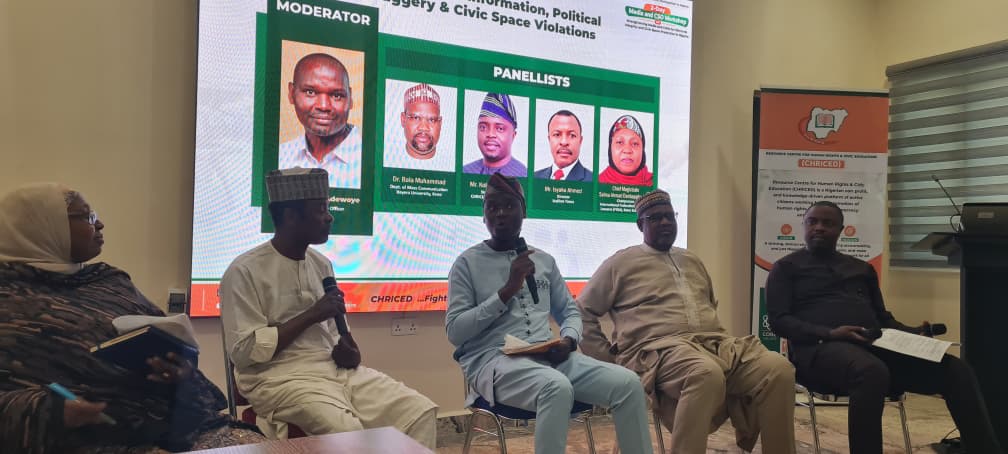
ABUJA — The Resource Centre for Human Rights and Civic Education (CHRICED) has issued an urgent warning that disinformation and political violence could further weaken Nigeria’s democracy and seriously undermine the integrity of the electoral process ahead of the 2027 general elections. The Executive Director of CHRICED, Comrade Ibrahim M. Zikirullahi, delivered this warning on Wednesday at a two-day workshop organised for media professionals and civil society organisations (CSOs) in Abuja, with the aim of strengthening their roles in promoting electoral integrity and protecting civic space in Nigeria. Zikirullahi declared that electoral integrity is under intense pressure, civic space is shrinking, and disinformation is poisoning public trust in democratic institutions. He also expressed deep concern over the persistent threat of political violence, which he said continues to threaten the very soul of Nigerian democracy. The workshop brought together journalists, activists, and civil society actors to deliberate on practical strategies for safeguarding democratic gains and ensuring that the 2027 elections are credible, peaceful, and reflective of the will of the Nigerian people.
Zikirullahi’s remarks set the tone for the two-day engagement, as he stressed the gravity of the moment by saying, “We are here because electoral integrity is under pressure. We are here because civic space is shrinking. We are here because disinformation is poisoning public trust. We are here because political violence continues to threaten the very soul of our democracy.” He called on journalists and civil society organisations to remain united and vigilant, urging them to protect civic space, counter disinformation, and report responsibly without fear or favour. According to him, stronger collaboration between the media and civil society would help keep citizens properly informed, empower communities, and contribute to the strengthening of democratic institutions. He emphasised that the media, as the fourth estate of the realm, has a critical role to play in exposing electoral malpractices, verifying information, and promoting issue-based political discourse. Civil society organisations, on the other hand, are expected to serve as watchdogs, mobilise voters, and hold political leaders and electoral officials accountable. The combination of a free press and active civil society, he argued, is essential to defending the democratic space and ensuring that ordinary Nigerians are not disenfranchised or manipulated by those seeking to subvert the electoral process.
Speaking at the workshop, Professor Kamilu Fagge, a lecturer in the Department of Political Science, called for greater independence of the Independent National Electoral Commission (INEC) and state electoral commissions as a fundamental step toward improving the credibility of elections in Nigeria. Fagge attributed some of the challenges confronting electoral integrity to the relative dependence of electoral management bodies on the executive arm of government. He argued that this dependence compromises their impartiality and undermines public confidence in their decisions. To address this, he proposed that the appointment of officials of electoral bodies should be completely removed from the control of the executive and instead handled through an independent process capable of producing credible, competent, and impartial personnel. He also called for financial autonomy for electoral management bodies, including the establishment of a direct line charge for their funding, rather than making them dependent on the executive for annual budgetary allocations. According to Fagge, without financial independence, INEC and state electoral commissions cannot effectively plan and conduct elections, especially in an environment where resources are often deployed as a tool of political manipulation. He further stressed that electoral bodies should be staffed by trained professionals and that their personnel should undergo regular training and retraining to build their capacity and keep pace with evolving electoral challenges. “Nigerians, especially the elite, must also participate actively in elections rather than leaving the responsibility of choosing leaders to others,” Fagge said, adding that every citizen has a role to play in bringing about positive change. He urged Nigerians to use their influence and resources to mobilise others to participate actively in the electoral process, noting that voter apathy and elite indifference have historically weakened the quality of democratic representation.
Similarly, Abdulmumin Bala Ahmed, a law lecturer at Bayero University, Kano, identified poor political and civic education as one of the major challenges affecting Nigeria’s electoral system. Ahmed explained that citizens cannot fully benefit from the legal protections available to them if they do not understand the laws governing elections and their rights as voters. He noted that many Nigerians are unaware of their electoral rights, the procedures for voting, or the mechanisms for challenging electoral malpractice, leaving them vulnerable to manipulation and disenfranchisement. He also identified the fragmented nature of electoral laws as another significant challenge, noting that the frequent introduction of new legal provisions and amendments can make the electoral system difficult to understand, even for some trained lawyers. This complexity, he argued, creates confusion and provides loopholes that political actors can exploit. He therefore called for the consolidation and simplification of electoral laws to make them more accessible and easier to implement. Additionally, Ahmed stressed the need to strengthen checks and balances among the three arms of government, pointing out that the overbearing powers of the executive can make it difficult for the legislature and judiciary to effectively carry out their oversight responsibilities. He argued that a weak system of checks and balances allows executive impunity to flourish, which in turn undermines the credibility of elections and the rule of law. He acknowledged that Nigeria has legal provisions capable of supporting a credible electoral system, but he insisted that the major challenge remains the effective implementation of those laws. Passing good laws is not enough, he said; there must be political will, institutional capacity, and consistent enforcement to translate legal frameworks into tangible democratic outcomes.
The concerns raised at the workshop come against a backdrop of growing anxiety over the state of democracy in Nigeria and the broader West African region. Over the past several election cycles, observers have documented widespread incidents of vote buying, ballot box snatching, thuggery, manipulation of results, and the use of state apparatus to influence electoral outcomes. The 2023 general elections, though widely seen as an improvement over previous ones in some respects, were still marred by logistical failures, accusations of bias against INEC, and the controversial use of technology, particularly the Bimodal Voter Accreditation System (BVAS) and the INEC Result Viewing Portal (IReV). These issues have left many citizens disillusioned and distrustful of the electoral process. With the 2027 elections now on the horizon, there is a real danger that disinformation campaigns, especially through social media, could deepen ethnic and religious divisions, incite violence, and distort public perception of candidates and policies. Political violence, which has historically erupted during election periods in Nigeria, remains a serious threat to the safety of voters, election officials, and security personnel. In some areas, political actors have been accused of sponsoring armed gangs to intimidate opponents and seize electoral materials, raising fears that the 2027 elections could be marred by bloodshed if proactive measures are not taken. Civil society organisations have also warned about the shrinking civic space, citing arbitrary arrests, harassment of activists, and restrictive regulations that hinder independent observation of elections. These developments, if left unchecked, could roll back the democratic gains Nigeria has made since 1999 and undermine the legitimacy of future governments.
The six-paragraph analysis underscored the urgent need for a comprehensive and collaborative approach to safeguarding Nigeria’s electoral future, with participants agreeing that the fight for electoral integrity must go beyond election day and involve all segments of society. The media, as a critical institution, must prioritise factual and balanced reporting, invest in fact-checking, and refrain from amplifying hate speech and unverified claims. Journalists must be protected and empowered by the government to do their work without intimidation, and media owners must resist the temptation to use their platforms to advance narrow political interests. Civil society organisations, meanwhile, must continue to monitor electoral processes, educate voters, and advocate for legal and institutional reforms. Independent candidates and political parties should be given equal access to public media and electoral resources, and the electoral commission must operate with transparency and impartiality. The government, for its part, must guarantee security during elections, ensure accountability for perpetrators of political violence, and provide adequate funding for electoral bodies without strings attached. Citizens also have a responsibility to participate actively in the electoral process, to reject inducements, and to hold their leaders accountable after elections. As Nigeria approaches 2027, the warning from CHRICED serves as a powerful reminder that democracy is not self-sustaining; it requires constant vigilance, sacrifice, and collective action. The decisions taken today by political leaders, electoral officials, the media, civil society, and ordinary citizens will determine whether Nigeria’s democracy deepens or deteriorates. In the words of Comrade Zikirullahi, the time to act is now, for “electoral integrity is under pressure, civic space is shrinking, disinformation is poisoning public trust, and political violence continues to threaten the very soul of our democracy.” The challenge before the nation is clear, and the response must be bold, united, and unwavering.


