









Beijing – Chinese authorities penalised 10 people accused of spreading misinformation online about a deadly mudslide along the Nepal border, police said Aug 31, as rescuers scour for hundreds missing at a border crossing on the Tibetan side. The penalties, which could range from fines to 10 days in detention, come as rescuers on both sides of the border pressed on with search operations after a devastating wall of water tore through parts of Nepal and Tibet in China last week, sweeping away entire villages. Rumours shared by the 10 individuals suggested the number of missing or dead was vastly more than officially reported figures, according to a statement by the cybersecurity bureau of China’s Ministry of Public Security. The statement did not identify the individuals beyond surnames, nor did it specify exactly what punishment each person received. Authorities in China have repeatedly warned against the spread of unverified information during natural disasters, arguing that false rumours can cause panic, hamper rescue efforts and undermine public trust. This latest enforcement action underscores the government’s determination to control the narrative around a catastrophe that has killed hundreds and left many more unaccounted for in some of the most remote and difficult terrain in the Himalayas. The disaster has drawn international attention, with questions raised about the accuracy of official figures and the accessibility of the affected region to independent observers.
One individual, surnamed Qiu, had shared online that “the news reports 1,400 fatalities, but in reality 3,000 people had previously been reported missing”, while another surnamed Liu had said more than 3,000 people died in China as a result of the mudslide, the statement added. These claims, which circulated on social media platforms, appeared to contradict the official death and missing counts published by disaster authorities on both sides of the border. According to Nepal’s disaster authority, the floods have killed at least 903 people in Nepal, where 4,247 people are missing. In Chinese-administered Tibet, another 16 have died and 546 people are missing, according to Chinese state media. The mudslide flattened an area of “about 0.7 sq km” – the equivalent of 98 football pitches – in the Gyirong border area, a region that includes multiple villages and a major port of entry between China and Nepal. The discrepancy between the official numbers and the rumours circulating online has become a flashpoint in the broader debate over how China communicates natural disasters, particularly in regions with restricted media access. Chinese authorities have insisted that their reporting is accurate and that they are making every effort to account for those who remain missing. At the same time, they have moved quickly to punish individuals who spread unverified figures, signalling that dissent or speculation during an emergency will not be tolerated. The exact nature of the penalties imposed on the 10 individuals remains unclear, but police indicated they could range from fines to short periods of administrative detention.
Asked about international reports that China was censoring images of the floods and underreporting deaths, Beijing’s foreign ministry said on Aug 31 that the “release of information has been open, transparent and timely”. “Malicious smearing and sensationalism using the disaster situation will not receive popular support,” ministry spokesperson Guo Jiakun told a news conference. The comments came after foreign journalists and human rights groups raised concerns that the full scale of the disaster may not be known because Tibet, an autonomous region of China, is largely inaccessible to foreign journalists. Independent reporting on the ground is extremely difficult, preventing verification of casualty figures and the extent of destruction. The Chinese government maintains that its own media and officials have provided accurate and up-to-date information, and that any suggestion of a cover-up is unfounded. The foreign ministry’s response reflected a broader official stance: that while the disaster is tragic, efforts to undermine China’s handling of it are politically motivated and will not be accepted. Guo’s remarks were among the first high-level public responses to external criticism, and they set the tone for how Beijing intends to manage the narrative in the coming weeks. With hundreds of people still missing, including dozens of foreign nationals, the pressure on Chinese authorities to provide credible and verifiable information is likely to intensify.
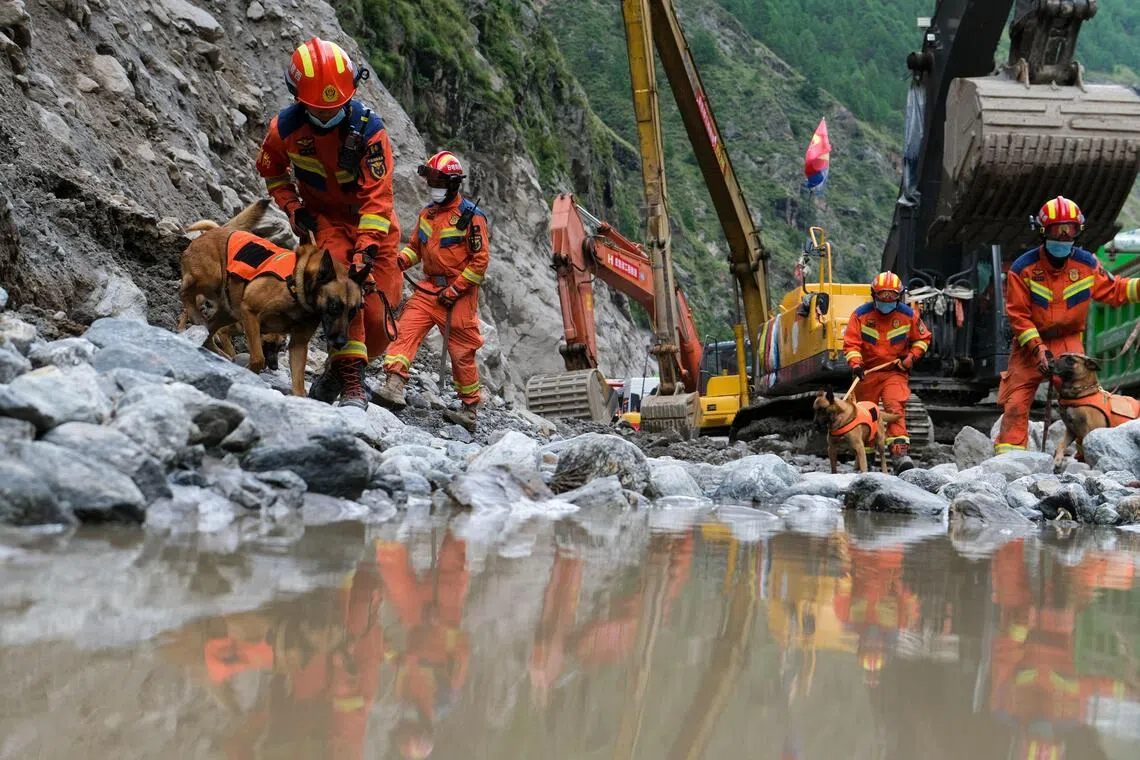
China’s Xinhua news agency reported earlier on Aug 31 that emergency workers were racing against time and the odds to search for survivors. Rescuers were “pushing forward into the core disaster area” despite challenges such as “high-altitude terrain, steep valleys and volatile weather”, it added. They were “carrying out road mud removal, search and rescue operations, hazard identification, disinfection and epidemic prevention, as well as clearing and restoring damaged routes” in Tibet. Videos published by state broadcaster CCTV showed rescue workers with sniffer dogs trudging through the debris in valleys where the mudslide had swept through. In other areas, rescuers were seen wading through thick mud, while others repaired power lines. Communication had been restored in Gyirong port, Xinhua said on Aug 30. The rescue effort is taking place in exceptionally challenging conditions. Gyirong, the county hardest hit by the mudslide, is expected to see some rainfall in the next few days, a National Meteorological Center forecaster said on Aug 30, warning that rescuers may face slippery roads. The combination of high altitude, unstable ground and the risk of further landslides makes the search extremely dangerous. Yet authorities have pledged to continue until every possible survivor is found. The visuals released by state media have been carefully curated, showing rescuers in action and officials overseeing the response, but they also reveal the immense scale of the destruction. Entire stretches of valley floor have been buried under mud and rock, with only the tops of buildings visible in some areas. The task of identifying bodies and accounting for the missing is expected to take weeks, if not longer.
Of those missing in Tibet, 261 were foreign nationals, including 104 from Nepal, 49 from India, 33 from Latvia, and 18 from the United States. The presence of so many foreign nationals among the missing has added an international dimension to the disaster, with several countries seeking information about their citizens from Chinese authorities. Nepal, which shares a porous border with Tibet, has been particularly affected, as many of its citizens were working or trading in the border region. Workers near the port had been “moved to a safe location” on Aug 30, after a new lake was formed by a landslide. But the lake “has naturally overflowed and basically emptied”, the Ministry of Emergency Management said Aug 30. This natural overflow may have reduced the immediate risk of a sudden outburst flood, but it also underscored how unstable the landscape remains. The formation of landslide-dammed lakes is a common hazard in the Himalayas after earthquakes and heavy rainfall, and authorities have been monitoring the situation closely. The fact that the lake has already emptied could be seen as a relief, but it also means that a large volume of water and debris may have been released downstream, potentially affecting areas already hit by the initial disaster. Emergency workers are now focused on both search and recovery and on preventing secondary disasters that could claim more lives.
President Xi Jinping said on Aug 31 that China is making every effort to search for those missing on its side of the border. His comments, carried by state media, were the highest-level acknowledgment of the disaster and a signal that the government is prioritising the response. Xi’s statement is also a clear message to both domestic and international audiences that the state is taking full responsibility for the rescue mission. However, the scale of the disaster, the remoteness of the affected area and the limitations placed on independent observers mean that questions about the official death toll and the handling of information will likely persist. The punishment of the 10 individuals accused of spreading misinformation serves as a reminder that in China, the official account of events is not open to challenge, especially during a national emergency. As rescue operations continue, the focus will remain on the search for survivors, the recovery of the missing and the difficult task of rebuilding lives in a region where the landscape itself has been transformed. For now, the official message is one of unity, determination and resilience. But underneath that message lies a complicated reality: hundreds of people are still unaccounted for, families are desperate for news, and the full extent of the catastrophe may never be fully known to the outside world. The coming days will test both the capacity of the rescue teams and the credibility of the official narrative.


