





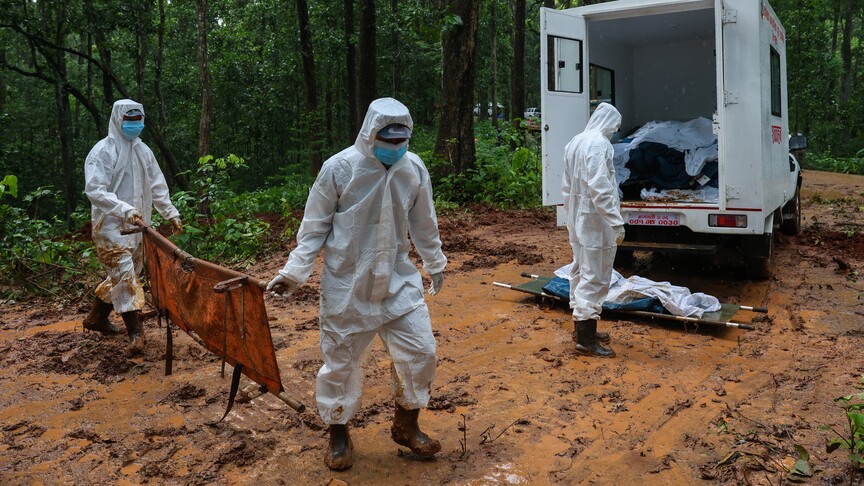
Tibet Memorial Services Held as Death Toll Climbs and Authorities Crack Down on Disaster Misinformation
China held solemn memorial services Tuesday morning in Gyirong County, located in the southwestern Xizang Autonomous Region commonly known as Tibet, to honor the victims of last week’s catastrophic flash floods and mudslides that devastated the Himalayan border region. The ceremony, conducted according to local traditions and attended by government officials, rescue workers, and grieving family members, served as a moment of collective mourning for the 16 confirmed Chinese fatalities while also paying respects to the broader human cost of the disaster that has claimed more than a thousand lives across both China and Nepal. The Aug. 26 catastrophe, which state media has described as one of the most severe natural disasters to hit the region in recent memory, transformed the tranquil border landscape into a scene of unimaginable destruction, as torrents of ice, rock, and mud thundered down mountain valleys, obliterating communities, infrastructure, and livelihoods in their path. The memorial services also provided an opportunity for authorities to address public concerns about the disaster’s handling and to reaffirm their commitment to ongoing search and rescue operations, even as the likelihood of finding additional survivors diminishes with each passing day. Local religious leaders were invited to conduct traditional Buddhist ceremonies, reflecting the deep spiritual significance of the region and providing comfort to those who have lost loved ones in the tragedy.
The disaster was triggered by a catastrophic geological event on Nepal’s Mount Langtang Lirung, where a glacier fractured at an altitude of approximately 5,200 meters, or 17,060 feet, unleashing an enormous ice-rock avalanche that rapidly transformed into a massive debris flow as it descended through the steep mountain terrain. This wall of ice, rock, and sediment swept through the narrow valleys along the Nepal-China border with terrifying speed and force, overwhelming everything in its path and leaving a trail of devastation that stretched across international boundaries. The sheer scale of the geological failure has prompted scientists and disaster management experts to examine the factors that may have contributed to the glacier’s collapse, with preliminary assessments suggesting that a combination of geological instability, recent seismic activity, and potentially changing climatic conditions in the high-altitude region may have played significant roles. The avalanche’s transformation into a debris flow amplified its destructive potential, as the mixture of water, rock, and sediment gained mass and momentum while carving through the valleys, ultimately reaching settlements and infrastructure that would have been considered safe from a simple avalanche. The disaster has reignited discussions about the vulnerability of Himalayan communities to glacier-related hazards, particularly as development continues to expand in these remote and geologically sensitive areas.
Official data released jointly by Chinese and Nepalese authorities Tuesday revealed that the combined death toll from the catastrophe has risen to 1,019, comprising 1,003 confirmed fatalities in Nepal and 16 in China, while an additional 4,462 people remain missing across the border, including 844 foreign nationals from various countries. The startling disparity between the death tolls in the two countries reflects the geographical distribution of the disaster’s impact, with the Nepalese side of the border experiencing the brunt of the debris flow’s destructive force, while the Chinese side, though less severely affected in terms of casualties, still suffered significant losses and damage. The high number of missing persons, particularly the substantial contingent of foreign nationals, has added an international dimension to the disaster, with embassies and diplomatic missions from multiple countries actively engaged in seeking information about their citizens and coordinating with local authorities on search efforts. The search and rescue operation has proven extraordinarily challenging due to the treacherous terrain, the scale of the debris, and the ongoing geological instability in the region, forcing rescue teams to employ a combination of traditional search methods and advanced technological tools in their efforts to locate survivors and recover the deceased, including the deployment of life detection equipment across a 0.7-square-kilometer area surrounding the border gate where the heaviest destruction occurred.
In a parallel development, China’s cybersecurity police have publicly disclosed 10 cases involving what authorities describe as online rumors and misinformation related to the mudslide disaster, with legal action initiated against individuals accused of fabricating information about the incident, exaggerating casualty figures, and misleading the public about the situation. The state-run Global Times reported that these measures were specifically designed to prevent false information from disrupting the ongoing search, rescue, and relief operations, underscoring the government’s determination to maintain control over the disaster’s narrative and ensure that accurate information reaches the public. The crackdown on misinformation highlights the growing challenge that digital platforms and social media present to authorities during major crisis events, as unverified claims and rumors can spread rapidly across networks, potentially causing panic, confusion, and even hampering rescue coordination efforts. Legal experts note that these cases represent a broader trend in Chinese governance, where authorities have increasingly taken assertive measures to regulate online discourse during emergencies, arguing that maintaining information order is essential for effective crisis management, though critics have raised concerns about the potential chilling effect on legitimate reporting and public discussion. The specific nature of the penalties and the identities of those charged have not been fully disclosed, but the cases serve as a clear warning to those who might seek to exploit the disaster for personal attention or gain through the dissemination of unverified information.
The disaster has inflicted severe damage on critical border infrastructure, prompting China to deploy approximately 700 personnel to restore access to the mudslide-hit Gyirong border crossing with Nepal, which serves as a vital economic lifeline for the region and a key link in cross-border trade between the two countries. Norbu Tsering, deputy head of the emergency rescue headquarters and acting mayor of Xigaze City, confirmed that road repairs are continuing in the affected area, while rescuers have spent four consecutive days meticulously searching the devastated zone near the border gate using life detectors and other specialized equipment. The Gyirong Port has historically been one of the most important border crossings in the Himalayas, facilitating substantial volumes of trade in agricultural products, manufactured goods, and other commodities between China and Nepal, and its closure or reduced capacity represents a significant economic disruption for communities on both sides of the border. Reconstruction efforts face considerable challenges beyond simply repairing roads, including stabilizing slopes, clearing massive deposits of debris, and rebuilding structures that were completely destroyed by the force of the mudslide, with engineers working under demanding conditions to restore basic connectivity as quickly as possible. The restoration timeline remains uncertain, with officials emphasizing that safety considerations must take precedence over speed, particularly given the risk of additional geological events in the region as the mountain environment continues to adjust to the massive disturbance caused by the glacier’s collapse.
The full scope of the disaster’s impact on Nepal, which bore the overwhelming majority of casualties, continues to unfold as rescue teams from multiple organizations work to reach isolated communities in the affected mountain valleys, where roads and communication systems remain severely compromised. International aid organizations have mobilized to provide emergency relief, including temporary shelter, clean water, medical supplies, and food assistance to displaced survivors, while coordinating with Nepalese authorities on the complex logistics of operating in such challenging terrain. The presence of 844 missing foreigners has transformed this from a regional catastrophe into an international crisis, with affected countries including trekkers, climbers, and tourists who were in the area when the disaster struck, prompting a coordinated global response and raising questions about risk management for travelers in geologically active mountain regions. For the survivors and the families of the missing, the coming weeks and months will bring the difficult work of rebuilding lives and communities, while for scientists and disaster management specialists, the event provides critical data and lessons that may inform future approaches to identifying and mitigating similar hazards across the Himalayan range, where climate change and ongoing geological activity continue to pose significant risks to the growing populations in these high mountain valleys. As the search operations gradually transition from rescue to recovery, the global community watches with a mixture of sorrow and solidarity, recognizing that the devastating mudslide has left permanent scars on the landscape and the people of this fragile mountain region.