









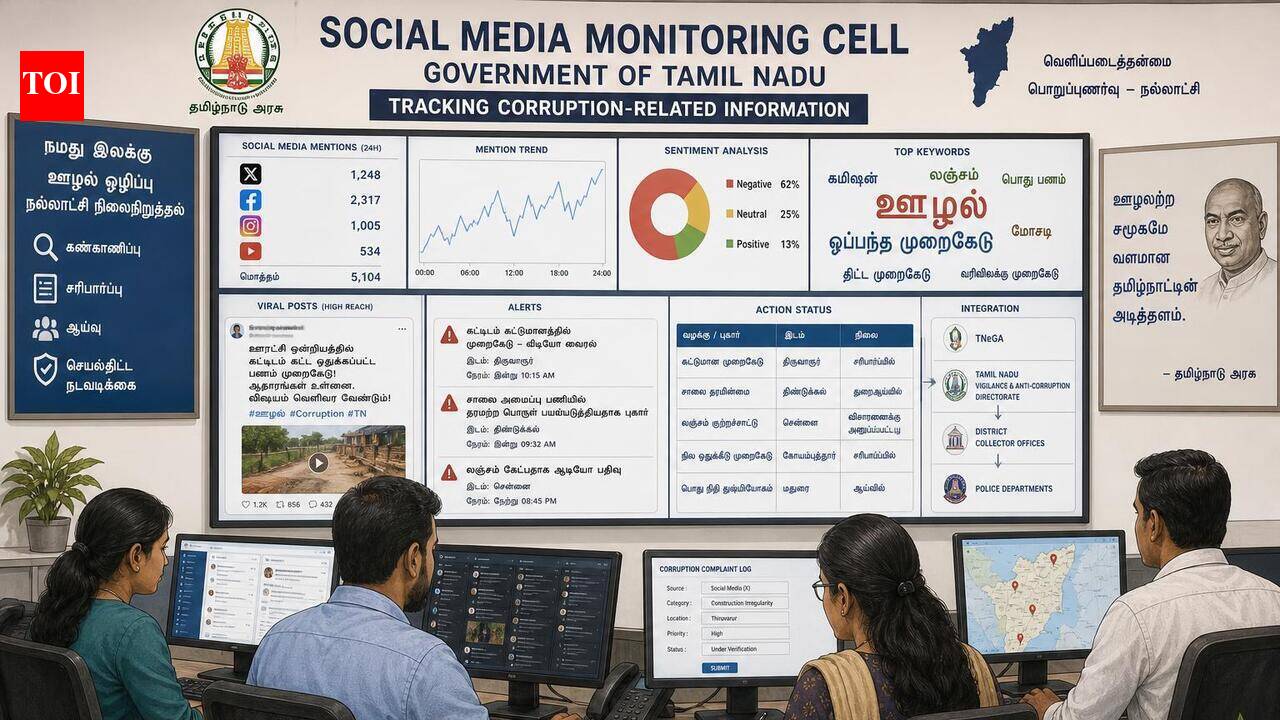
Chennai: In a landmark move to fortify the state’s administrative integrity and harness the power of digital intelligence, the Tamil Nadu government has officially announced the establishment of a dedicated Social Media Monitoring Centre (SMMC) under the Directorate of Vigilance and Anti-Corruption (DVAC). Allocated a substantial initial budget of ₹50 lakh, this high-tech facility is designed to function as the vanguard of digital vigilance, meticulously tracking corruption-related information that surfaces across the vast expanse of public domains, social media platforms, and instantaneous television news broadcasts. The announcement, delivered by Human Resources Management Minister D. Sarathkumar, signals a paradigm shift in how the state perceives the intersection of technology, public opinion, and law enforcement. Recognizing that the instantaneous nature of the internet often serves as the genesis for uncovering illicit activities or administrative malpractice, the SMMC is poised to act as a crucial bridge between digital whispers and formal legal scrutiny. This initiative reflects a global trend where open-source intelligence (OSINT) is becoming a cornerstone of modern policing and anti-corruption strategies, moving beyond traditional physical evidence gathering to proactively intercept the digital footprints left behind by wrongdoers in their unguarded moments of online boastfulness or through the investigative diligence of ordinary citizens.
The rationale behind this ambitious project, as articulated by Minister Sarathkumar, underscores a critical operational gap that has long plagued the vigilance wing of the state. He noted that information pertaining to corruption—ranging from formal public complaints, whistleblower disclosures, and viral social media posts to undercover sting operation footage and flash reports from news channels—often emerges first on platforms like X (formerly Twitter), Facebook, YouTube, WhatsApp, and instant messaging communities. However, the DVAC, traditionally equipped for physical evidence collection and conventional investigation, lacked the dedicated infrastructure to systematically, continuously, and efficiently monitor such volatile digital content. The minister highlighted a palpable and growing risk: the ephemeral nature of social media means that crucial electronic evidence could be deleted by the original poster, removed by platform moderators due to terms of service violations, or simply vanish into the void of the internet through algorithmic changes or account suspension before it is officially collected, documented, and secured by state machinery. This window of vulnerability has, in the past, allowed several high-profile corruption leads to fizzle out due to evidentiary gaps or the unavailability of the original digital artifact. By establishing this dedicated monitoring cell, the government aims to preemptively and automatically capture this data in real-time, ensuring that the digital footprint of corruption is frozen in a secure, immutable state and immediately made admissible in judicial proceedings, thereby lending unprecedented teeth to the state’s anti-corruption crusade.
The operational blueprint of the SMMC is meticulously engineered for relentless observation, failsafe data management, and legal robustness. Operating on a strict 24/7 surveillance protocol, the centre will be equipped with cutting-edge hardware and software systems, including a centralized recording and storage server capable of handling massive volumes of audiovisual data, high-resolution display panels for real-time monitoring across multiple concurrent feeds, and dedicated workstations for analytical staff to conduct deep-dive investigations. To guarantee that the surveillance net never slips, the facility will be fully backed by an Uninterrupted Power Supply (UPS) system and robust redundancies in networking facilities, ensuring that the vigilant eye of the DVAC never blinks, even during power fluctuations, natural disasters, or network outages. Manpower for this ambitious project comprises a dedicated, specially selected team of ten personnel, structured hierarchically to ensure clear command and control dynamics: one Inspector will lead the unit and make strategic deployment decisions, supported by three Sub-Inspectors who will oversee shift operations and preliminary data triage, three Head Constables for technical execution and systemic monitoring, and three Constables for auxiliary documentation and logging support. This team will be rigorously trained in digital forensics, social media analytics, legal compliance under the Information Technology Act and the Indian Evidence Act, and specialized chain-of-custody preservation protocols, ensuring that the raw data collected is not only stored securely but also legally vetted for its probative value and evidentiary integrity, effectively transforming chaotic, unverified online chatter into structured, actionable, and court-admissible intelligence for investigating agencies.
Concurrent with the establishment of the SMMC, the state government is aggressively pursuing a parallel agenda of administrative simplification and transparency through the ‘SimpleGov’ initiative, as highlighted by the minister during the same announcement. This comprehensive digital push aims to digitize a staggering 150 government services, spanning essential approvals, permissions, licensing, and No Objection Certificates (NOCs) that are vital for both individual citizens and the business community. The rationale behind this massive digitization effort is intrinsically two-fold: to exponentially enhance the ease of doing business within the state, thereby attracting investment and stimulating economic growth, and to fundamentally alter the very dynamics of the citizen-government interface. By migrating these services to a fully online, end-to-end digital ecosystem, the government effectively removes the physical touchpoints between bureaucrats, intermediaries, and citizens, which have historically served as fertile grounds for petty corruption, rent-seeking behavior, and opaque discretionary decision-making. The transition to a fully digital approval matrix ensures that applications are registered, routed, processed, and sanctioned based on objective, time-stamped, and rule-based digital workflows rather than subjective human intervention. This not only drastically reduces the turnaround time for businesses and ordinary citizens but also creates an intrinsic, unalterable digital audit trail that makes corrupt practices demonstrably difficult, if not practically impossible, to conceal. The strategic synergy between the SimpleGov initiative and the SMMC is starkly apparent: while the former proactively reduces the opportunities for corruption at the front end by eliminating human mediation, the latter acts as a ruthless, omnipresent sentinel at the back end, monitoring public sentiment and viral reports for any residual incidents of misconduct or coercion that might still leak into the public consciousness.
In a significant expansion of the state’s digital empowerment portfolio, which showcases a holistic approach to leveraging technology for governance, Minister Sarathkumar also unveiled plans for a dedicated learning mobile application named “Vettri Paadhai” (Path to Success). Developed at an estimated cost of ₹20 lakh, this platform is strategically designed to democratize access to high-quality educational resources for the millions of job aspirants in Tamil Nadu who are vying for lucrative, stable careers in the government sector. Considering the fiercely competitive, high-stakes landscape of state and central recruitment examinations—including the Staff Selection Commission (SSC) for central govt posts, the Railway Recruitment Board (RRB) for railway jobs, the Institute of Banking Personnel Selection (IBPS) for public sector banks, and the Tamil Nadu Public Service Commission (TNPSC) for various state services—the app serves as a powerful leveling instrument for candidates who lack the financial means or geographical proximity to afford expensive private coaching academies in metropolitan hubs. By offering a comprehensive digital learning environment entirely free or at a nominal cost accessible directly on one’s smartphone, the government aims to decisively bridge the urban-rural and rich-poor divides that often determine success in such ultra-competitive examinations. The initiative is a direct acknowledgment that raw talent and intellect are evenly distributed across the demographic spectrum, but structured opportunity and preparatory resources are not, and it seeks to rectify this systemic imbalance through proactive, benevolent state intervention in the ed-tech space.
Ultimately, the “Vettri Paadhai” app is engineered to be far more than just a static repository of downloadable PDFs or recorded videos; it incorporates a suite of modern, interactive, and adaptive features designed to maximize candidate preparation, engagement, and outcome success. Key functionalities include access to live interactive classes conducted by subject matter experts and guest educators, comprehensive and high-quality recorded lectures for flexible self-paced learning, and an extensive repository of mock examinations that closely simulate the actual test environment, including time constraints and difficulty variances. Furthermore, aspirants will benefit from a vast, continuously updated practice question bank spanning multiple subjects and decades of previous papers, detailed and logically explained answer keys for self-assessment, and cutting-edge performance tracking analytics. These advanced analytical tools will allow candidates to generate personalized reports that identify their specific weak areas, track their progress over time with granular precision, and dynamically tailor their study schedules accordingly—effectively mimicking the personalized attention and diagnostic capabilities offered only by high-end, expensive tutoring centers. Looking at the broader picture, the twin announcements made by Minister Sarathkumar—the SMMC for robust anti-corruption vigilance and the Vettri Paadhai app for aspirational employment and skill building—underscore the Tamil Nadu government’s unwavering commitment to leveraging technology as a dual-edged sword: one that actively cuts down graft, inefficiency, and administrative inertia while simultaneously paving the way for a more skilled, informed, competitive, and empowered citizenry. It marks a mature, holistic policy approach where digital infrastructure is not merely a tool for surveillance and enforcement, but also a potent catalyst for equitable socio-economic advancement and the creation of a meritocratic future for the state’s youth.


