




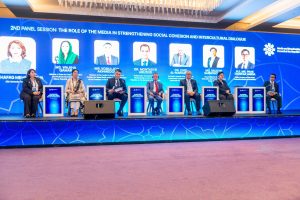



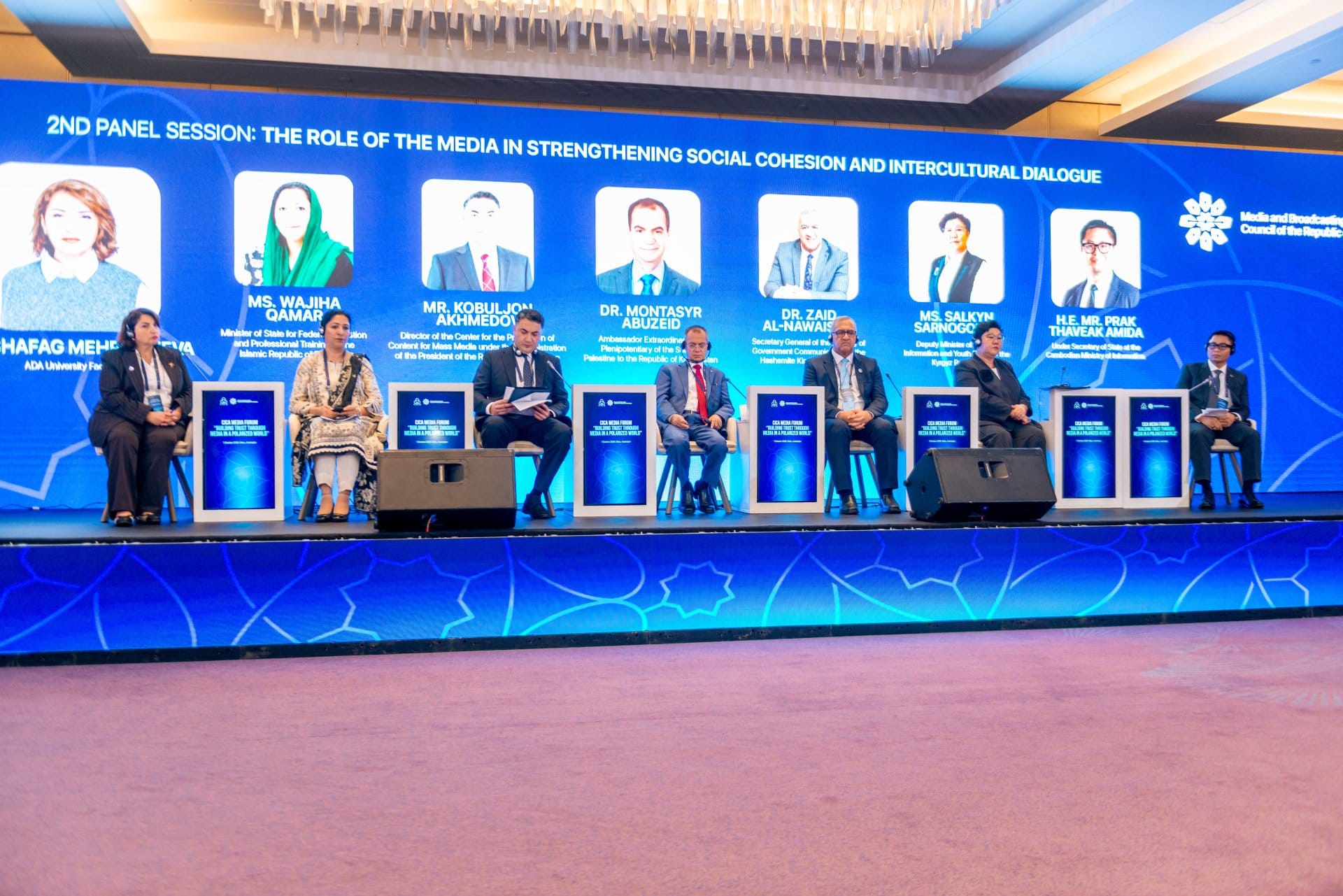
BAKU, Azerbaijan — A senior Cambodian official has called on global media organisations to strengthen their fact-checking standards and to provide space for differing views, warning that artificial intelligence and social media are making misleading and manipulated content far easier to spread. Prak Thaveak Amida, undersecretary of state at Cambodia’s Ministry of Information, issued the appeal on October 1 at the inaugural Conference on Interaction and Confidence-Building Measures in Asia (CICA) Media Forum, held in the Azerbaijani capital. Amida was representing Information Minister Neth Pheaktra at a roundtable session titled “The Role of the Media in Strengthening Social Cohesion and Intercultural Dialogue.” In his address, Amida argued that reliable information, fair representation and respectful discussion are essential ingredients for strengthening social cohesion in any country. “Social cohesion does not depend on everyone holding the same view. It depends, in part, on the ability to examine differing views on the basis of verified information and with respect for those involved,” he said. “Responsible journalism helps sustain that common ground, especially when an issue is sensitive or public emotions are strong,” he added. The forum was organised by Azerbaijan’s Media Development Agency under the theme “Building Trust through Media in a Polarised World.” It brought together senior government officials, media leaders and communication specialists from CICA member countries to discuss public trust, ethical reporting and regional media cooperation. CICA, which began as an initiative of Kazakhstan and now counts many Asian nations among its members, has long concentrated on confidence-building measures in the military and political spheres. The Baku conference marked the first time the organisation devoted an entire forum to the media’s role, signalling a recognition that trust in the information space is inseparable from trust between nations. According to Cambodia’s Ministry of Information, Amida’s participation formed part of the country’s contribution to that new dialogue.
The day-long forum comprised two roundtable sessions, according to the Cambodian ministry. The first was devoted to initiatives, cooperation and results achieved under Azerbaijan’s current CICA chairmanship, offering member states a chance to review the organisation’s recent activities and to identify areas where cooperation could be deepened. The second session, titled “The Role of the Media in Strengthening Social Cohesion and Intercultural Dialogue,” included representatives from Pakistan, Uzbekistan, Kazakhstan, Jordan and Kyrgyzstan, in addition to Amida. The panel was moderated by Shafag Mehraliyeva, a faculty member at ADA University in Baku. During that session, participants reflected on how media can contribute to social cohesion in societies that are often deeply divided by religion, ethnicity, nationality or political affiliation. They also considered how journalists can maintain their independence and credibility in an environment shaped by algorithms and commercial pressures. The fact that the session brought together such a diverse group of Asian states underlined a shared recognition that the media’s role cannot be reduced to a single model; different societies may require different approaches to balancing press freedom, national harmony and intercultural dialogue. Still, there was convergence around the idea that accurate, fair and respectful journalism is an indispensable public good. The forum’s setting in Baku, under Azerbaijan’s CICA chairmanship, was also expressive of an emerging Eurasian media space in which regional powers and smaller states alike are seeking to diversify the sources of information available to their citizens. For delegates from Central Asia, South Asia, the Middle East and Southeast Asia, the meeting was a chance to compare experiences with misinformation, social media regulation and public broadcasting in settings that ranged from parliamentary democracies to more state-centred systems. In this sense, the forum was less a lecture about universal standards than an exchange of practical approaches. The discussions, according to participants, were candid and detailed, with a focus on what has worked — and what has not — in different national contexts.
Throughout his remarks, Amida returned to the accelerating transformation of the information landscape. Social media and artificial intelligence, he acknowledged, have expanded opportunities for people to communicate, learn about other cultures and participate in public debate. But they have also lowered the cost of producing falsehoods and made manipulated content more accessible and more believable. “Such content can deepen distrust if it is accepted or shared without scrutiny,” he warned. A photograph can be altered in seconds; a voice can be cloned; a video can be fabricated; a false accusation can be laundered through dozens of accounts before anyone has examined it. In that environment, the distinction between professional journalism and viral speculation becomes ever more important. Amida highlighted Cambodia’s “Say No to Fake News” campaign as a practical response. The campaign encourages citizens to check the source, evidence and context of information before deciding to share it. “These skills help citizens engage with information responsibly and support dialogue based on facts rather than suspicion,” he said. The initiative is part of a wider effort by the Cambodian government to promote media literacy, especially among young people, who are the heaviest users of social platforms. Amida’s emphasis on fact-checking was not limited to ordinary users. He explicitly called on global media organisations to invest in verification and to treat the need for accuracy as prior to the need for speed. In his view, verification cannot be restricted to specialised fact-checking units; it must be woven into the reporting process at every stage, from initial research to final publication. According to the ministry, discussions in Baku also covered strategies to counter misinformation, strengthen journalism ethics and manage the opportunities and risks that artificial intelligence presents for media organisations. The conversations acknowledged that AI could make journalists more efficient, for example by helping them analyse data or translate languages, but that it also creates new vulnerabilities. Deepfakes, automated bot networks and algorithmically amplified outrage are no longer hypothetical; they are everyday realities. There was also concern that the same tools that allow journalists to search vast databases and visualise complex stories also allow bad actors to manufacture evidence, impersonate officials and saturate comment sections with abuse. The common thread in the Baku discussions was that technical tools must be paired with human judgment, transparent standards and public education. Without those safeguards, the credibility of all media — traditional and digital, global and local — is at risk.
Amida stressed, however, that verification alone is not enough to build social cohesion. Journalists must also think carefully about how they represent culture, identity and belief. Reporting on such subjects, he said, should include the voices of the people directly concerned and enough context to make their experiences understandable. “An isolated incident should not be allowed to define an entire community. Accuracy, thoughtful language and professional judgment can help prevent misunderstanding from taking root,” he observed. The warning was particularly relevant in an international news environment in which coverage of religious, ethnic and national groups is often dominated by conflict, crime or exoticism. A single terrorist attack can reframe public perception of a whole faith; a single violent protest can obscure the diversity of opinion within a community; a single scandal can erase decades of constructive contribution. To counter this, Amida proposed three ways in which the media could strengthen social cohesion. The first is fair and accurate representation that portrays communities in their full complexity rather than as stereotypes. The second is coverage that makes intercultural dialogue part of everyday public life, rather than confining it to special events or official occasions. The third is the creation of credible platforms for constructive discussion of differences, where disagreement is allowed but contempt is not. These three pillars, he argued, would help societies handle sensitive issues more calmly and prevent small misunderstandings from becoming large fractures. He also suggested that when journalists choose examples and anecdotes, they should be mindful of their power to shape audiences’ perceptions of entire groups. The media’s daily decisions — headlines, pictures, quotations, placement on a website — are not neutral technical choices; they are acts of definition. In a region as diverse as Asia, where histories of colonialism, migration, religion and ethnic coexistence have produced intricate social fabrics, such care is particularly important. Amida’s approach implied that journalists should regard themselves as participants in society, not merely observers of it — a position that carries both ethical responsibilities and public trust.
Amida also linked his argument to Cambodia’s experience as a member of the Association of Southeast Asian Nations (ASEAN), a region whose many languages, cultures, traditions and histories put a special burden on journalists to consider how their coverage shapes perceptions of other communities. Media, he said, could help audiences appreciate that diversity while also recognising shared experiences and aspirations. He pointed to stories of cooperation in schools, workplaces and communities as powerful examples of how people from different backgrounds can address common concerns together. Such stories, he argued, deserve more attention because they provide public models of coexistence and remind readers and viewers that difference does not have to mean discord. To bring these experiences across borders, he suggested, there should be more exchanges among journalists in CICA member countries and more jointly produced content. This would allow audiences to learn about other societies through the voices of their own people — rather than through the mediated lens of distant news agencies or social media algorithms. Cambodia, he added, welcomed cooperation among CICA media institutions and professionals on responsible reporting, verification, media literacy and the responsible use of emerging technologies. He also expressed support for joint content production that presented participating countries’ cultures and experiences with authenticity and respect. These proposals are significant because they move the discussion from defensive measures, such as debunking falsehoods, to affirmative storytelling. If countries can collaborate on producing films, documentaries, news features and digital series, they can create a richer picture of their neighbours than crisis-driven coverage typically provides. They can also establish relationships of trust among journalists that survive political ups and downs. Cambodia’s participation in the CICA Media Forum, in this sense, was not merely diplomatic courtesy; it was a statement of intent to be active in shaping the emerging regional media order. Amida’s remarks suggested a particular vision of Asia: one in which media systems respect national sovereignty but remain open to cross-border cooperation, and in which journalists are empowered to report critically yet fairly, with an eye to the long-term health of the communities they serve. That vision resonates with ASEAN’s own commitment to “unity in diversity,” a principle Cambodia has long championed.
Amida concluded that the media’s contribution to social cohesion depends in large part on the editorial choices made by newsrooms every day. Whose voices are heard? Which claims are verified? How are conflicts and differences explained? These questions determine whether journalism adds to social trust or subtracts from it. “When those decisions are guided by accuracy, fairness and respect, the media do more than inform. They help build the trust that allows dialogue to flourish,” he said. The first CICA Media Forum provided a rare opportunity for Asian officials and media professionals to discuss these issues in a structured diplomatic setting. It acknowledged that in a polarised world, the search for trust must happen not only between governments but also between citizens and the platforms, publications and broadcasters that shape their understanding of reality. Cambodia’s message in Baku was that no society can afford to treat journalism as a mere industry; it is a civic institution with a direct impact on peace. The country’s own experience — including the “Say No to Fake News” campaign and its calls for media literacy — reflects a conviction that governments, citizens and journalists share responsibility for the health of the public sphere. As artificial intelligence continues to evolve and social media becomes even more deeply embedded in daily life, the challenges highlighted by Amida are unlikely to diminish. They may intensify. In that context, his call for stronger fact-checking, greater fairness and more space for differing views was not simply an appeal to journalists. It was an invitation to build a culture in which information is treated with seriousness, and in which the common bonds of society are stronger than the forces that seek to pull them apart. For the CICA forum itself, the task now is to turn words into action. Concrete follow-ups could include training exchanges for journalists, joint verification standards, multilingual content-sharing platforms and regular regional media forums; Cambodia has already indicated it supports such steps. The Baku meeting may thus be remembered as the moment when CICA, a body originally designed to manage security relations among states, began to take the media seriously as a partner in building trust. If that happens, Amida’s speech will have contributed to a meaningful shift in how Asian countries understand the role of journalism in international affairs.


