








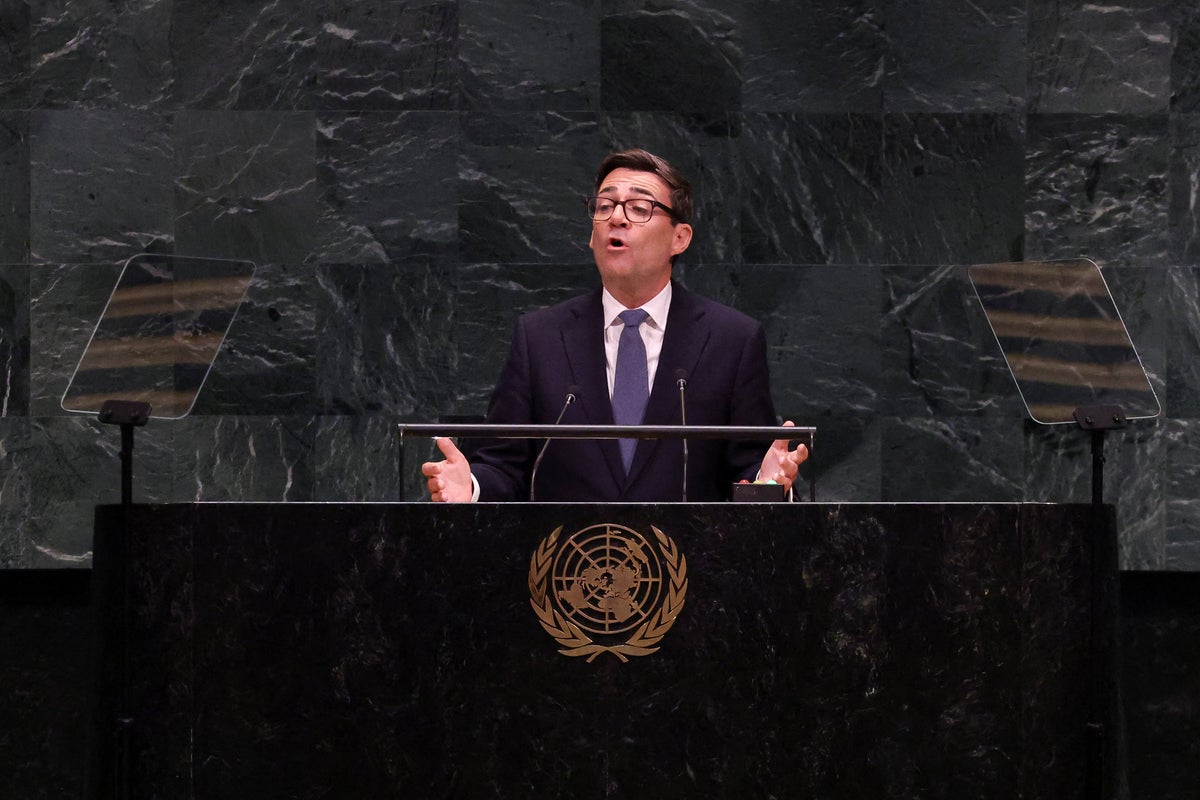
The Prime Minister has accused Russia of exploiting the divisions and societal damage left by Brexit to target the United Kingdom with a sustained, industrial-scale information war, using his address to the United Nations General Assembly in New York to announce a new National Centre for Information Defence. In a speech in which he told world leaders that Britain’s experience of the past ten years had given it a unique perspective, he acknowledged the scale of Moscow’s operations, from bogus websites and forged newspaper articles to amplified far-right narratives, and insisted the new centre would help restore public resilience against foreign manipulation. The centre, initially led out of the Office for the Prime Minister and Cabinet, is designed to co-ordinate intelligence agencies, police, government departments and social media companies in a whole-of-society response to hostile information activity. The Prime Minister said the UK and its allies had been subjected to an assault that was carefully designed to prey on fear, and that Britain’s post-referendum period had made the country both a target and a laboratory for the Kremlin’s methods. “In recent years we have seen an industrial-scale assault by hostile actors on the information environment in the UK and many of our allies,” he told the UN. “Russian agencies have used every means at their disposal to spread lies and disinformation and prey on people’s fears.” He added a deeply personal framing rooted in Britain’s recent history: “It is now ten years since Brexit, my country has lived through the destruction, and it has given us a unique perspective that I want to share with you today.”
The Prime Minister’s speech marked a significant escalation in how the British state is choosing to talk about information warfare. Rather than treating disinformation as a narrow technical concern for social media platforms or security services, he placed it at the centre of a democratic emergency. In a detailed and at times blunt indictment of Russian behaviour, he said Moscow had used every instrument available to saturate the British public sphere with falsified material engineered to inflame existing tensions. The Prime Minister specifically cited bots and fake websites, fabricated newspaper articles, and the forged branding of 28 British organisations, including universities and the BBC. He said Russian operatives had amplified far-right narratives and had attempted to interfere in the 2019 general election. He also warned that the same actors had tried to exploit moments of national grief and public shock after horrific events, saying: “The idea that anyone would try to use such things to their advantage is just repulsive – but it is what they do.” This was a direct reference to the Kremlin’s long-standing technique of using social media to stoke anger and confusion after terrorist attacks, protests, and other events that naturally produce fear and uncertainty. The Prime Minister went on to quantify the severity of the threat, pointing out that the Kremlin spends approximately £1.3 billion each year on manipulating information. He described this as an insidious campaign that reaches into people’s homes and twists how they feel about their own country and community, creating what he called “a narrative of decline, stoking division and sowing despair”. That choice of language was significant: it suggested that the ultimate aim of Russian disinformation is not merely to influence an election or boost one faction, but to corrode the basic sense of national confidence and social trust on which democracy depends.
The Prime Minister suggested that some of the most vulnerable targets of this campaign were out-of-work young people, who may be more exposed to online radicalisation, false conspiracy theories, and far-right content that offers simple explanations for complex problems. He argued that disinformation had become more dangerous in recent years because it preys on genuine social grievances and amplifies them in ways that overwhelm public discourse. The aftermath of Brexit, he said, had created a particularly fertile environment for such operations, because the country had already become divided along lines of identity, geography, and political affiliation. His speech implied that the referendum itself had become a kind of raw material for hostile actors, an undeniable national rupture that could be exploited for years. By acknowledging that Britain had lived through the destruction of divided politics, the Prime Minister was not only warning other nations about Russia’s playbook; he was also positioning the United Kingdom as a reluctant expert in the field of foreign interference. The idea that the country’s “unique perspective” could now help other democracies is a central part of the new centre’s mission. In effect, the British government is saying that the country learned hard lessons through its own exposure to information manipulation, and that those lessons can now be shared with allies who have not yet experienced the same shock. This is a significant shift in tone from the years immediately after the referendum, when politicians were reluctant to associate Brexit with foreign interference. Now the government is openly connecting the two, treating the experience as both a national wound and a source of strategic insight.
The new National Centre for Information Defence is being set up as a response to what officials described as an evolving and increasingly aggressive threat landscape. It will initially be led from the Office for the Prime Minister and Cabinet, giving it authority to co-ordinate across government rather than being confined to a single department. Its work will sit alongside the intelligence services, the police, and the security agencies, but it will also have a public-facing role in exposing and rebutting disinformation. Social media companies, which have often been reluctant to act against state-linked influence campaigns, will be expected to partner with the new body in identifying Russian-linked networks and removing fake accounts. The centre will also be involved in strengthening the wider information environment by promoting media literacy and helping citizens understand when they are being manipulated. The Prime Minister warned that the threat was not static. He noted that UK companies and institutions had already been targeted by cyber-attacks, and he said the rapid development of artificial intelligence would multiply the danger. AI tools, he argued, would allow hostile states to generate convincing fake content at an unprecedented scale, making it harder than ever for people to separate truth from fiction. This is why, he said, the state must think seriously about defending the information environment in the same way that it defends physical infrastructure. The speech was not just an announcement of a new body; it was an argument that information defence must be treated as a core function of modern democratic government.
Speaking to the BBC after the announcement, cabinet minister Wes Streeting echoed the Prime Minister’s warnings and set out the wider security logic behind the new centre. Streeting argued that the UK needed to think carefully about the increasingly challenging propaganda war being waged by state threats like Russia, as well as by hostile non-state actors who seek to exploit open societies. He described a situation in which the Kremlin and others were actively trying to sow misinformation in order to give Britons a warped sense of what is happening in their own country, with the goal of making it harder for people to separate fact from fiction and reach their own informed conclusions. Streeting drew a powerful analogy, saying that just as the UK thinks about defending its underwater cables and its satellites in space, it must also think about how to defend democracy itself from interference. His remarks underlined a growing recognition among Western governments that information warfare is no longer a peripheral issue, but is now part of the central security challenge of the age. The creation of the National Centre for Information Defence is therefore not merely a technical initiative, but a statement of intent: the British state is prepared to name the threat, organise against it, and invite the public into that defence effort. There are, of course, difficult questions about how such a centre can operate without becoming a tool of government censorship or political bias. The policy response will have to be transparent, based on evidence, and subject to independent oversight. The government appears aware of that tension, which is why the centre is designed to work alongside social media companies and intelligence agencies rather than to act as a standalone propaganda watchdog. The challenge, however, is immense. Russian information operations have become so integrated into the everyday online environment that many people no longer notice them; they simply absorb false messages as part of the background noise of the internet.
In the final part of his address, the Prime Minister sought to translate Britain’s difficult experience into a practical offer of help to other countries. “So we are going to use our experience in the UK – and the fact that we have already been through this shock – to help other countries,” he said. This is a message likely to resonate with European allies, many of which have faced their own campaigns of Russian disinformation in recent years, and with democratic institutions around the world that are struggling to respond to new forms of online manipulation. The creation of the National Centre for Information Defence is an attempt to turn that shared vulnerability into a platform for international co-operation. The broader political context is also important. The Prime Minister’s speech came after years of discussion, particularly among pro-European campaigners, about how Britain can rebuild its future in Europe and rebuild public trust after Brexit. The decision to link Russian disinformation directly to the political damage of Brexit suggests that the government now believes the two are impossible to separate. It also signals a willingness to confront one of the most uncomfortable episodes in modern British political history: the period after the referendum, when public discourse became increasingly polarised and foreign actors moved to take advantage of that instability. The new centre will not be able to undo those years overnight, nor will it be able to eliminate disinformation from the internet. But by directly acknowledging the scale of the threat, and by building an institution to counter it, the Prime Minister has placed information defence at the heart of Britain’s democratic resilience. The speech was a warning, a confession, and a proposed solution all at once. It recognised that the country has been wounded by hostile information operations, but also that it has learned something valuable from that experience. Whether that lesson can now be converted into effective action will depend on the resources, powers, and credibility that the new centre is given, and on whether other countries are willing to accept Britain’s offer of help. What is no longer in question is the gravity of the threat. The Prime Minister’s words at the United Nations made clear that Russia has treated the United Kingdom as a testing ground for disinformation, and that the consequences of that experiment have been felt across the country’s political life. The National Centre for Information Defence is an acknowledgment that the era of passive defence is over. It is also an invitation for the public to become more aware of the manipulation surrounding them. In a speech that was at times startlingly frank, the Prime Minister reminded the world that the next great battle for democracy may not be fought with tanks or missiles alone, but with bots, forged stories, and carefully engineered lies.


