







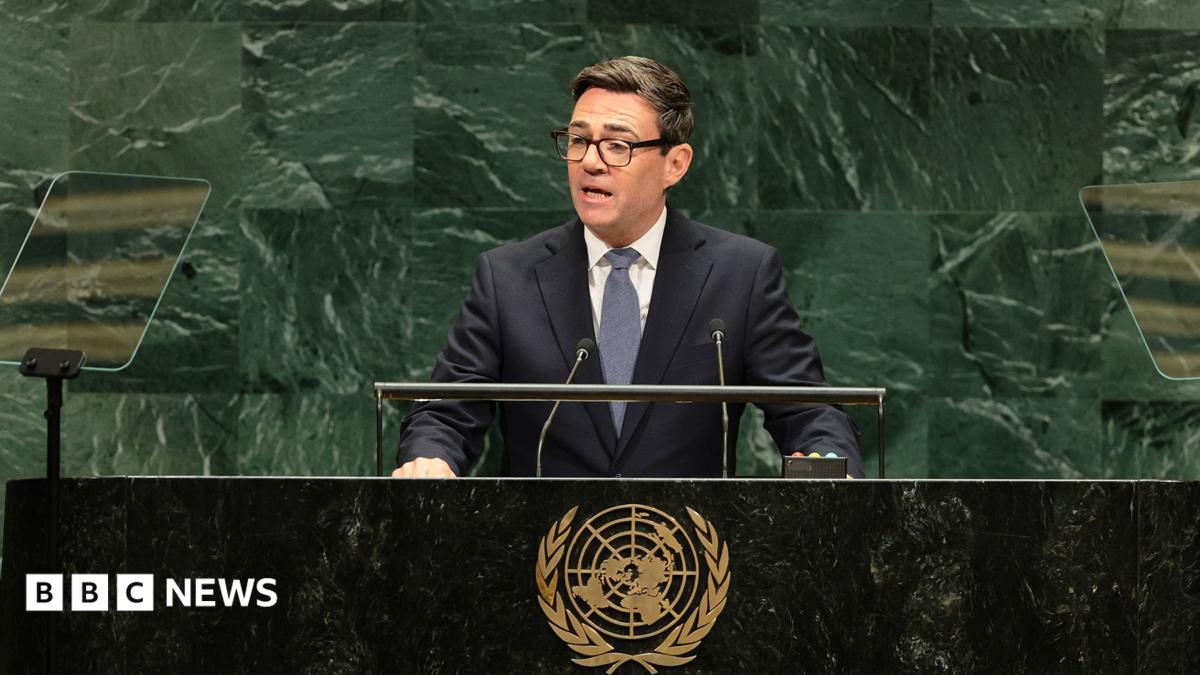
The United Kingdom is preparing to establish a new centre dedicated to countering the rising threat of disinformation, Prime Minister Andy Burnham has announced, using his first major international speech at the United Nations General Assembly in New York City to warn that Russian agencies are engaged in an increasingly sophisticated campaign against Western democracies. Describing the effort as a need to “stem the poisonous tide,” Burnham told assembled world leaders that the Kremlin spends roughly £1.3 billion every year on manipulating information, using an arsenal of tools that includes social media bots, fake websites, falsified newspaper articles, and the forged branding of British institutions such as universities and the BBC. He described an “insidious campaign” designed to reach into people’s homes, twist their sense of national identity, create a narrative of decline, stoke division, and sow despair. The prime minister’s speech represented a significant escalation in the UK’s public response to hostile state activity, coming at a time when fears about the misuse of artificial intelligence have grown following stark warnings from technology industry insiders that AI could ultimately threaten humanity itself. Burnham argued that artificial intelligence will “multiply” existing threats and pitched the UK as an “honest broker” on the technology, calling for global standards to govern its deployment and to defend democratic societies against weaponised information.
The prime minister’s address detailed the extent of Russian interference operations, which he said have included cyber-attacks on British companies and institutions as well as the manipulation of public discourse. He referenced the 2019 UK general election, in which the British government previously said Russia had almost certainly sought to interfere, and made clear that the new threats are being driven not just by traditional espionage but by an information warfare apparatus that operates openly and at scale. Burnham’s language was notably blunt, accusing the Kremlin of running a disinformation campaign that exploits the very openness of democratic societies, and warning that the combination of foreign manipulation and advanced AI could create an environment in which citizens cannot trust what they see, read, or hear. He argued that hostile states are using every means at their disposal to undermine confidence in democratic institutions and to weaken the social cohesion that sustains them. The speech was carefully timed to coincide with high-level UN discussions about the future of artificial intelligence and the global digital order, and it sought to place the UK at the centre of the push for international cooperation on these issues. Burnham’s framing of the UK as an honest broker was an attempt to distinguish British leadership from the more confrontational approaches taken by some other major powers, while also acknowledging that the problem of disinformation cannot be solved by any one country acting alone. He called on the international community to take collective action, warning that the threats are not limited to one nation or region but affect every country that relies on an informed citizenry.
To give substance to this effort, Burnham announced the creation of a new National Centre for Information Defence, an institution tasked with detecting and disrupting AI-enabled disinformation campaigns carried out by hostile states. The centre will work alongside intelligence agencies, government departments, law enforcement bodies, and social media platforms to bring together expertise from across the security and technology sectors. Its mission, according to the prime minister, is to defend the UK against information warfare and to help protect the integrity of elections, public health messaging, and civil discourse more broadly. Burnham said the centre would not simply monitor threats but would actively seek to expose foreign interference, counter false narratives, and build resilience within British society, including by equipping citizens with the critical thinking tools they need to recognise manipulated content. The announcement reflects a growing recognition within Western governments that traditional counter-espionage methods are insufficient to deal with the speed, scale, and sophistication of modern disinformation operations. Unlike a missile strike or a conventional cyber-attack, information campaigns can operate on social media for months or years before they are even noticed, and by the time they are detected, the damage has often already been done. The new centre is intended to address that gap by providing a dedicated focal point for understanding how AI-generated content, deepfakes, bot networks, and fake websites are being deployed against the UK and by developing responses that can be implemented in real time. Burnham’s proposal also includes an international component, with the UK seeking to lead efforts to establish global safety standards for artificial intelligence, ensuring that technologies developed by private companies are not used to undermine democratic processes or spread harmful falsehoods. He stressed that the same tools that power online services, medical research, and economic productivity can also be used as weapons, and that the world must act now to establish clear rules before the threats become even more difficult to control.
The prime minister’s speech inevitably drew attention to the broader state of UK-Russia relations, which have remained deeply strained since the 2020 report on Russian activity in the UK, including its assessment that Moscow had sought to interfere in elections. Russian officials have repeatedly rejected such findings, with Moscow describing the allegations as “Russophobia.” There was no immediate official response from the Kremlin to Burnham’s UN speech, but the Russian representative was sitting in the room listening as the prime minister delivered his remarks. The atmosphere was made more significant by the fact that Russia’s Foreign Minister, Sergei Lavrov, had spoken in Moscow just hours earlier, criticising Western media for embracing what he called “anti-Russian cliches and fantasies” during a forum on disinformation. Lavrov’s remarks were clearly aimed at pre-empting the British prime minister’s address, and they highlighted the extent to which the information war has become a diplomatic battleground within international institutions. Burnham, however, did not respond directly to Lavrov’s comments, instead focusing on the need for practical cooperation among democracies. His announcement of the National Centre for Information Defence was framed as an example of how governments can take concrete steps to protect their citizens without resorting to censorship or other heavy-handed measures. He also sought to reassure the UN General Assembly that the UK would uphold democratic values, including free expression, even as it moved to counter hostile state interference. That balance is likely to be a central challenge for the new centre, as efforts to curb disinformation can easily be seen as an attack on free speech, particularly in a political climate where allegations of foreign interference have become deeply polarising.
The domestic reaction to Burnham’s announcement was immediate, with Reform UK leader Nigel Farage accusing the government of using the real problem of bot accounts from Russia and India interfering in politics as an “excuse” to “clamp down on free speech.” Farage’s comments reflect a strain of opinion that is suspicious of government efforts to police online content, arguing that the same tools used to combat foreign disinformation could be turned against domestic political opponents or legitimate criticism of government policy. That tension has become a recurring theme in British politics, particularly as concerns grow about the influence of social media on elections and public debate. Supporters of the government argue that the threat is real and urgently needs to be addressed, pointing to the evidence of Russian attempts to interfere in Western elections and the increasing use of AI-generated content to manipulate public opinion. They also note that the new centre will focus on foreign hostile actors rather than on regulating ordinary citizens’ speech, and that its job will be to provide information rather than to censor it. Nevertheless, the row over free speech threatens to complicate the UK’s international leadership ambitions, particularly if the government is seen to be using the shadow of foreign interference to justify intrusive controls on the internet. Burnham insisted during his speech that the United Kingdom would not compromise on the principle of free expression, and that the aim was to protect the information ecosystem, not to police thought. He argued that hostile states must not be allowed to exploit openness as a vulnerability, and that democracies can defend themselves without sacrificing the values that make them worth defending in the first place.
Looking ahead, Burnham’s announcement signals an increasingly explicit acknowledgement within Western capitals that the next phase of geopolitical conflict may well take place in the digital information environment, rather than on traditional battlefields. The combination of cheap, powerful AI tools and the global reach of social media means that a single fabricated video, supposedly showing a political leader saying something scandalous, could circulate around the world in a matter of minutes and have real consequences before it is debunked. The UK’s decision to create a dedicated National Centre for Information Defence, with a mandate to detect and disrupt hostile disinformation campaigns, is part of a wider pattern among Western governments, many of which have set up similar units in recent years. But Burnham’s emphasis on global AI safety standards goes a step further, proposing that the international community should agree on common principles for the development and use of machine learning systems that touch on public communication. There are numerous practical challenges ahead, including questions about how such standards could be enforced, how they would be reconciled with the free flow of information, and how they would deal with countries that refuse to sign up. There is also the risk that an over-reaction by democratic states could undermine public trust in any information that contradicts government narratives, no matter how well-founded it may be. Nonetheless, the prime minister’s speech was an attempt to frame the issue as a shared global challenge, one that requires both national resilience and international cooperation. The United Nations provides a natural platform for such an effort, but the organisation’s inability to agree on even basic definitions of disinformation shows how hard it will be to reach consensus. Burnham’s message to the General Assembly was clear: the threats from Russian disinformation are real, artificial intelligence will make them worse, and it is time for the world to come together to defend the truth itself. Whether the UK can translate that rhetorical ambition into meaningful global standards remains to be seen, but the announcement of the new centre is a concrete step, and one that is likely to shape British security policy for years to come.


