


BJP’s New Social Media Team: A Controversial Appointment Amidst Concerns Over Disinformation
The Bharatiya Janata Party (BJP) announced a significant restructuring of its digital presence on August 17, appointing Deepak Mhaskey as the new IT cell in-charge, replacing Amit Malviya in a move that signals a shift in the party’s social media strategy. The party simultaneously named four new social media co-convenors: Priti Gandhi, Shivanand Dwivedi, Alok Bhatt, and Arun Yadav. What immediately followed this announcement was a peculiar and concerning pattern—the social media accounts of these newly appointed officials either vanished entirely or their historical posts became inaccessible to the public. This sudden digital housecleaning raised eyebrows among observers and journalists, who noted that screenshots and archived versions of past tweets containing personal, contentious, and sometimes controversial opinions remained available, suggesting a deliberate attempt to scrub their digital footprints before assuming their new roles.
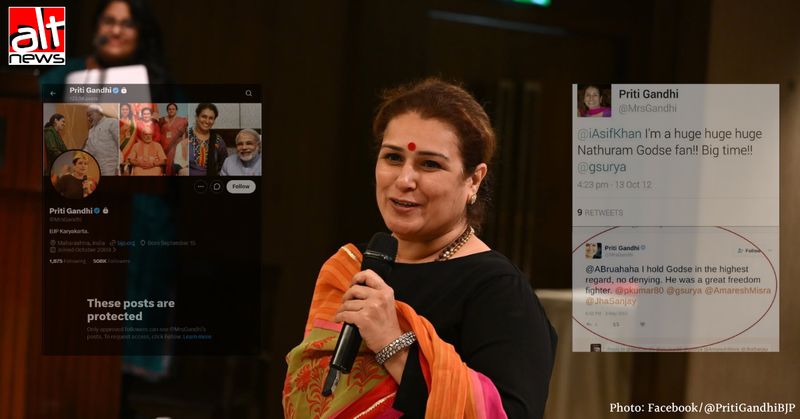
The scale of deletion was particularly striking. Arun Yadav reportedly deleted more than 60,000 posts before making his X handle accessible again, while Mhaskey himself removed at least 1,342 posts from his account. Priti Gandhi, whose X account boasts over 500,000 followers, has now placed her account in a ‘protected’ or hidden mode, with a platform notice stating that “Only approved followers can see @MrsGandhi’s posts.” Alt News observed that Gandhi’s following count decreased from 2,015 to 1,875 handles, indicating she had recently unfollowed 140 X users in an apparent attempt to distance herself from certain connections. When approached for comment about hiding her posts, Gandhi declined to respond, though her Facebook profile describes her role as ‘IT & Social Media National In-charge for all 7 BJP Morchas’ and ‘Official Spokesperson, Maharashtra BJP,’ making her apparent reluctance to engage with media scrutiny particularly noteworthy given her new position of significant responsibility within the party’s digital infrastructure.
Gandhi’s Controversial History: From Godse Admiration to Targeted Attacks
Priti Gandhi’s elevation to co-convenor comes with a trail of deeply controversial statements that have now resurfaced through archived screenshots. Most concerning among these are her repeated expressions of admiration for Nathuram Godse, the assassin of Mahatma Gandhi. In tweets dating back to 2012-13, Gandhi declared herself a “huge fan and follower” of Godse, with multiple posts announcing that she “misses him,” that there is a need for “1000 more Godse’s,” and expressing that “India misses him.” She has also expressed disdain for her surname in older posts, stating she would rather have ‘Modi’ or ‘Godse’ as a surname instead. Perhaps most ironically, given her namesake, she has targeted the Gandhi family politically, including a November 2025 controversy where she criticized Indian cricketer Jemimah Rodrigues over her expression of Christian faith during a post-match interview after India’s semi-final victory against Australia. Gandhi argued that while wearing the Indian jersey, Rodrigues represents all Indians and “not her church,” drawing criticism for her narrow interpretation of religious expression.
Gandhi’s association with the BJP and specifically with Narendra Modi dates back to around 2012, when she operated under the handle @pritirules. Her aggressive anti-Congress posts caught the attention of senior BJP leaders, leading her to change her handle to @MrsGandhi, explaining to The Telegraph that she realized “this name has a lot of potential, as there would be one Gandhi questioning the other.” Modi himself began following her on Twitter in 2012, and she was eventually invited to Gandhinagar to meet him personally. Gandhi explained that Modi appreciated her independent voice defending him on social media. However, her history includes a January 2014 incident where she amplified a false claim that WikiLeaks founder Julian Assange had stated “Modi is incorruptible,” featuring a fabricated poster and quote. WikiLeaks itself responded to correct the misinformation, marking an early example of what would become a pattern of spreading unverified or fabricated content in support of the BJP and Modi.
A Deep-Rooted History of Misinformation and Fact-Checking
Gandhi’s rise within the BJP’s digital ecosystem has been accompanied by a substantial record of disseminating misinformation, as documented extensively by fact-checking organizations including Alt News. In 2019, she circulated an edited video suggesting Rahul Gandhi wanted to leave India permanently. The following year, she revived the ‘potato-gold’ remark, a claim based on a clipped video with distorted context, to mock Rahul Gandhi and mislead the public. During the COVID-19 pandemic in 2021, she shared a misleading video purportedly showing empty streets in Haridwar during the Kumbh Mela, an event that had attracted millions of pilgrims and resulted in thousands of COVID-19 cases. The video she shared was actually shot at Govind Ghat, several kilometers away, and at a time when that specific location wasn’t crowded, misleadingly implying the entire pilgrimage site was empty despite overwhelming evidence to the contrary.
Her misinformation campaigns have also extended to communal and polarizing content. During the 2021 West Bengal post-poll violence, she shared a doctored video showing men wielding swords while dancing to the TMC election song ‘Khela Hobe.’ In another instance, she claimed that “Modi Modi” slogans were raised inside Pakistan’s Parliament, but fact-checkers determined the actual chants were “Voting Voting.” In 2020, she shared an image of Priyanka Gandhi embracing the mother of the Hathras rape victim and falsely described the woman as a “fake Naxal-bhabi,” accusing both Rahul and Priyanka Gandhi of consoling what she claimed was a “Naxal operative who had infiltrated the family’s home.” The same year, she circulated a clipped video of journalist Arfa Khanum Sherwani speaking about the Citizenship Amendment Act (CAA), using the edited footage to distort context and present her speech in a communal light.
Amplification of Harmful Narratives and Conspiracy Theories
A Centre for the Study of Organised Hate (CSOH) paper cited by Newslaundry identified Gandhi among BJP figures who amplified the ‘Love Jihad’ narrative following the killing of Nikita Tomar, a student shot outside her college in Ballabhgarh by a Muslim youth. In an October 2020 tweet reported by Lokmat, Gandhi wrote: “Those in denial of the existence of Love Jihad are only closing their eyes to reality, maybe even purposely. Unless we don’t accept the problem, finding a solution is impossible. Today it is Nikita, tomorrow it could be you!” Notably, the chargesheet in the Nikita Tomar case contained no sections of the IPC related to forced conversions or associated crimes, as reported by the Times of India, making Gandhi’s amplification of the ‘Love Jihad’ conspiracy particularly irresponsible given the evidence.
Her pattern of spreading communal misinformation continued across multiple incidents. In 2019, she shared a clipped video with Bengal BJP to falsely claim communal bias in a speech by then Bengal Chief Minister Mamata Banerjee, cutting out the part where Banerjee had recited Hindu scriptures. In 2021, she shared a video of a man apparently blowing on food, suggesting he was spitting on it with explicit communal framing. In 2022, she falsely claimed that participants at a Popular Front of India (PFI) protest in Pune had raised “Pakistan Zindabad” slogans, when fact-checkers determined the actual slogan was “Popular Front Zindabad.” That same year, she shared a photo of Rahul Gandhi with a girl, falsely identifying her as Amulya Leona, who raised ‘Pakistan Zindabad’ slogans during anti-CAA protests in Bangalore in 2020, when the girl was actually Miva Jolly, an activist associated with the Kerala Students Union, the student wing of Congress. During the 2024 farmers’ protest, she shared an image claiming a farmer was sitting on a Mercedes worth Rs 3 crore to portray protesters as wealthy and illegitimate, but investigation revealed the vehicle was actually a modified Force Motors SUV Gurkha.
Deleting Evidence and Evading Scrutiny
The pattern of deleting evidence by newly appointed BJP social media officials raises serious questions about transparency and accountability within the party’s digital operations. Priti Gandhi, who has now been promoted to a position of significant authority, has a documented history of deleting tweets when challenged. In January 2022, she falsely claimed that Uttar Pradesh BJP MLA Vinay Shakya had been kidnapped after being pressured by the Samajwadi Party to join them. When local police responded to her tweet clarifying that the abduction claim was entirely false, Gandhi deleted the tweet rather than issuing a correction or apology. This pattern of deletion rather than correction suggests a consistent approach to handling misinformation: spread it, face scrutiny, then erase any trace rather than accepting responsibility for the falsehoods propagated.
Interestingly, Gandhi herself has been a target of misinformation, demonstrating that she understands the damage of false claims firsthand. In 2021, a viral thread shared three genuine screenshots of her old posts alongside a fabricated tweet claiming her husband had escaped the Capitol Hill riots. While three of the screenshots were genuine and referred to a single incident (the 26/11 Mumbai attack), the Capitol Hill tweet was entirely fake. The thread gained over 10,000 likes and was amplified by several journalists and Congress members, treating the manufactured tweet as evidence of a pattern. This experience makes her own dissemination of misinformation even more troubling, as she clearly understands the real-world consequences of false information but continues to spread it when it serves her political purposes.
Digital Accountability in the Age of Mass Deletion
The mass deletion of social media posts by newly appointed officials raises fundamental questions about digital accountability and the preservation of public records. When individuals ascending to positions of significant public importance systematically erase years of social media activity, they effectively destroy the historical record of their own statements, positions, and actions. This digital scrubbing is particularly concerning when the individuals involved have long histories of spreading misinformation, false claims, and communal polarizing content. The partisan nature of this approach—deleting evidence of problematic posts while maintaining the accounts themselves—suggests a conscious strategy to avoid public scrutiny of past statements while still maintaining the follower bases and digital infrastructure built through years of aggressive political activity.
The timing of these deletions, immediately following the announcement of their new positions, indicates that the individuals themselves recognized the problematic nature of their past posts. Yet rather than addressing these controversies openly, they chose to hide from them, making it impossible for journalists, fact-checkers, and the public to hold them accountable for their previous statements. This raises broader questions about the transparency of political parties in the digital age and whether appointments to key social media positions should require some level of public accountability for past online behavior. As the BJP continues to lead India’s digital political mobilization efforts, the appointment of individuals with such documented histories of misinformation, communal polarizing content, and reckless sharing of false information raises significant concerns about the party’s commitment to truth and digital responsibility. The protection of accounts and erasure of evidence not only undermines transparency but also destroys the digital public record, making it increasingly difficult for researchers, journalists, and the public to hold powerful figures accountable for their historical statements and actions.
This article was published on August 27, 2026, at 10:06 PM IST. The Wire is now on WhatsApp—follow our channel for sharp analysis and opinions on the latest developments.