








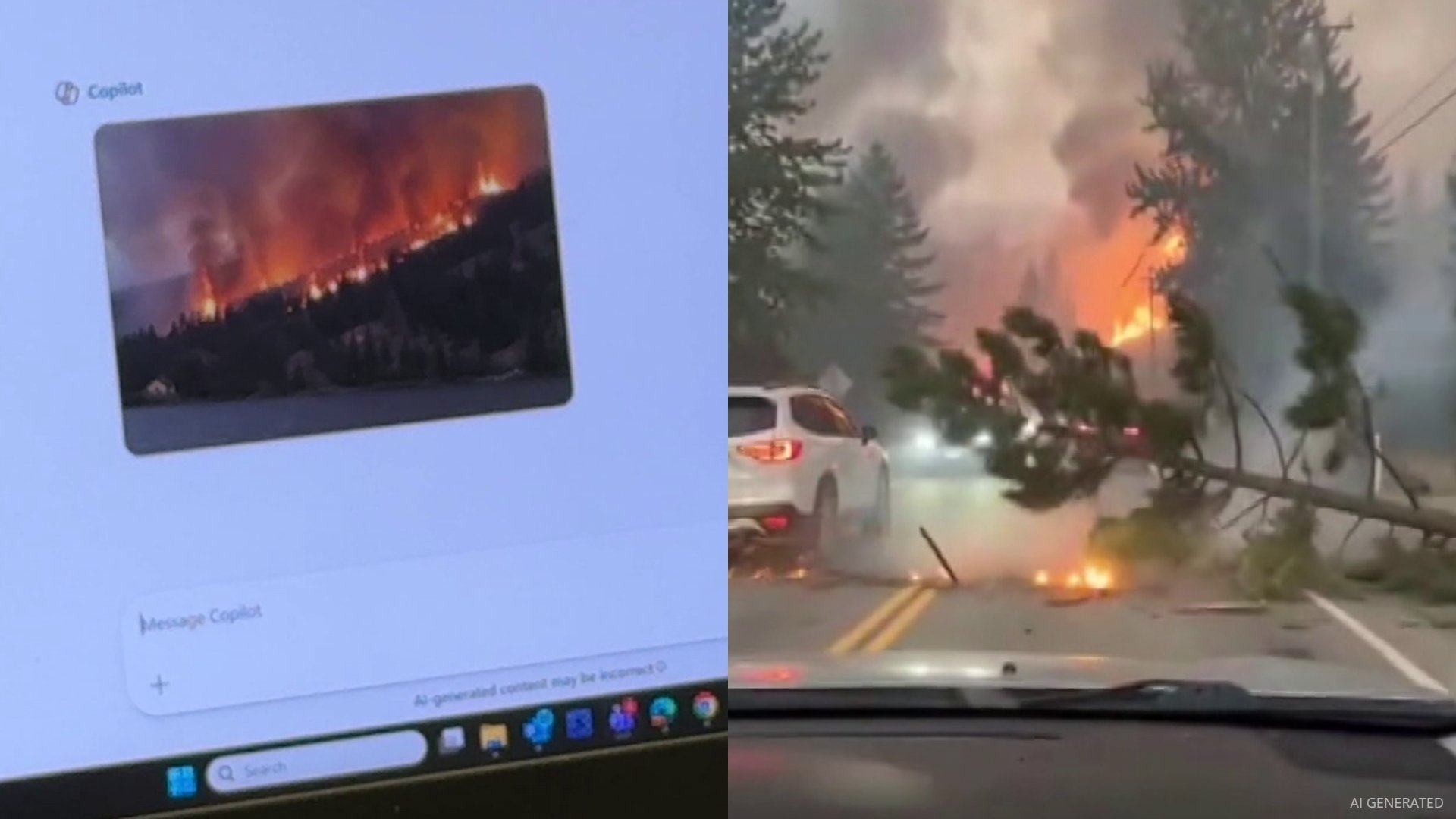
AI Generated Content Fanning the Flames of Misinformation Online: A Growing Threat to Public Safety During Wildfire Season
By Sarah Jones, Senior Correspondent
August 12, 2026 10:00 am MST
As the West braces for another scorching wildfire season, a new and insidious threat is burning through the digital landscape: artificial intelligence-generated content that is intricately weaving fiction into the fabric of real-time disaster reporting. Social media users, desperate for up-to-the-minute updates on evacuations, fire perimeters, and air quality, are finding themselves navigating a minefield of fabricated images, cloned audio warnings, and algorithmically generated news alerts that are stoking confusion and panic. The convergence of a climate-fueled crisis with the unregulated proliferation of generative AI tools has created a perfect storm of misinformation, where the public’s instinct to seek information is being exploited by malicious actors, careless hobbyists, and algorithmically amplified bots. This trend is making it profoundly difficult—and in life-threatening situations, dangerously so—to distinguish between verified facts, well-intentioned but flawed speculation, and outright digital propaganda. The result is a fragmented public sphere where trust in critical safety information is eroding just when it is needed most.
The nature of the AI-generated misinformation circulating during the 2026 wildfire season is sophisticated, adapting to the emotional cadence of the moment. Deepfake videos of firestorms engulfing suburbs that are actually safe, or of officials declaring evacuations that have not been ordered, have become weaponized tools of chaos. These are not merely crude Photoshop jobs; they are high-definition, photorealistic renderings produced by advanced text-to-video models that can synthesize smoke plumes and ember-filled skies with unsettling accuracy. Furthermore, the audio component has evolved to a dangerous degree of fidelity. Reports have surfaced of AI-generated voice clones mimicking local emergency management officials, delivering fabricated mandatory evacuation orders to specific neighborhoods or instructing residents to “shelter in place” when the opposite is the true safety directive. These synthetic clips are often designed to be untraceable, lacking the metadata that would normally tie them back to a source, and they spread relentlessly through local community Facebook groups, Nextdoor, and hyper-local Twitter/X threads, often shared by panicked residents who believe they are helping their neighbors. The speed at which these files propagate—often within minutes of a genuine alert being issued—suggests that the agents creating them are actively monitoring official channels and piggybacking on real events to lend their fiction an aura of legitimacy.
The cascading consequences of this AI-fueled misinformation are not limited to the digital realm; they are and have been translating into real-world harm and wasted resources. Firefighters and emergency dispatchers report being inundated with calls from citizens responding to fake evacuation orders, clogging the very 911 lines that are needed for genuine emergencies. In some counties, unverified AI-generated maps showing massive fire encroachments have led to “spontaneous evacuations” that jammed highways and prevented the safe movement of firefighting apparatus, creating an infrastructure bottleneck that delays actual response times. Similarly, the phenomenon of “whiteout” alerts—AI-generated images showing total sky occlusion and near-zero visibility in areas where the actual conditions are merely smoky—have caused residents to make unnecessary last-minute dashes to hardware stores for masks and supplies, stripping shelves of essential N95 respirators and water that are vital for those in actual danger zones. The psychological toll is equally profound; residents report a creeping sense of “alert fatigue” and paranoia, oscillating between trusting nothing they see and overreacting to everything. This corrosive doubt directly undermines the credibility of legitimate news agencies and government bodies. When people cannot differentiate between a true emergency text from the county sheriff and a viral AI-generated voice memo, the entire civic infrastructure of disaster response begins to crack. Public information officers are now spending more time debunking false claims on X (formerly Twitter) than issuing genuine safety updates, fundamentally derailing their mandate to protect the public. The phenomenon has forced authorities to attach cryptographic hashes and unique identifiers to official press releases and video briefings—a stopgap measure that lags behind the sophistication of the AI tools it is meant to combat.
In response to this escalating crisis, technology platforms and government agencies are scrambling to deploy countermeasures, but the fight is currently asymmetric. Companies like Meta, Google, and TikTok have announced new policies requiring AI-generated content to be watermarked and labeled, and they have expanded fact-checking partnerships specifically for crisis situations. However, enforcement is inconsistent: AI-generated content is often posted without labels, either because creators use open-source models that do not technically embed metadata, or because they deliberately crop, compress, or re-screen the content to strip away its digital signature. During the July 2026 “Cedar Ridge” fire, fact-checkers struggled to keep pace with a viral deepfake news anchor report that routinely outperformed legitimate news coverage in engagement metrics. In response, several state governors have invoked emergency powers to temporarily suspend the immunity granted to social media platforms under Section 230 of the Communications Decency Act, demanding that platforms identify and purge AI-bot networks or face legal liability for the spread of dangerous falsehoods. However, these legal maneuvers are being met with constitutional challenges and fierce lobbying from tech industry groups. On the ground, new grassroots solutions are emerging; “digital neighborhood watch” groups composed of volunteer geologists, meteorologists, and GIS analysts are working round-the-clock to geolocate and verify claims, posting “FAKE” banners over manipulated images. Yet these volunteers admit they are exhausted and overwhelmed, comparing their work to “fighting a hydra”—for every piece of content they disprove, three more appear.
For the average social media user, the burden of discernment has become an exhausting, full-time job. Digital literacy experts advise a “zero-trust” approach to any information received during a disaster, recommending that individuals verify any claim through at least two independent, official sources (e.g., going directly to fire.ca.gov or InciWeb) before taking action. Specific red flags have been identified: AI-generated fire images often contain impossible lighting conditions, absurdly high contrast, or unnatural pixel symmetry in the smoke; AI-voice clones frequently have eerily perfect pronunciation and an unnatural cadence, speaking with a flatness that betrays human emotion. But relying on the public to perform forensic analysis in the middle of a crisis is a flimsy defense. Community leaders are therefore advocating for “pre-bunking” campaigns in the weeks leading up to wildfire season, teaching residents to identify official alert app channels (like FEMA and Wireless Emergency Alerts) and to program those into their phones. The Federal Emergency Management Agency (FEMA) has launched an awareness campaign using PSA-style clips that ironically feature AI-generated “skeletons” and “ghosts” of misinformation, attempting to use the tools of the enemy to educate the public. Still, the psychological reality is that humans are biologically wired to share information that triggers fear—it is an evolutionary survival mechanism. An AI model that generates fear-inducing content is exploiting a hardwired human vulnerability that no amount of fact-checking can fully mitigate. The fundamental architecture of social media algorithms, which rewards virality and emotional engagement over accuracy, remains the primary accelerant fueling this digital fire.
As the 2026 wildfire season continues to burn, this crisis of misinformation serves as a stark case study of the double-edged nature of generative AI. The same technology that provides hyper-localized, real-time mapping and predictive modeling for fire spread is also being used to destabilize communities and endanger lives. It is a race against time, but also a race against the architecture of the internet itself. Without a coordinated, global regulatory framework and a radical redesign of social media amplification algorithms, the problem will only worsen as AI generation becomes cheaper, faster, and more embedded into daily content creation. The onus cannot solely rest on the shoulders of vulnerable residents or exhausted journalists. Industry leaders must move beyond performative safety policies and implement mandated, unremovable provenance authentication for all AI-generated content, while treating disaster misinformation with the same severity as terrorism or child exploitation in their moderation queue. Lawmakers must fund and empower digital forensic units within emergency management agencies to provide real-time counter-narrative dissemination. And society as a whole must renew its commitment to media literacy education, treating the ability to navigate the information ecosystem during a crisis as a core survival skill akin to having a go-bag or an evacuation plan. In an era where a new wildfire can be simulated in less time than it takes a real one to cross the road, the separation of fact from fiction is no longer just a question of civic virtue; it is a matter of life and death. The information landscape is ablaze, and unless we find a way to put out the fire of synthetic falsehoods, we will find ourselves operating blindly in the smoke, unable to find our way to safety.


