








Paragraph 1
The rapid integration of artificial intelligence into everyday life has quietly transformed how millions of people approach their health, often replacing the traditional first step of booking a doctor’s appointment. Recent estimates suggest that roughly one in seven individuals have now used AI for a health-related query instead of consulting a general practitioner, while one in ten have turned to AI for mental health support. Among these users sits a particularly vulnerable group: people seeking accurate, timely and legally sound information about abortion care. In a post-Roe America, where the legal status of abortion is a patchwork of state-by-state restrictions, conflicting laws and shifting judicial interpretations, the stakes could hardly be higher. The internet was already saturated with anti-abortion propaganda, crisis pregnancy center marketing, and misinformation designed to confuse, delay, or deter. Now the arrival of large language models and AI-powered chatbots such as ChatGPT and Claude has introduced a new, opaque layer of complexity. As Kelly Baden, vice president of policy and communications at the Guttmacher Institute, told Salon: “Unfortunately, we live in a world where it feels like some days you need a law degree to even understand abortion policy and legality on any given day. And the presence of AI has complicated that even further.” The landscape changed dramatically on June 24, 2022, when the U.S. Supreme Court’s decision in Dobbs v. Jackson Women’s Health Organization overturned Roe v. Wade, eliminating the federal constitutional right to abortion and triggering a wave of so-called “trigger bans” in states poised to restrict the procedure. Since then, people seeking information have had to navigate a morass of legal nuance and digital misinformation. The advent of generative AI has made this already treacherous path even more unpredictable, prompting abortion rights advocates, researchers and direct-service organizations to rethink their digital strategies, rewrite their content for machine comprehension, and warn users about the hidden hazards of conversational interfaces that often present confidently incorrect or dangerously incomplete answers.
Paragraph 2
For organizations dedicated to providing accurate abortion information, the AI era has created a novel challenge: how to ensure that their carefully researched data survives translation by algorithms that neither understand nor care about the human consequences of their output. The Guttmacher Institute, a leading research and policy organization, maintains an interactive abortion policy map that has become an indispensable resource for understanding the legal landscape across all fifty states. According to Baden, the institute now has to think not only about the accuracy of the map itself, but about how AI systems will summarize, quote, and reinterpret that information when users ask chatbots for guidance on where abortion is legal. “Our job now is to also think about how the information that we share is getting translated by other tools that didn’t exist, or weren’t on our radar, a few years ago,” Baden told Salon. “And now, these tools are a big part of how people understand their rights and their ability to get abortion care.” This shift reflects a broader transformation in information-seeking behavior. People increasingly rely on AI assistants to provide digestible answers to complex legal and medical questions, treating these systems as authoritative guides rather than probabilistic text generators. The problem is that AI models are trained on vast corpora of online content, including websites that intentionally misrepresent abortion care, religiously motivated misinformation, and imprecise news headlines that flatten legal nuance. When a user in a restrictive state asks, “Can I get an abortion?” the AI may draw from sources that use the phrase “abortion is banned in Texas” to conclude that no abortion options exist whatsoever, entirely missing the availability of medication abortion pills by mail, telehealth consultations from providers in other states, or travel to neighboring jurisdictions. This is not a hypothetical failure mode; it is a structural weakness of the technology itself. For organizations like Guttmacher, the response has been to write with machine readers in mind, embedding precise qualifiers and explicit options into their public resources to reduce the risk of overgeneralization. Yet even as these organizations adapt, they are racing against a technology that evolves faster than policy guidance can be updated, and whose outputs are notoriously difficult to audit or correct.
Paragraph 3
The real-world traffic data suggests that the threat is not abstract. Amy Merrill, co-founder of Plan C Pills, an organization that provides resources for self-managed at-home abortion with pills, reported seeing notable spikes in referral traffic from ChatGPT to her organization’s website. Rebecca Nall, founder of I Need an A, a free website that connects people to abortion providers, telehealth services, financial assistance, and travel information, said her organization has also observed growing referrals from AI assistants. “We see in our data the referrals from AI assistants,” Nall said. “Referrals have been increasing over the last two years pretty significantly.” These numbers likely reflect a broader trend: people seeking abortion care are often in crisis, under time pressure, and fearful of surveillance in states that criminalize abortion. The perceived privacy of a chat interface feels safer than making a phone call, searching openly on a web browser, or clicking through a website that could be monitored. But this mirage of confidentiality carries its own risks. “It feels like you’re dialoguing with your healthcare provider,” Merrill said. “Whereas you’re actually just talking to a tech company and giving them all your personal data, and that’s a real concern within the movement.” This concern extends beyond personal privacy to the quality and bias of the information provided. A July investigation by Open Democracy found that AI chatbots were actively “nudging” pregnant women toward anti-abortion resources. A 2025 assessment by healthcare providers and researchers concluded that only 65 percent of ChatGPT-3.5’s responses to abortion-related questions were “acceptable.” Perhaps even more alarming, a separate 2024 study found that ChatGPT was actively spreading misinformation about self-managed medication abortions, with researchers warning that “the chatbot’s tendency to perpetuate health misinformation and associated stigma regarding self-managed medication abortions poses a threat to public health and reproductive autonomy.” These findings highlight a profound disconnect between the polished, empathetic tone of AI responses and the often dangerous inaccuracies lurking beneath the surface.
Paragraph 4
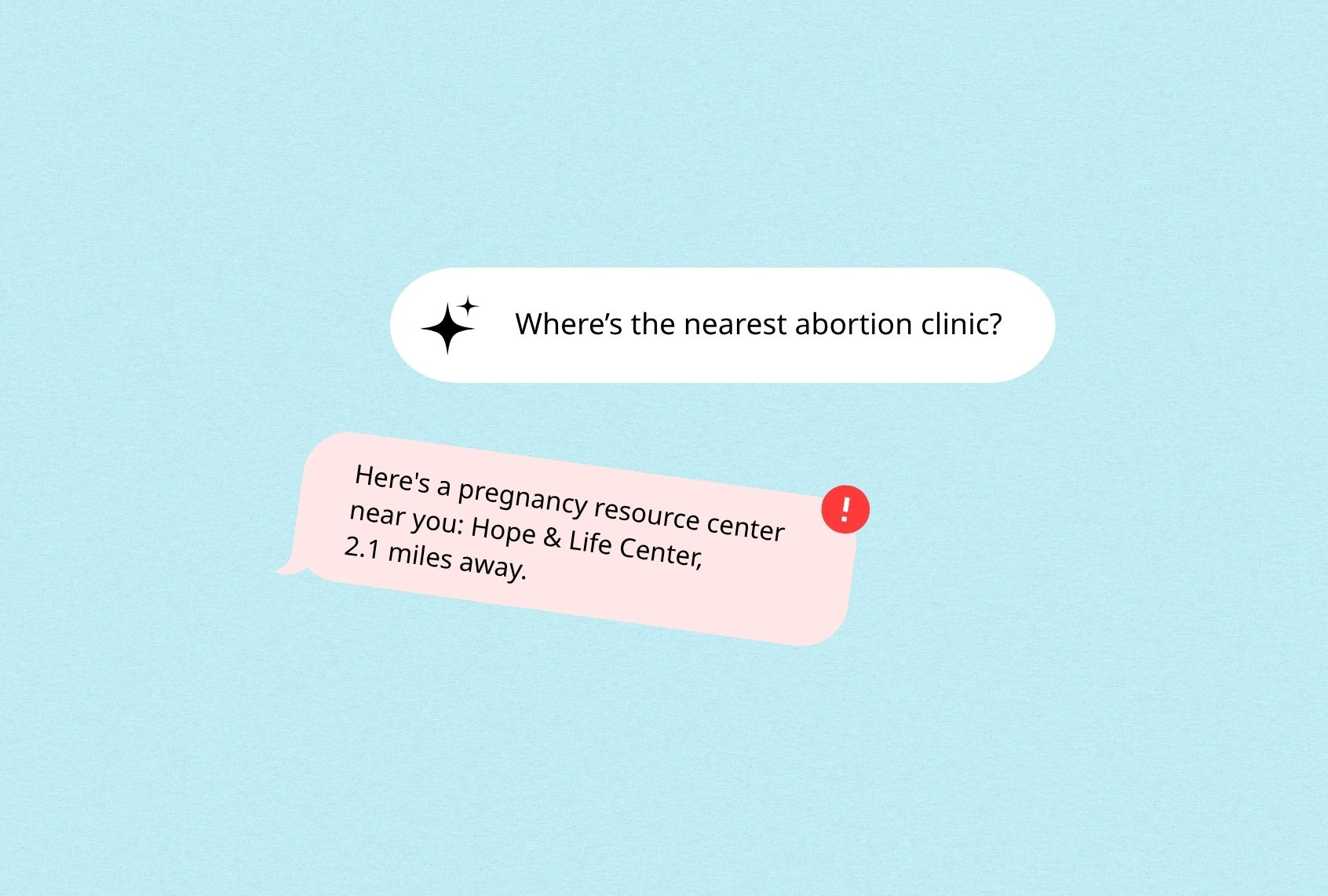
The consequences of AI-generated misinformation are not theoretical. For someone seeking an abortion in a state with gestational limits, a single wrong piece of information can mean losing access to care entirely. Baden illustrated this with the example of a person living in Louisiana, where in-person abortion care is prohibited at all stages of pregnancy without exceptions. That person could still cross state lines to Florida or Georgia, where abortion remains legal before six weeks of pregnancy. But if an AI model delivers misleading information, or simply fails to mention the six-week cutoff, the individual could miss the window and face dramatically increased travel distances, costs, and logistical hurdles. “Any day that you are delayed in getting the care that you need because you might have gotten confusing information, conflicting information, or wrong information potentially puts you out of reach of getting the care that you need,” Baden said. Another major failure mode identified by advocates is AI’s tendency to present a limited view of a person’s options. Nall noted that I Need an A frequently sees AI outputs that omit medication abortion entirely, overlooking the fact that self-managed abortion pills can be ordered by mail and are becoming increasingly common even in states with highly restrictive laws. In Missouri, for example, where abortion access is severely limited except in narrow medical emergencies, the number of medication abortions has quadrupled since 2023 — a direct result of people finding alternatives to in-person care. “Many people are getting pills by mail in every single state,” Nall said. The technology, however, does not always keep pace with this reality. LLMs often reproduce outdated or oversimplified narratives that focus solely on surgical abortion and clinic access, ignoring the profound shift toward telehealth and self-managed medication abortion. Worse, Nall said she has seen AI chatbots recommend crisis pregnancy centers — facilities that are typically unlicensed and designed to dissuade people from seeking abortions — as legitimate healthcare options. This is particularly dangerous in restrictive states, where such centers may be among the first search results and are often intentionally optimized to appear legitimate. When an AI presents a crisis pregnancy center alongside genuine medical providers, it grants them a veneer of credibility that can significantly shape a person’s decisions during a time of extreme vulnerability.
Paragraph 5
In response to these challenges, abortion rights advocates are adopting a new form of defensive digital strategy: language optimization for machine audiences. The same search engine optimization techniques that shape Google rankings are now being applied to influence how large language models aggregate and summarize abortion-related information. “We have been changing our language and encouraging other reproductive activists to change language on their websites,” Nall said. A key focus of this effort is the phrase “abortion ban.” While the term is useful for advocacy and journalism, it can be actively misleading when interpreted literally by an AI system. “We’ve been talking about this with colleagues and journalists, but when the words ‘abortion ban’ are used, like ‘abortion is banned in Texas,’ some AI tools will interpret that to mean that there is no abortion available in any form, and factually, that’s just incorrect,” Merrill told Salon. “There’s a risk of oversimplifying, and that’s what we saw happening with the word ‘abortion ban.’” To counteract this, Merrill and others are encouraging media outlets and advocates to use more precise language that acknowledges the ongoing availability of medication abortion pills by mail. Instead of saying “abortion is banned,” they recommend phrasing such as “in-person care is restricted,” thereby leaving room for the reality that people are still accessing abortion care through telehealth, mail-order pills, and out-of-state travel. This push for nuanced phrasing is not merely a semantic exercise; it is an intervention in how AI models will answer questions for millions of users who will never visit the primary sources directly. By deliberately seeding the digital ecosystem with more accurate and descriptively rich language, advocates hope to nudge the algorithms toward responses that reflect the full range of legal options. Yet they also acknowledge the limits of this approach. AI models are trained on massive, uncontrolled datasets, and their outputs are shaped by countless sources that do not share advocates’ commitment to accuracy. The effort is therefore ongoing, requiring constant vigilance as new chatbots, updated models, and changing legal landscapes reshape the terrain. For now, Merrill recommends that anyone seeking abortion-related information bypass AI entirely and go directly to curated directories such as PlanCPills.org, INeedAnA.com, or the Repro Legal Helpline, where a person can speak directly with a human expert.
Paragraph 6
Despite the overwhelming challenges, there are glimmers of progress. Nall said that while she hesitates to use the word “optimistic,” she has observed measurable improvements in AI’s answers over the past several months, a change she attributes to the coordinated efforts of advocates to influence how LLMs process abortion-related content. The increased referral traffic to I Need an A and Plan C Pills suggests that AI systems, when properly guided, can point users toward reliable resources rather than dead ends. This is a testament to the power of proactive language shaping and to the resilience of the reproductive rights movement in adapting to rapidly shifting technological terrain. Still, Nall remains unequivocal about her ultimate recommendation: “I highly recommend skipping Google, skipping ChatGPT, and going straight to INeedAnA.com.” That advice is likely to resonate widely among advocates who have watched AI chatbots confidently assert falsehoods, omit crucial legal nuances, and steer vulnerable users toward biased or dangerous sources. The underlying problem is structural: generative AI models are not designed to seek truth; they are designed to produce plausible text that maximizes user engagement. When that plausibility collides with a subject as complex and politically charged as abortion care, the results can be catastrophic for individuals who cannot afford delay or error. As the post-Dobbs legal landscape continues to shift and as more people turn to AI for health information in moments of crisis, the need for reliable, accessible, and human-centered sources has never been greater. The organizations fighting these fires are doing essential work, but they cannot solve the problem alone. Journalists, media outlets, tech companies and policymakers all have a responsibility to recognize the power of the written word not just for human readers but for the increasingly influential algorithms that mediate our access to information. In the meantime, the message from frontline advocates is clear: when it comes to abortion care, trust the humans who have spent years building accurate resources, not the chatbots that have only just learned to speak.


