








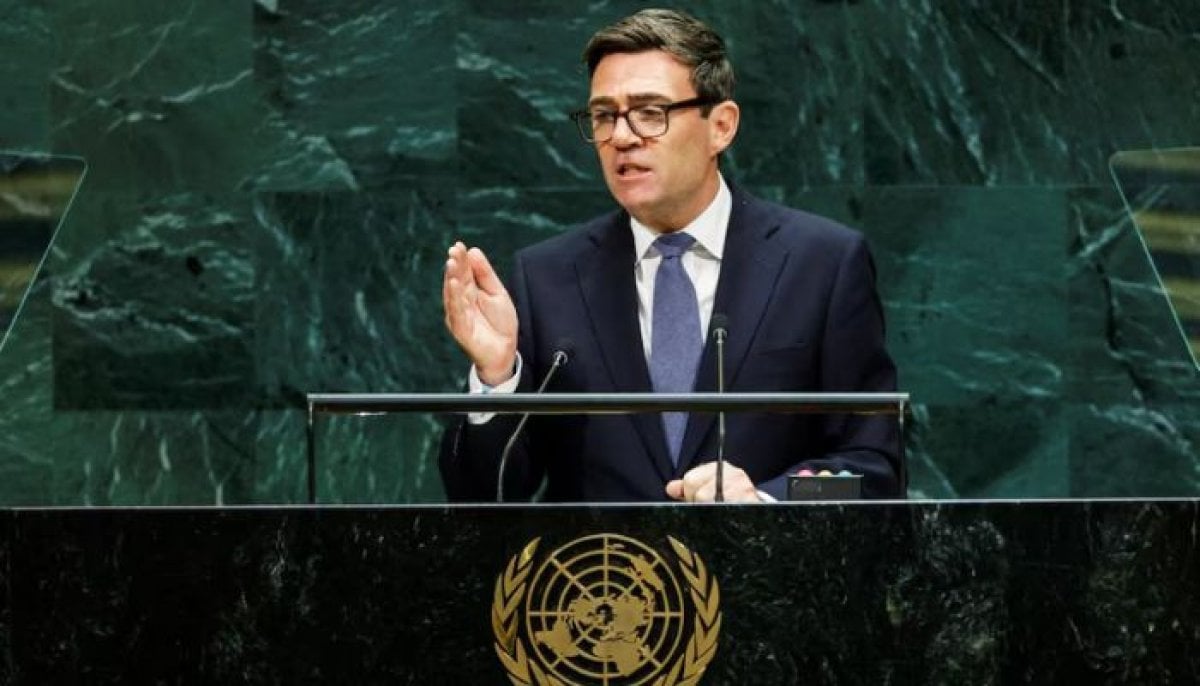
UK Prime Minister Andy Burnham used his debut address to the United Nations General Assembly to announce the establishment of the National Centre for Information Defence, a new intelligence hub aimed at countering the growing threat of hostile state information attacks. Speaking from the UN podium, Burnham described the initiative as urgent and necessary, asking British security chiefs to begin work immediately. The centre is intended to detect, attribute and disrupt the methods used by adversarial actors, including AI-generated deepfakes and coordinated disinformation campaigns. Burnham’s decision to place the announcement on an international stage underscored his belief that information warfare has become a central feature of modern geopolitical conflict and can no longer be treated as a fringe issue. The UK’s answer, he said, is not merely defensive but proactive—designed to expose and dismantle hostile operations before they can take root.
The newly minted intelligence hub will be specifically designed to identify covert influence operations, trace them to their state sponsors, and take action to neutralise them. In his speech, Burnham said: “Today, I’m asking our security chiefs in the UK to begin work on a new National Center for Information Defense to detect, attribute and disrupt these kinds of hostile state information attacks.” He added: “We are ready to share our understanding of how these actors work and how we can respond.” The quote reflects a broader shift in national security strategy. Traditional defence focuses on physical attacks and military threats, but the National Centre for Information Defence is built for a world where a deepfake video can alter perceptions, or a fake news network can inflame social divisions. By integrating intelligence collection, technical analysis and law enforcement powers, the centre is expected to act as a command post for defensive and offensive responses to foreign interference.
Burnham singled out Russia in his address, warning that the Kremlin spends approximately £1.3 billion every year on digital manipulation. This immense budget funds bots, fake news websites, and falsified branding designed to look like the work of legitimate institutions. Burnham revealed that Russian state actors have already forged the credentials of 28 major British organisations, including the BBC and several universities. The goal, he said, is to sow domestic division and manufacture narratives of national decline. By impersonating trusted British brands, these operations seek to weaponise public trust against itself. Rather than creating new stories from scratch, adversaries hijack existing trust in established institutions, making disinformation far harder to identify and counter. Burnham’s message was clear: this is not a random or occasional nuisance but a systematic, state-backed assault on the foundations of democratic debate.
To counter these threats, the centre will forge a unified defensive front by bringing together UK intelligence agencies, law enforcement bodies, and major tech and social media platforms. This approach acknowledges that governments cannot fight disinformation alone. Technology companies control the networks through which hostile information spreads, so they must become partners in detecting and removing malicious content. Law enforcement is needed to investigate criminal activity, while intelligence agencies can track foreign actors and uncover their methods. The centre will therefore operate at the intersection of cybersecurity, digital forensics and public policy. By coordinating between these players, the UK hopes to respond more quickly and effectively to incidents, rather than allowing each institution to work in isolation. Burnham’s language around “attribution” is particularly important, because knowing who is behind an attack is the first step toward exposing them and, if necessary, imposing consequences.
Furthermore, Burnham emphasised that national resilience begins at the grassroots level, noting that citizens facing economic hardship or social inequality are disproportionately vulnerable to online manipulation. He argued that people who are struggling, disconnected or marginalised are more likely to fall for narratives that blame immigrants, minorities, politicians or the press. Therefore, the National Centre for Information Defence cannot be solely a technological fix; it must also address the social and economic conditions that make disinformation effective. Burnham’s point suggests that media literacy, education and community investment are as important as intelligence and law enforcement. A society with strong public institutions, trusted journalism and equal opportunities is far more difficult to destabilise. In this sense, the centre’s work could include public information campaigns, partnerships with schools and universities, and support for local journalism, all aimed at strengthening the resilience of ordinary citizens.
As part of a broader push to secure democratic institutions, the UK intends to share its defensive strategies and expertise with international allies facing similar election interference. Burnham’s pledge to share knowledge and response strategies signals that Britain wants to lead a global coalition against information warfare. Because hostile state attacks do not respect borders, cooperation between governments is essential. An attack on one country’s election system can offer lessons for all others. The new centre could become an international hub, helping allies identify foreign threats and coordinate responses. Burnham’s choice to announce this at the UN General Assembly highlighted that the UK views this as a collective challenge requiring collective action. Ultimately, the National Centre for Information Defence represents an acknowledgement that the battle for truth is a battle for democracy itself. The question now is whether other nations will follow the UK’s lead and build the kind of resilient, transparent and coordinated defences needed to protect open societies in the digital age.


