








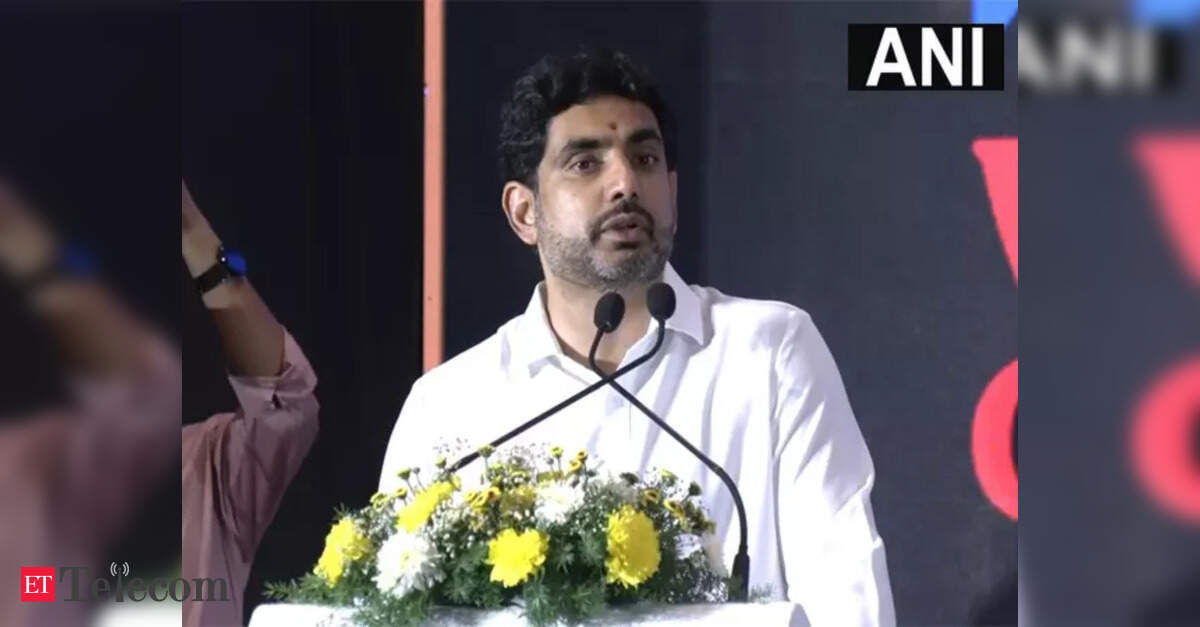
AMARAVATI: Andhra Pradesh IT Minister Nara Lokesh on Wednesday strongly defended the state government’s decision to establish a colossal data centre ecosystem in Visakhapatnam, directly countering what he termed a “deliberate misinformation campaign” regarding the environmental and water requirements of these critical digital facilities. Addressing the state Assembly during a high-stakes question hour, Lokesh took exception to the sector’s characterization as a water-guzzler, arguing that the current projections are based on flawed assumptions and outdated technological parameters. The Minister confirmed that the state, under the leadership of Chief Minister N Chandrababu Naidu, has successfully achieved the clear-cut ceiling of 6.5 GigaWatts (GW) of data centre capacity allocation – a figure that represents the total approved IT load capacity. He revealed that once this entire proposed ecosystem becomes fully operational, based on prevailing cooling and processing technologies, it will require an estimated 3 TMC (Thousand Million Cubic Feet) of water annually. Breaking down the figure, Lokesh emphasized that this volume is markedly less than what traditional heavy industries, such as steel, fertilizer, or power generation, consume. He questioned the selective scrutiny directed at data centres, arguing that the state’s industrial history has always involved water allocation, yet the digital sector is being held to a different and harsher standard without substantial scientific basis. “There is an intentional effort to mislead the public on this matter,” he asserted, vowing that the government will not be swayed by baseless allegations while simultaneously committing to a framework that prioritizes only those companies demonstrating strong environmental responsibility. The Minister pointed out that the 6.5 GW target is a testament to the immense trust the private sector has reposed in the state’s infrastructure and governance, a trust that would be severely undermined if unfounded narratives were allowed to take root, thereby jeopardizing lakhs of potential jobs and future investments.
Lokesh provided a comprehensive macro-economic context, explaining that data centres are no longer mere IT warehouses but the strategic pivots of the AI-driven digital economy and national security. He articulated that as India marches towards its trillion-dollar economic aspirations, the capacity to securely store, process, and compute massive volumes of data within domestic borders has become synonymous with data sovereignty. “In a world fraught with geopolitical tensions, cyber warfare, and cross-border data manipulation, retaining control over our own data infrastructure is an existential imperative for India,” Lokesh said during his detailed reply. He stated that the 6.5 GW allocation strategically positions Visakhapatnam on the global map of hyperscale data hubs, creating a formidable ecosystem that can rival established global counterparts like Singapore and Northern Virginia. The minister singled out Google’s significant investment decision as a powerful catalyst, asserting that this single move has triggered a “wider interest” from a host of other global technology giants, including cloud providers, AI startups, and semiconductor companies looking to establish a foothold in South Asia. He elaborated on the multiplier effect of data centres: they bring in high-value jobs, attract ancillary industries, foster local talent in AI and machine learning, and enable digital public infrastructure. He reminded the house that without these centres, the data generated by millions of Indians leveraging UPI, Aadhaar, and digital health platforms would have to seek refuge on foreign soil, exposing the nation to data theft and privacy breaches. He further argued that the deployment of renewable energy for this digital backbone is not a cost but an investment in India’s future technological autonomy, transforming Visakhapatnam from a traditional port city into a premier digital geopolitical outpost.
At the heart of the controversy lies the stubborn debate over water consumption, and Lokesh directly dismantled the ‘misinformation’ narrative by contrasting it with existing industrial benchmarks. He explained that a conventional 1 GW thermal power plant consumes nearly 10 times more water annually than a similarly sized data centre, and yet protestors have historically raised little to no objection against the massive water footprints of these incumbent industries. “If water scarcity is a genuine concern, then protests should begin at the thermal plants that dot our coastline, not at the facilities that will power India’s digital future,” he argued forcefully. The Minister meticulously explained that the projected 3 TMC requirement is predicated on current air-cooled technology, which is rapidly being superseded by advanced liquid cooling and closed-loop systems. He highlighted that modern data centres are increasingly moving towards Direct-to-Chip (D2C) cooling and immersion cooling technologies, which slash freshwater usage by up to 90% and operate on recycled water. Furthermore, he mentioned the advent of zero-water cooling towers, which utilize ambient air to dispel heat, meaning the environmental footprint is shrinking with every generation of hardware. He conceded that water is a precious commodity in a rain-fed state like Andhra Pradesh, but stressed that the government’s strategy is built around modern efficiency rather than wastage. The Minister urged the opposition to compare apples with apples, suggesting that on a per-hour basis of high-performance computing, data centres are among the most water-efficient industrial activities in existence. He challenged critics to provide concrete evidence that the 3 TMC figure translates to a genuine shortage for the port city, reiterating that the state is confident in its ability to meet the demand through sustainable sourcing without compromising municipal supply in any way.
Lokesh delved into the technicalities of the water sourcing, providing a strong assurance that the data centre demand will be met exclusively from the industrial allocation of the ambitious Polavaram Project. He clarified the state’s water budget, explaining that Polavaram was designed to create a massive surplus through its irrigation and drinking water network. The Minister underscored that the government is sworn to protect the interests of Visakhapatnam’s residents and will not permit a single drop of water earmarked for urban domestic use to be diverted towards these centres. “The industrial grid and the domestic grid are separate entities in our planning. They will not intersect,” Lokesh asserted. He announced a crucial timeline: the government is fully committed to completing the gravity-based drinking water supply system from the Polavaram project to Visakhapatnam within the next 18 months. This gravity-based mechanism is critical because unlike lift-irrigation systems, which are energy-intensive and prone to operational failures and power outages, gravity systems leverage topographical elevation to deliver water reliably and cost-effectively. Once operational, this system will not only feed the city’s growing domestic needs but will also create a robust industrial surplus. To cater specifically to the data centre zone, the government is laying dedicated pipelines that will connect these high-consumption facilities directly to the primary reservoirs. This dedicated infrastructure ensures a steady, uninterrupted supply for critical digital operations while insulating the public distribution network from industrial load fluctuations. Lokesh also addressed agricultural concerns, reiterating that the irrigation allocation remains untouchable, and framed the data centre usage as a secondary, high-value use of industrial water that will generate tax revenue and employment, in turn funding more water infrastructure for farmers and expanding the overall water security net for every citizen of the state.
Recalling the strategic foresight of Chief Minister N Chandrababu Naidu, Lokesh underscored that the 6.5 GW ceiling is not an arbitrary figure but a meticulously calculated target based on grid stability, land availability, and hydrological resources. The fact that this target has been fully achieved through allocation requests is a strong vote of confidence from national and international investors. The government’s new policy specifically mandates the prioritization of companies that demonstrate strong environmental responsibility, including a rigorous evaluation of their compliance with water recycling quotas, utilization of renewable energy, and implementation of zero-liquid discharge systems. Lokesh assured that the policy is designed to attract ethical hyperscalers who see sustainability as a core business value, not a mere CSR checkbox. He elaborated on the economic bonanza that this sector will bring to Visakhapatnam and the broader state, extending beyond direct employment of highly skilled computer engineers, data scientists, and network administrators. The ecosystem will spawn a wave of ancillary industries, including cooling system manufacturers, server rack assemblers, electrical switchgear suppliers, and specialized security services. He predicted a surge in local real estate and services, transforming the cityscape into a bustling tech corridor. Lokesh also highlighted the synergy between the state’s abundant renewable energy capacity (solar and wind) and the data centre’s enormous power demands, creating a green-data-host model that is a global first. He argued that hosting data centres powered by green energy in Visakhapatnam, instead of coal-rich states, is an environmentally superior choice, significantly reducing the carbon footprint of India’s digital economy, while the 100% achievement of the allocation target stands as a testament to the state’s streamlined single-window clearance and investor-friendly climate.
In his concluding remarks, Lokesh elevated the debate beyond regional politics, framing the data centre policy as a pivotal pillar of India’s national security architecture. He drew an analogy with how India built its physical infrastructure—highways, ports, and airports—to secure trade and economic growth during the 20th century, asserting that digital infrastructure is the equivalent enabler for the 21st century. Without domestic data capacities, India would be vulnerable to external shocks, sanctions, and digital blockades, a risk no sovereign nation can afford in the current geopolitical climate. Acknowledging the legitimate environmental concerns raised by civil society and the opposition, Lokesh insisted that the government’s approach is amongst the most sophisticated and environmentally conscious in the country. The dual benefit of the 18-month Polavaram gravity-based supply timeline is not just for the data centres; it will permanently resolve the city’s recurring water stress, a chronic issue that has plagued Visakhapatnam for decades. He rejected the zero-sum narrative that industrial growth and environmental protection are mutually exclusive, stating that Andhra Pradesh is pioneering a model of ‘sustainable digital industrialisation’. He closed by calling for broader public dialogue but made it unequivocally clear that the government will not allow fabricated fears to derail its march towards becoming India’s digital capital. As global AI compute demand skyrockets, placing unprecedented pressure on existing hubs in the US, Europe, and Singapore due to land, energy, and water constraints, Visakhapatnam stands ready as a highly strategic and resilient alternative. The Minister’s address painted a clear picture for the assembly: the city’s water resources are being expanded and fortified, not depleted; the environment is central to the policy, not peripheral; and the future of India’s digital sovereignty is being solidified right here on the shores of the Bay of Bengal. “We are building for the century,” he concluded, “and every drop used today is an investment in a trillion-dollar digital tomorrow for our children.”


