



Washington, D.C. (TNND) — Americans hold a deeply conflicted view of freedom of the press, according to a new Pew Research Center study released under the Pew-Knight Initiative. On one hand, 73% of Americans say press freedom is “very” or “extremely” important to the well-being of society, a view protected by the First Amendment and widely shared across party lines. Majorities of both Republicans and Democrats affirm that a free press matters, although Democrats are more likely than Republicans to rate it as highly important. On the other hand, the same survey reveals that a majority of Americans are willing to allow the government to override press freedom in specific situations. Just over half of all Americans — including 59% of Republicans and 45% of Democrats — say it is acceptable for the government to demand that a news organization take down a story if it contains false information. And 60% of Americans — including 72% of Republicans and 50% of Democrats — say the same of a story that poses a risk to national security. These findings suggest that while Americans value the abstract principle of press freedom, they are less certain about how it should apply when information is disputed or potentially dangerous, and they are more divided along partisan lines than the broad consensus on the First Amendment might suggest.
Peter Loge, director of the School of Media and Public Affairs at George Washington University, said the Pew findings reflect a long-standing American tension between absolute free-expression ideals and practical concerns about safety and truth. Loge compared the situation to the classic legal example of falsely yelling “fire” in a crowded movie theater: most people understand that there are some forms of speech that are not protected and can cause real harm. “Just as you can’t falsely yell fire in a crowded movie theater,” he said, “most Americans would agree for some national security purposes, there’s some things best left unsaid, or at least unsaid in the moment.” That instinct, Loge said, helps explain why substantial majorities in the poll endorse government action against stories that are false or that could threaten national security. But he emphasized that journalists already have ethical responsibilities to avoid harm, tell the truth, and strive for fairness. The existence of those professional norms, however, does not mean the government should be the one deciding what is accurate or safe enough to publish. Loge said he may not love the way every journalist and news organization polices itself, but he far prefers that to the alternative of government oversight of reporting. “I may not love all journalists policing themselves,” he said. “I really loathe the government trying to police journalists.”
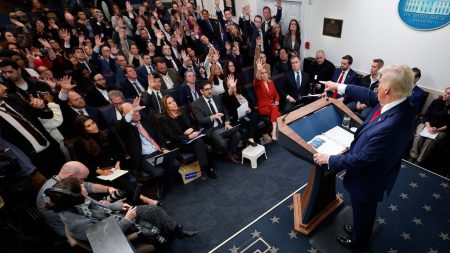
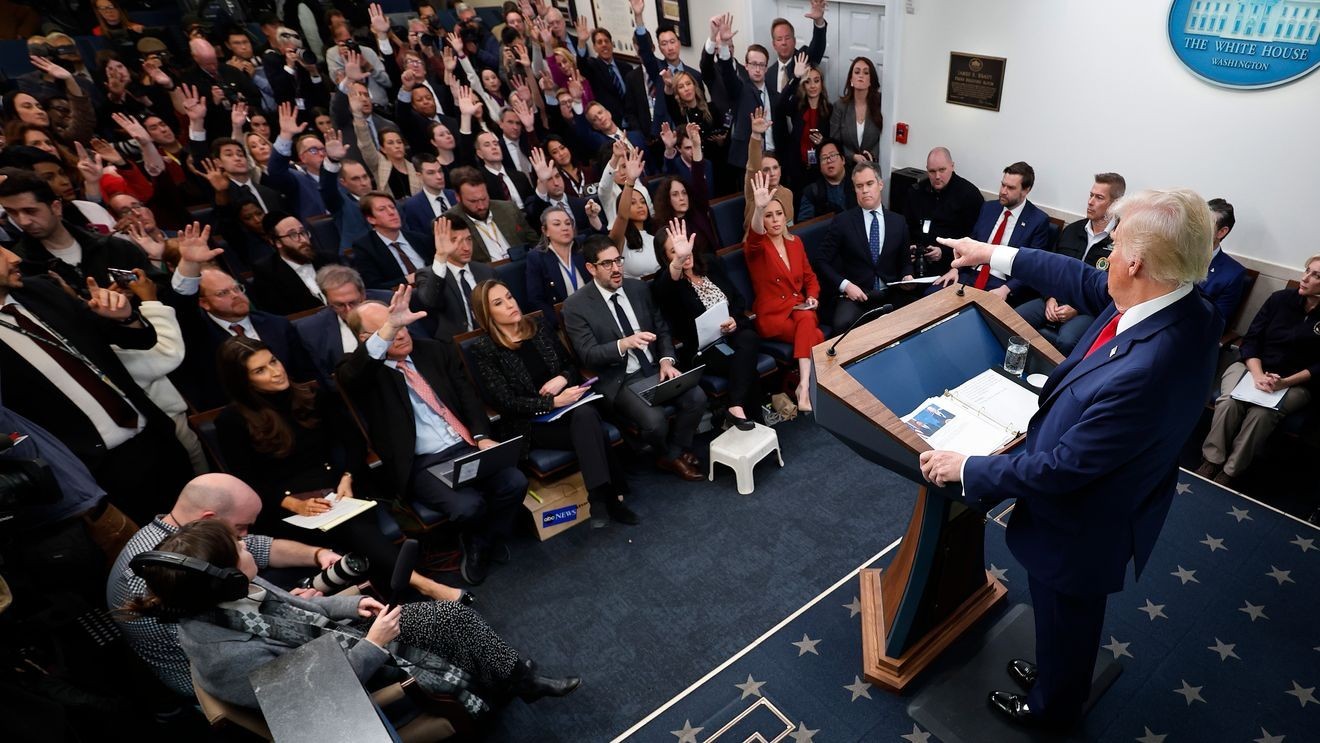
The Pew study arrives at a moment of intense political debate over the role of the press and its treatment by political leaders, especially former and current President Donald Trump. More than four in 10 Americans told Pew that the press has become less free during the second Trump administration, a perception that is dramatically polarized: 72% of Democrats say the press has become less free, while only 15% of Republicans agree. Loge said Trump has undermined confidence in the press through his repeated attacks on reporters and news organizations. In particular, Loge pointed to the president’s habit of describing journalists as “enemies of the American people” when they publish stories he dislikes. That kind of language, Loge said, is “remarkably dangerous” for a democracy because it frames the news media not as a check on power but as a hostile force to be discredited and suppressed. He acknowledged that a president is certainly free to disagree with a reporter or reject a particular point of view, and that robust political debate is healthy. But, he said, the president should always embrace an open and robust exchange of ideas, not suggest that a free press is an enemy of the country. “Our democracy demands no less,” Loge concluded.
The Pew Research Center also found that Republicans and Democrats bring different concerns to the table when they think about press freedom. Democrats, the study found, tend to worry more about direct government restrictions on the press, such as censorship, legal threats, or the seizure of newsgathering materials. Republicans, by contrast, often express concerns about false information and the role of news organizations in deciding what information people see, including the power of editors, platforms, and media companies to control the public narrative. These divergent anxieties help explain why the two parties respond so differently to survey questions about censorship and press freedom. For Democrats, the danger is typically government overreach; for Republicans, the danger is often perceived bias or suppression on the part of the media itself. The survey indicates that overall, 28% of Americans say the media is completely free to report the news today, a relatively low number for a country that prizes press freedom. Meanwhile, 46% of all Americans say they are extremely or very worried about potential restrictions on press freedom, with Democrats significantly more likely than Republicans to express that worry. Even with these concerns, however, a notable minority of Americans are willing to accept certain government actions that would traditionally be considered serious threats to press freedom. Around 30% of Americans say it is at least sometimes acceptable for the government to force journalists to reveal the identities of unnamed government sources, a practice that would make it much harder for whistleblowers and investigative reporters to expose wrongdoing. A similar share of Americans say it is at least sometimes acceptable for the government to take away a news organization’s license to broadcast, a power that would effectively allow the government to shut down a media outlet.
The study’s findings also reveal a deep skepticism about the flow of information in American society. Around 80% of Americans said the government at least sometimes intentionally keeps important news from reaching the public, and a similar share said the same of news organizations. That bipartisan cynicism suggests that Americans do not fully trust either the government or the media to give them the complete picture, even as they debate how much freedom the press should have. It also helps explain why so many people are willing to grant the government some censorship powers: if the public already believes that both institutions are withholding information, they may see government intervention as a lesser evil than unchecked media power, or vice versa. For Loge, the findings ultimately point to the essential role of press freedom in democratic self-governance. “Democracy is an ongoing debate about what to do next,” he said. “You can only have an honest debate if you have all perspectives and all perspectives are represented.” In his view, that means journalists must exercise restraint and responsibility, but it also means the government must not be the arbiter of what is true or permissible. A free press, even an imperfect one, is essential to ensuring that citizens have the information they need to make decisions and hold their leaders accountable.
The Pew-Knight Initiative study illustrates the complexity of American attitudes toward press freedom at a time when trust in both media and government is strained. It suggests that the public is not simply divided between absolutist defenders of the First Amendment and those who would happily censor the press. Instead, most Americans occupy a middle ground, saying that press freedom is crucial but not unlimited. They support some government intervention in cases of false information or national security, yet they remain worried about the possibility of government overreach. They believe the media are not fully free, but they also think news organizations deliberately withhold information. They express concern about press restrictions, yet a significant minority are willing to accept government demands for source disclosure and broadcast license revocation. These contradictions are not necessarily a sign of confusion; they may reflect a pragmatic, if uneasy, public that wants the press to be accountable without being stifled. Loge’s comments suggest that the best path forward is not more government control but a renewed commitment by journalists to ethical standards and by political leaders to respecting the independence of the press. As he put it, democracy depends on an open debate in which all perspectives are represented. That debate cannot happen if either the government or the media is allowed to decide unilaterally what Americans may see or hear, and it cannot happen if journalists are treated as enemies simply because they report inconvenient facts. The Pew study makes clear that the public understands those stakes, even when its answers reveal deep partisan divisions and significant unease about the balance between freedom and security.