





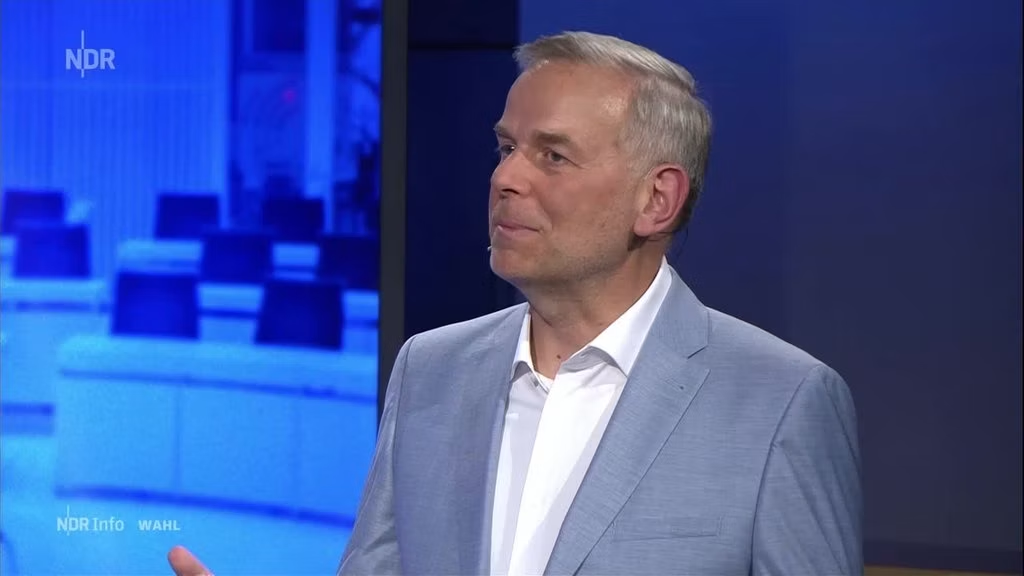



By Monday’s deadline, Mecklenburg-Vorpommern may know whether Leif-Erik Holm of the Alternative for Germany has achieved a political breakthrough or become another cautionary tale. In the closing minutes of Wednesday evening’s televised debate at the NDR Funkhaus in Schwerin, the 56-year-old AfD leader suddenly seemed to discard the image of a revolutionary dismantler of public broadcasting. Asked by veteran host Thilo Tautz to explain in concrete terms what the AfD’s promise to terminate the NDR state treaty and abolish the broadcasting licence fee would actually mean in government, Holm did not repeat his often-quoted pledge to sign the termination notice “with a thick marker, just like Mr. Trump.” Instead, he adopted a softer vocabulary, insisting that the AfD had “nothing against critical reporting” and was only demanding that “all perspectives be considered.” The moment crystallized the central tension of Holm’s campaign: an opposition politician who wants to be minister-president while simultaneously retaining a safe seat in the Bundestag, a challenger who has built his rise on rejecting established institutions but who now must appear plausible to voters. With the election only days away and the latest Insa poll showing the AfD at 37 percent and the SPD at 35 percent, every word from the debate was likely to be weighed for its effect on a race that remains extraordinarily tight. The CDU, once the dominant force in the state, is far behind at under ten percent, leaving the contest as a two-party drama with unstable coalition possibilities.
The sharpest confrontation of the evening came when Tautz refused to let Holm’s accusation stand. Holm had claimed that public broadcasting, including NDR, “spreads disinformation” and fails to present balanced coverage, but he offered no concrete examples to support the allegation. Tautz interrupted him and said, with visible sharpness: “We won’t stand for being accused of spreading disinformation.” Holm then changed his line of attack, complaining that the AfD was rarely invited to participate in television talk shows. Tautz reminded him that he was standing right there in the studio, at that moment, on a public broadcaster. It was a rhetorical victory for the moderator, but it also exposed the strange relationship between the AfD and the media system that the party has made a central enemy in its campaigns. After that exchange, Holm retreated to a reform platform, saying he merely wanted a broader range of voices and more fairness in the news programmes. Yet Tautz was not finished: he turned to Holm’s controversial candidacy and asked why a man seeking the highest state office was only in the country “with half a butt cheek.” The blunt phrasing underscored the paradox of Holm’s strategy. He is running in the Schwerin I district as a direct candidate but is not on his party’s state list, meaning that unless he wins that seat, he will not enter the Mecklenburg-Western Pomerania state parliament at all.
That arrangement has become one of the defining controversies of the campaign. Manuela Schwesig, the incumbent SPD minister-president who is now 52 and seeking another term, has called Holm’s approach a “return ticket to the Bundestag.” Her point was that Holm could campaign as a future leader of the state while preserving a comfortable fallback: if he loses the direct mandate, he simply returns to his existing seat in the federal parliament in Berlin. A genuine commitment to leading Mecklenburg-Western Pomerania, Schwesig implied, would require a candidate to put everything on the line. Tautz’s “half a butt cheek” question made the same accusation directly to Holm, and the AfD politician was forced to defend his decision. He argued that contesting a direct mandate showed his desire for a personal mandate rather than a list seat, but the explanation did little to quiet critics who saw a tactical safety net. The issue matters beyond symbolism because the state’s electoral rules and the likely balance of power after Sunday may make the Schwerin I result decisive. If Holm wins that seat and the AfD emerges as the strongest party, he will have a powerful claim to lead negotiations. If he loses, he will be a federal parliamentarian watching the formation of a new state government from Berlin, and the AfD will have to turn to less prominent figures to take the lead in the state parliament. For Schwesig, by contrast, winning her district would give the SPD a strong symbolic foothold even in a difficult environment, and she could continue as minister-president as long as she can assemble a coalition.
The latest Insa poll has put the AfD at 37 percent and the SPD at 35 percent, a statistical tie that lies within most polling margins of error. The CDU, trailing at under ten percent, is facing an existential crisis in the state. A result in that range would dramatically reshape the political landscape of a region that once seemed solidly in the CDU’s corner. If the AfD finishes first, it will demand the right to lead the government, but no other established party has thus far declared a willingness to rule with it. Holistic coalition arithmetic in such a scenario would become extremely complicated, and Holm could find himself in the position of being the strongest politician in the state yet unable to form a government. If the SPD manages to edge ahead, Schwesig would have a broad range of options, depending on how many smaller parties cross the five percent threshold. A renewal of the traditional grand coalition with the CDU might be impossible if the CDU falls below or only barely enters the parliament with a handful of seats. The Greens, the Left Party, and possibly the FDP could then become indispensable partners. The closeness of the race means that even tiny shifts in voting behaviour in the final days could determine who rules Mecklenburg-Vorpommern for the next five years. Holm’s debate performance was widely read as an attempt to reassure moderate voters that he is not a radical destructionist, but the base of the AfD still expects him to take on the public broadcasting establishment if he takes office.
Behind the political theatrics lies a complicated institutional reality that Holm’s rhetoric never fully addressed. The NDR is not a state broadcaster of Mecklenburg-Vorpommern alone; it is a joint institution serving several northern German states under a state treaty. A single minister-president cannot simply “terminate” that treaty on his own, and any unilateral withdrawal by Mecklenburg-Western Pomerania would almost certainly trigger a complex legal process involving the other NDR states, the state parliament, and possibly the Federal Constitutional Court. Similarly, the broadcasting licence fee known as the Rundfunkbeitrag is collected under a nationwide legal framework, not at the discretion of one regional government. Abolishing it would require a coordinated change of treaty law across all German states and would collide with the federal constitutional principle of safeguarding independent public broadcasting. The fact that Holm avoided the details during the debate suggests that he understands the gap between his campaign rhetoric and the legal powers of a state minister-president. His call for “reform” may therefore be a tactical concession to governing reality, but it also risks disappointing the voters who value him precisely because he promises to tear down the system. In the end, the debate indicates that the AfD is trying to have it both ways: mobilizing indignation against public broadcasting in the east, where the fee is widely resented as intrusive, while projecting a more statesmanlike image when faced with a moderator’s pointed questions. Whether that balancing act succeeds will be tested at the ballot box.
As Sunday approaches, the only certainty is that the state of Mecklenburg-Vorpommern is heading toward a historic decision. The television debate in Schwerin may be remembered as the moment when Holm stopped talking about termination and started talking about reform, but that shift may be too late to undo the impression of a candidate simultaneously aiming for the minister-president’s office and keeping a parliamentary seat in reserve. Tautz’s confrontational questioning forced the AfD challenger to explain a position that is unusual in German regional politics, and Schwesig has spent the final weeks of the campaign hammering the same point. The Insa poll, with its two-point gap between AfD and SPD, promises a compelling election night. For the CDU, a weak result could trigger introspection about its entire regional strategy. For the party system as a whole, the question whether the AfD can transform poll numbers into governmental power remains unresolved. Holm’s talk of reform, the “return ticket” phrase, the debate over disinformation—all of these issues are likely to be on the minds of voters as they cast their ballots. If the AfD wins, it will claim a mandate despite the refusal of other parties to cooperate with it. If the SPD wins, Schwesig will likely portray the victory as a rebuke to political extremism. The narrow margins, the unusual candidacy, and the unresolved legal questions around public broadcasting all combine to make this less a routine state election and more a test of the stability of Germany’s political system in the east. On Sunday, the voters will decide whether Holm’s gamble, his rapid retreat from radical promises, and his “half a butt cheek” strategy are rewarded or punished.


