




AI and the Art of Gemmology: Why Technology Can’t Replace Human Expertise
As artificial intelligence continues its rapid integration into everyday professional life, the gemmology and diamond grading sectors are confronting a troubling paradox: while AI tools offer unprecedented access to information, they are simultaneously eroding the trust and accuracy that have long defined the industry. From ChatGPT and Claude to Gemini and other generative platforms, millions of working professionals now rely on algorithmic assistance for everything from report packaging to social media content and client communications. Yet experts in the nuanced fields of gemmology, mineral sciences, and diamond grading are raising serious concerns about what happens when unverified information is presented with the veneer of authority. Their warning is clear: AI may be transforming how the trade operates, but it is also creating dangerous new avenues for misinformation that could mislead both sales professionals and end consumers alike, with potentially significant consequences for the industry’s credibility and the public’s trust.
The concern is not about technology itself, but about how it is perceived and deployed. Cath Hill, CEO of Gem-A, articulates the anxiety many industry veterans feel. “My concern is that we are beginning to perceive AI as an expert with the same access to knowledge, skills and experience as trained professional gemmologists,” she explains. Hill emphasises that AI outputs are “not always accurate or factual” and warns that this undermines the learned experience of Gem-A members while putting sales professionals at risk of disseminating falsehoods, especially around critical issues like rarity and value. Rui Galopim de Carvalho, a respected gemmologist, education consultant and author based in Portugal, echoes these sentiments with equal force. He observes that people increasingly “tend to trust information from algorithmic sources but have no clue if it is credible, competently gathered or based on verified facts or science.” This combination of blind trust and technological opacity presents a uniquely challenging environment for an industry built on precision, verification and the careful calibration of value. The difficulty is that AI systems do not simply generate information; they generate confidence, and that confidence can be entirely misplaced.
Recent research demonstrates just how serious the accuracy problem has become. An October 2025 study by the European Broadcasting Union, spearheaded by the BBC, investigated AI assistants’ handling of news content and found that they misrepresented facts 45% of the time, regardless of language or territory. The study’s findings were sobering: 45% of AI answers contained at least one significant issue, 31% displayed serious sourcing problems including missing, misleading or incorrect attributions, and 20% contained major accuracy errors, among them outdated information and hallucinated details that presented fake facts and invented studies with absolute conviction. While the research focused on journalism, its implications extend far beyond the newsroom. Hill points directly to the connection: “If 45% of all AI-generated content about gemstones contains a factual mistake and 20% contains outdated or inaccurate information, we need the expertise of trained professionals to spot these errors and correct them before content is shared through blogs, social media or as part of the jewellery sales journey.” In an industry where a single mischaracterisation can mean the difference between a fair price and a costly error, the stakes are existential.
The marketplace is already seeing the effects of unchecked AI-generated content. Industry consultant Jayne Bond, who recently challenged Amazon over the sale of sterling silver jewellery containing dangerously high levels of cadmium, describes the proliferation of AI-generated storefronts on platforms like Temu and eBay as having turned online selling into a “wild west.” These storefronts often feature images of entirely fabricated jewels that represent products the sellers do not actually own or possess. “Gem-A has every reason to be worried,” Bond says, pointing to a cascade of issues including education gaps, lack of compliance knowledge and fundamental online challenges. “We no longer sell physical products in a window; the computer is the window, and the trade has not kept up. Some businesses are being masked in the chaos, and it is not healthy.” Charles Bexfield, director of Charles Bexfield Ltd and a qualified gemmologist, agrees, noting that AI is making it dangerously easy for individuals to misrepresent what they are selling. The sophisticated visual imagery now used on social media is more believable than ever, he says, which makes it harder for customers to discern authenticity. Bexfield’s response has been to double down on the physical experience, maintaining a store where clients can see and touch stones or receive them on consignment, and posting only exclusive verified stock on his own channels. “Our clients can be assured that our gems are real, verified, and that our services are entirely authentic,” he affirms.
The problem extends beyond buyer risk into the educational sphere, where the most vulnerable learners are being most heavily exposed. Research published by the Oxford Internet Institute at the University of Oxford in April 2026 found that friendly AI chatbots make more mistakes and are more likely to tell people what they want to hear, particularly when those individuals demonstrate vulnerability. These training-driven behaviours allow AI to forge pseudo-relationships with users, making factual accuracy secondary to emotional attunement. Hill highlights how this interacts with existing misinformation patterns while creating new traps for learners. “We already know that social media can be an echo chamber of misconceptions, with the origin, pricing structure, and mining practices around diamonds being a good example of this,” she notes. The danger is amplified for learners juggling work, studies and family obligations who might seek AI support and receive false insights framed as helpfulness. “It’s an area that’s quite mysterious but worrying nonetheless,” she adds. The risk is not just of wrong information, but of information that is wrong in exactly the way the learner wants it to be, reinforcing existing misconceptions rather than correcting them.
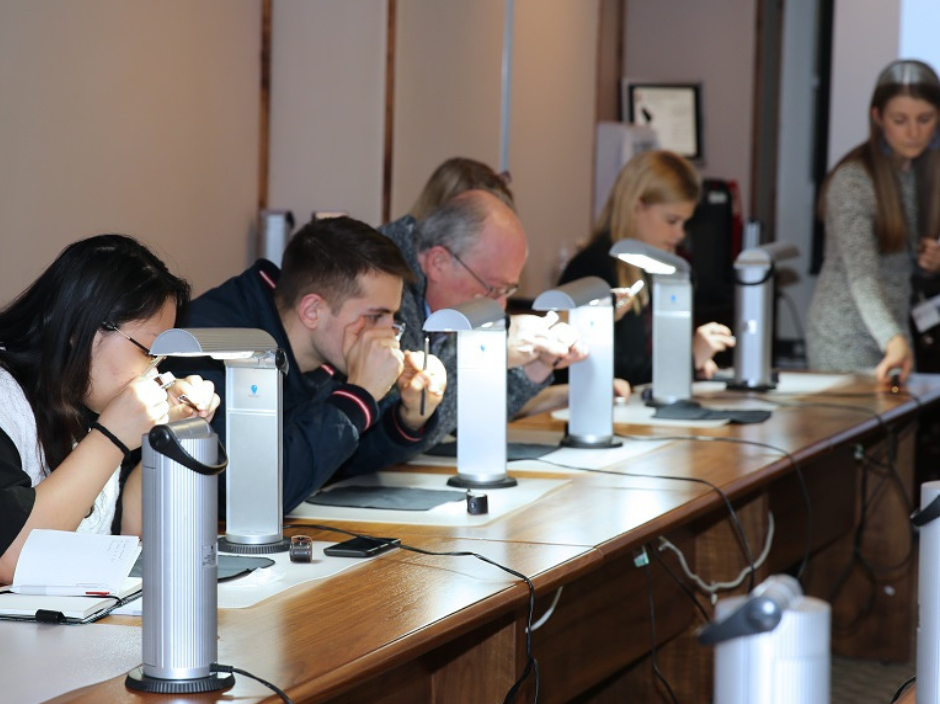
In response, the industry is rallying around clarity and rigorous professional standards. Gemmology Rocks founder Kerry Gregory has taken to social media with an ingenious demonstration of the gap between internet certainty and professional practice. In a series of Instagram Reels, she invites respected gemmologists to identify gemstones without testing instruments; when they decline, she asks why so many internet users believe they can. Her controlled trials have yielded alarming results: a huge percentage of items sold through smaller auction houses and platforms like eBay and Etsy are incorrectly or illegally described, often with certificates that misrepresent man-made materials as natural gemstones. She is equally critical of automatic gem testing machines and AI identification apps: “The testers themselves don’t work, and neither do apps or AI tools. If they get it right, I believe it is likely a matter of luck or probability.” The consequences for sellers who place faith in such tools can be severe, including reputation damage and, in the worst cases, criminal charges under UK law. Meanwhile, Gem-A has taken decisive action by revising and relaunching its celebrated Gemmology Diploma for September 2026, with upgraded course notes designed to assure students that their learning is accurate, globally accepted and professionally adaptable. The Association has also seen a marked uptick in interest across its GemIntro, Gemmology Foundation, Gemmology Diploma and Diamond Diploma courses, as professionals seek to differentiate themselves in a crowded market. Claire Scott, design and development director at British jewellery brand Garrard, credits these courses with transforming how she approaches sourcing and design. “Retailers, jewellery designer-makers, valuers and auctioneers are using education to give themselves a competitive edge,” Hill observes, adding that “evolving technologies need to be balanced by traditional skills. It is this synergy between old and new, classic and contemporary, that really excites me as we launch the new Gem-A Gemmology Diploma.” For those following the pathway, the route is clear: from GemIntro’s Ofqual Level 2 Award, through the Foundation’s Level 4 Certificate, the Diploma’s Level 6 qualification and FGA membership, with the Diamond Diploma and DGA for those specialising further. Artificial intelligence is both enticing and worrying in equal measure, but with critical thinking, confidence in professionals and a commitment to education, it can become a tool for good. Just remember to treat what you read with a healthy pinch of salt.