








# Evolutionary Game Theory Reveals Core Dynamics of Digital Public Opinion Governance: New Simulations Illuminate Path to Cooperative Equilibrium
## A Computational Framework for Understanding Tripartite Governance in the Digital Age
In an era where digital platforms mediate public discourse at unprecedented scale, the governance of online public opinion has emerged as a critical challenge for regulators, content creators, and technology companies alike. A new computational study employing advanced evolutionary game theory methods offers fresh insights into how these three stakeholder groups interact, revealing the delicate balance of incentives, risk perceptions, and behavioral biases that determines whether online ecosystems converge toward responsible governance or descend into chaos. Using MATLAB 2026a’s ode45 solver—the Dormand-Prince numerical integration method—with default tolerance settings for optimal balance between computational efficiency and accuracy, researchers simulated the evolutionary dynamics of a tripartite game involving government regulators, self-media creators, and social platforms over a time horizon of T=5 units. The simulation framework, built on prospect theory’s foundational assumption of bounded rationality, assigned initial probabilities to each player’s strategy choices (x₀, y₀, z₀) across the full range [0,1], with average runtime per trial under 0.2 seconds permitting extensive parameter sweeps. The model’s baseline calibration drew from established literature on evolutionary games in public opinion governance, with parameters including p₁=15 (image gain from active regulator disclosure), p₂=30 (costs of regulator silence), c₁=40 (costs of active regulator publication), c₂=12 (costs of self-media reporting), q₁=27 (positive impact of regulator disclosure), q₂=35 (public pressure from regulator silence), m₁=29 (benefits of self-media verification), c₃=60 (penalties for false reporting), J=35 (regulator rewards for verified reporting), F=5 (penalties for misinformation), n₁=20 (orderly gains from platform governance), n₂=20 (order losses from passive governance), c₅=30 (platform governance costs), w₁=36 (information benefits of platform governance), w₂=25 (information losses from passivity), and w₃=20 (additional governance costs). This comprehensive parameter landscape enabled rigorous sensitivity analyses while maintaining logical consistency with real-world governance dynamics, where regulators tend toward transparency to preserve credibility, self-media balance traffic incentives against compliance risks, and platforms weigh operational costs against regulatory pressure.
## Baseline Simulations Confirm Global Stability of Cooperative Equilibrium
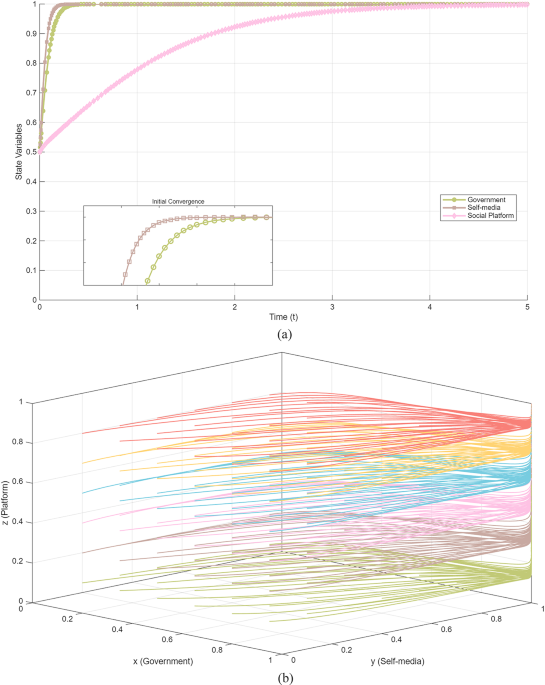
The foundational numerical experiments establish a remarkably robust result: under baseline parameter conditions, the tripartite system converges unfailingly to the ideal cooperative equilibrium at point (1,1,1), wherein all three actors simultaneously adopt proactive governance strategies. In this equilibrium state, regulators actively release authoritative information to quickly establish factual baselines during public opinion events, thereby preventing panic and misjudgment while enhancing public trust; self-media creators rigorously verify information before dissemination, prioritizing long-term credibility over short-term traffic gains; and social platforms implement intelligent content auditing systems that promptly remove harmful material, recommend high-quality information, and maintain orderly digital spaces. The global stability of this equilibrium was confirmed through comprehensive analysis including Lyapunov stability methods and extensive numerical simulation across diverse initial conditions. Time-evolution trajectories reveal that convergence rates exhibit meaningful variation depending on initial willingness levels. At low initial participation (x₀=y₀=z₀=0.2), the system converges slowly to the cooperative equilibrium, reflecting the inertia that characterizes governance systems when stakeholders begin with skeptical or passive orientations. Moderate initial willingness (0.5) produces correspondingly moderate convergence speed, while high initial willingness (0.8) generates rapid synchronization toward proactive governance. This gradient pattern carries significant practical implications: policymakers seeking to accelerate governance improvements cannot rely solely on equilibrium outcomes but must actively cultivate initial stakeholder buy-in through engagement, education, and trust-building measures. The “rising slope” of convergence with increasing initial willingness aligns precisely with prospect theory predictions—actors who begin with cooperative orientations perceive potential losses from non-cooperation more acutely, accelerating their commitment to proactive strategies. The baseline results thus establish unequivocally that the cooperative equilibrium (1,1,1) represents the system’s global attractor, yet simultaneously reveal that the path to this ideal state depends critically on initial conditions, setting the stage for deeper investigation into parameter sensitivity.
## Reward-Penalty Intensity Reveals Critical Threshold Effects in Platform Governance
A systematic sensitivity analysis of the reward-penalty intensity coefficient β, which functions as the gain coefficient in prospect theory reflecting risk appetite and behavioral choice under potential rewards, uncovered a profound asymmetry in how different actors respond to incentive structures. At low reward-penalty intensity (β=0.28), a striking divergence emerges: regulators and self-media creators converge rapidly toward active governance strategies, while social platforms remain locked in a stable passive governance equilibrium. This asymmetry illuminates the fundamental differences in perceived utility among the three actors. For regulators, public trust gains from active governance function as rigid institutional constraints that operate regardless of incentive intensity—the reputational costs of silence are sufficiently severe that proactive disclosure remains dominant even without substantial reward-punishment pressure. Similarly, self-media creators find that compliance benefits and risk-aversion expectations under active governance adequately offset the temporary allure of traffic-driven speculation. However, social platforms face a fundamentally different calculus: the operational costs and potential user churn risks associated with active governance are amplified by the loss aversion effect inherent in prospect theory, while the positive incentives available at low reward-penalty levels remain insufficient to overcome this aversion. This finding directly confirms that platform governance inertia represents rational risk-averse behavior in low-incentive environments rather than simple negligence or irresponsibility. At moderate reward-penalty intensity (β=0.68), the picture shifts meaningfully: while regulators and self-media maintain their proactive strategies, social platforms begin transitioning toward active governance—though with convergence rates lagging notably behind the other two actors. This lag embodies a “threshold effect in benefit perception”: although moderate incentives have altered platforms’ expected returns from active governance, their decision-making as rule enforcers remains subject to path dependence and delays in cost transmission. Platforms respond to policy signals significantly more slowly than regulators (rule-makers) and self-media (content producers), revealing what may be termed “platform transmission losses” that erode the effectiveness of moderate policy interventions. The transformation becomes complete only at high reward-penalty intensity (β=0.88), where all three parties achieve rapid, synchronized convergence to proactive governance. At this threshold, high-intensity incentives fundamentally restructure perceived utility functions: regulators’ credibility gains are reinforced, self-media creators recognize that compliant content yields superior long-term traffic and reputational benefits, and platforms finally perceive the costs of passive governance—including regulatory penalties and reputational damage—as exceeding the costs of active intervention. This result validates prospect theory’s core prediction: when perceived gains exceed the loss aversion threshold, actors shift from risk aversion to risk-seeking, enabling the emergence of collaborative governance equilibrium. Critically, these findings establish that reward-penalty intensity must reach a “perceived tipping point” to overcome platform inertia and path dependence, providing quantitative guidance for policy design.
## Loss Aversion Coefficient Drives Non-Monotonic Platform Strategy Shifts
Perhaps the most theoretically significant finding emerges from sensitivity analysis of the loss aversion coefficient λ, the prospect theory parameter quantifying individuals’ asymmetric sensitivity to losses relative to gains, where higher values indicate that losses are felt more intensely than equivalent gains. The simulations uncover a non-monotonic, threshold-driven relationship between λ and platform governance strategy that fundamentally challenges naive assumptions about risk preferences. In the low range (λ from 1.45 to 1.75), social platforms consistently tend toward passive governance, with convergence to this suboptimal equilibrium accelerating as λ increases within this band. The behavioral mechanism is clear: at these values, platforms are acutely sensitive to the immediate costs of active regulation—resource investment, legal risks, operational disruptions—while remaining relatively insensitive to the long-term consequences of inaction. As λ rises within this range, the aversion to incurring direct costs grows, strengthening the tendency to avoid the perceived losses associated with spending resources on governance. The system thus locks into a passive equilibrium driven by proximate cost aversion. However, a dramatic reversal occurs as λ increases into the higher range (2.25 to 2.75): platforms abruptly shift toward proactive governance, and the speed of convergence to the cooperative equilibrium accelerates with further increases in λ. This reversal reflects the amplification mechanism of loss aversion: at higher λ values, the anticipated losses from passive governance—regulatory penalties, reputational damage, user trust erosion, long-term competitive disadvantage—loom far larger in platforms’ cognitive framing than the direct costs of active governance. To mitigate these large perceived losses, platforms become increasingly willing to bear the costs of enhanced content review, algorithmic transparency, and proactive moderation. The numerical boundary between these regimes lies at a critical threshold around λ≈2.25, where the balance of perceived losses tips decisively. This threshold effect carries profound theoretical implications: the relationship between loss aversion and governance behavior is not monotonic but exhibits a sharp phase transition, echoing the nonlinear characteristic functions at the heart of prospect theory. The simulations thereby illuminate how identical psychological mechanisms—loss aversion—can produce diametrically opposed behavioral outcomes depending on the relative weighing of different loss categories. When immediate resource costs dominate the loss frame, loss aversion breeds passivity; when future reputational and regulatory losses dominate, the same psychological mechanism produces proactive governance. This duality suggests that effective policy interventions must not merely adjust incentive magnitudes but deliberately reframe stakeholders’ loss perception structures, shifting attention from proximate costs to long-term consequences of inaction.
## Multi-Dimensional Analysis Confirms Global Stability and Synergistic Dynamics
To transcend the limitations of one-dimensional time-evolution trajectories, the study employs sophisticated multi-dimensional visualization techniques that reveal the system’s global properties. Two-dimensional phase portraits examining the co-evolution of regulator and self-media strategies across multiple initial conditions demonstrate striking coordinated dynamics: regardless of starting points, regulator supervision strategies and self-media reporting strategies exhibit stable positive interaction, with all trajectories converging reliably to equilibrium point (1,1). This robust convergence, absent any multiple equilibrium branches or periodic fluctuations, confirms a virtuous cycle wherein government proactive supervision positively guides self-media compliance, and self-media compliant transformation in turn reduces government oversight burden. The synergy between these two actors emerges as a foundational pillar of effective governance, suggesting that strengthening either party reinforces the other. Parameter space analysis systematically varying the loss aversion coefficient across its domain reveals statistical confirmation of the critical threshold near λ≈2.25, where platform equilibrium strategy undergoes a phase transition from passive to active governance—fully consistent with the time-evolution results and lending additional credibility to the threshold identification. Most compelling is the three-dimensional evolutionary phase portrait exploring the full strategy space of all three actors. Generating trajectories across comprehensive initial condition combinations—covering all variations of participating willingness from fully passive to fully proactive orientations—the three-dimensional analysis demonstrates that every trajectory, without exception, converges smoothly to the unique equilibrium point (1,1,1). No stable limit cycles, chaotic attractors, or alternative equilibria emerge from any initial configuration. This constitutes definitive evidence of global asymptotic stability for the cooperative equilibrium, establishing that proactive governance, verified reporting, and platform content control constitute the inevitable long-term outcome of the system under baseline incentive structures. The consistency between these multi-dimensional analyses and the time-evolution trajectories creates a unified numerical framework that comprehensively validates the theoretical derivation. The phase portraits reveal not merely stability but also the synergy mechanisms among actors, while parameter space analysis uncovers the threshold-driven roles of key prospect theory variables. Together, these multi-faceted visualizations transform isolated simulation results into a coherent picture of a governance system characterized by remarkable resilience: despite variations in initial conditions and perturbations, the system reliably returns to its cooperative equilibrium, with convergence pathways shaped predictably by incentive intensity and loss perception structures.
## Policy Implications and Theoretical Contributions for Digital Governance
The comprehensive numerical investigation yields conclusions of substantial theoretical and practical significance for digital public opinion governance. The foundational insight that the cooperative equilibrium (1,1,1) is globally asymptotically stable provides normative assurance: regardless of current governance states, sustained application of appropriate incentive structures will ultimately produce responsible behavior across all stakeholder groups. However, the path to this equilibrium is mediated by two critical parameters—reward-penalty intensity β and loss aversion coefficient λ—whose threshold effects carry urgent policy implications. Governments designing governance interventions must recognize that moderate incentives produce incomplete results: while regulators and self-media respond readily, platforms exhibit significant transmission losses and delay due to path dependence. Only when incentive intensity crosses the “perceived tipping point” does synchronized, rapid convergence occur. This suggests that public opinion governance policies must be calibrated to overcome platform-specific inertia, potentially requiring disproportionate initial intervention intensity to shift entrenched organizational behavior. Equally important, the threshold effect of loss aversion indicates that policymakers can influence governance outcomes by shaping how platforms frame their decisions: shifting the dominant loss frame from immediate resource costs to long-term reputational and regulatory risks can transform platforms from passive to active governance without requiring massive incentive expenditure. The finding that platform governance inertia represents rational risk-averse behavior rather than simple irresponsibility reframes the policy conversation—effective interventions must alter the incentive landscape, not merely exhort better behavior. The research also demonstrates the power of integrating evolutionary game theory with prospect theory, capturing both strategic interaction dynamics and psychological decision biases within a unified framework. The model’s global stability results, confirmed through multiple complementary analytical techniques including phase portraits and parameter space analysis, provide a robust foundation for policy recommendations. Future research might extend these findings by incorporating heterogeneous actor types, dynamic parameter evolution, or network effects across interconnected platforms. The authors’ commitment to reproducibility—sharing simulation code and transparently documenting parameter choices—facilitates such extensions and enables verification by the research community. As digital ecosystems continue to evolve and public opinion formation increasingly occurs through complex platform-mediated processes, the insights from this evolutionary game-theoretic analysis offer a scientifically grounded roadmap for achieving the elusive goal of healthy, orderly, and responsible online discourse. The research ultimately demonstrates that cooperative governance is not merely aspirational but represents the mathematically inevitable outcome of properly calibrated incentive structures—a finding that should inform both scholarly understanding and practical governance strategy in the digital age.


