


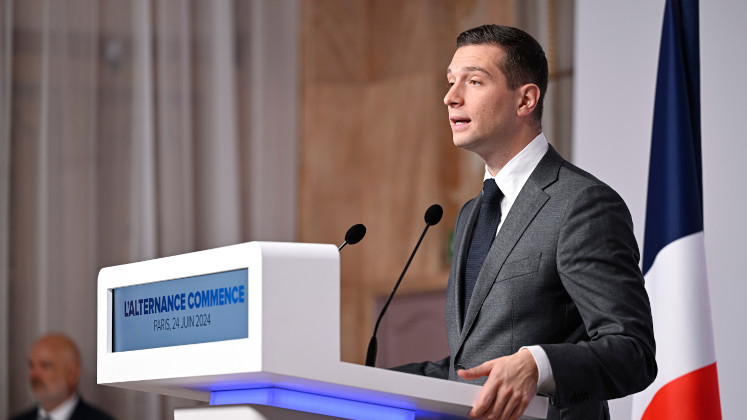
The Rise of the Far Right in France: How Social Media Algorithms Fuelled the National Rally’s Victory
The 2024 European Parliament elections in France witnessed a seismic shift in the political landscape, marked by the unprecedented success of the far-right National Rally. This victory, largely attributed to the influence of social media and the engagement of young voters, has raised serious concerns about the role of online platforms in amplifying extremist ideologies and shaping political discourse. New research reveals how social media algorithms, designed to personalize content recommendations, can inadvertently create echo chambers that reinforce and radicalize political views, ultimately contributing to the normalization of far-right narratives.
The National Rally’s success was particularly striking among young voters, a demographic often seen as more progressive. While the majority of the youth vote still leaned left, a significant portion, particularly those under 35, gravitated towards the far right. This shift is largely credited to Jordan Bardella, the party’s charismatic young leader, who leveraged platforms like TikTok and Instagram to cultivate a substantial online following. Bardella’s savvy use of social media allowed him to bypass traditional media channels and connect directly with young voters, effectively normalizing the National Rally’s presence within their online spaces.
Research into the role of social media in the 2024 elections reveals a disturbing trend: the algorithms powering platforms like TikTok and Instagram can inadvertently radicalize users by progressively exposing them to more extreme content. Using a synthetic far-right profile, researchers observed how these platforms quickly tailored content recommendations to align with far-right interests, creating an echo chamber of extremist viewpoints. Even more concerning, the algorithms seemed to nudge users towards increasingly nationalist, xenophobic, and violent content, starting with moderate material and gradually escalating to more hateful messages. This suggests that these platforms may unintentionally, or perhaps even actively, amplify extreme opinions, even among users who initially showed no interest in such content.
The content presented to the synthetic profile showcased a diverse range of far-right narratives. Some videos featured excerpts from candidates’ speeches and public appearances, often edited to mock or misrepresent their opponents. Others promoted jingoistic and masculinist themes, emphasizing national identity, border security, and traditional values, often incorporating surprising references to the Catholic Church. A third category employed a more manipulative approach, featuring individuals who identified as immigrants or Muslims advocating for stricter immigration policies and cautioning against the perceived spread of Islam. This tactic seemingly aims to lend credibility to these viewpoints while shielding the far right from accusations of racism and xenophobia. Finally, overtly Islamophobic and anti-immigration messages, often presented in a humorous or satirical tone, also surfaced in the feed.
One of the most unexpected findings was the prevalence of Catholic content within the far-right social media ecosystem. While not explicitly promoting extremist Catholic viewpoints, the algorithms frequently recommended videos with a clear religious agenda, often associating Catholicism with French ultra-patriotism and nostalgia for a romanticized past. This intermingling of religious and political content potentially normalizes the far right within Catholic circles, suggesting it as a natural political choice for adherents. This online phenomenon may partially explain the significant shift of Catholic voters towards the far right in recent years.
The research paints a picture of a multi-layered far-right online world, offering a variety of entry points and intersections for different segments of the population. Users initially drawn to mainstream political content can quickly find themselves exposed to conspiracy theories, Islamophobic stereotypes, or Catholic patriotism. Conversely, those seeking racist humor might be captivated by Bardella’s charisma and persuaded by his political talking points. This fragmented audience is gradually unified within a loosely defined online community, sharing a common ideological platform and effectively disseminating political programs and preferences. Even more moderate members may be subtly nudged towards increasingly radical ideas. This complex, layered structure, akin to a mille-feuille pastry, effectively binds together diverse individuals through a shared thread of ethnonationalism.